Influencer Ms Kuan teamed up with Behati for a social media dalliance, shot in Penang’s renowned Blue Mansion. One wears, the other dares, but who is really honouring the culture?
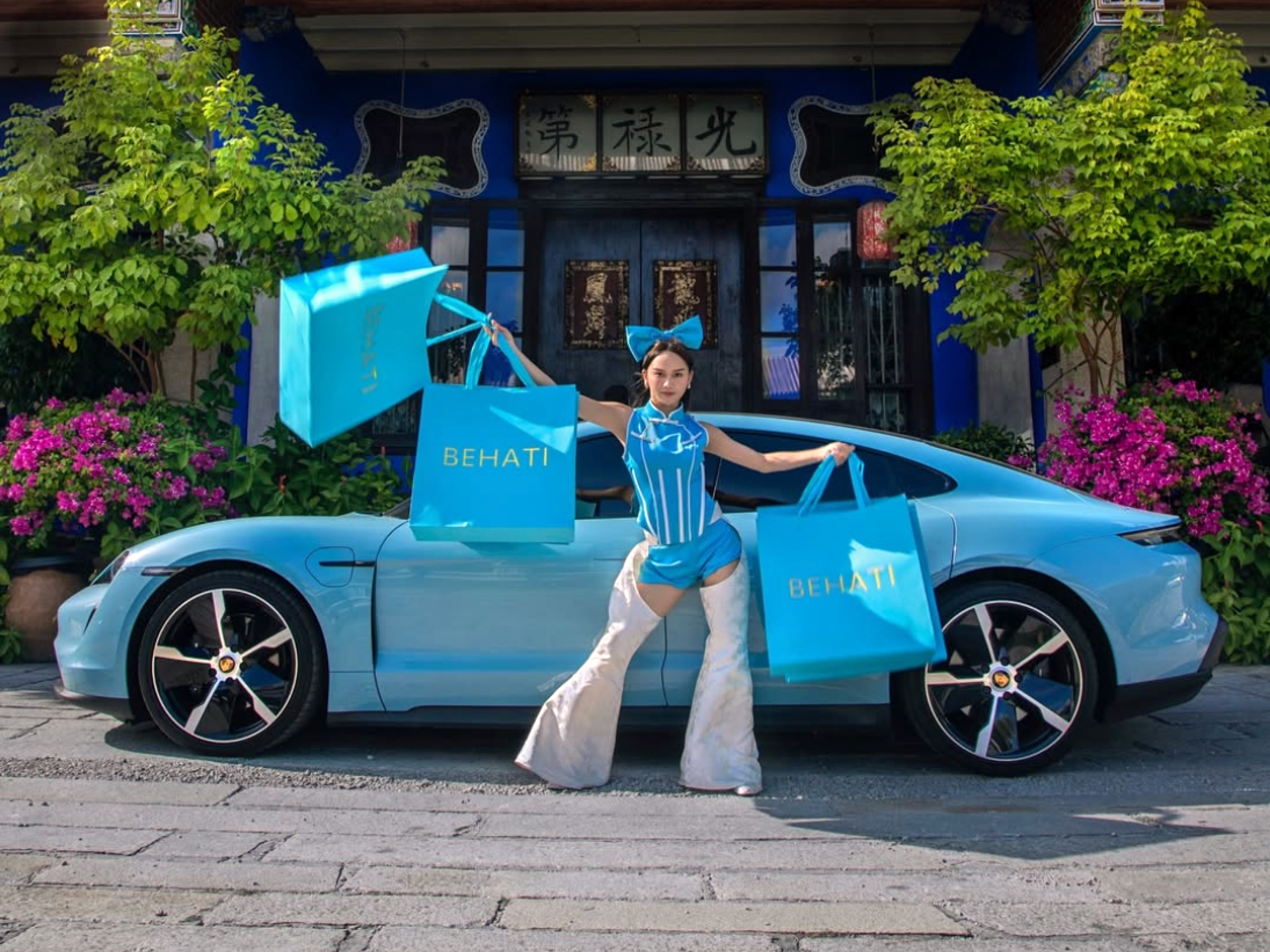
Christinna Kuan arrives in her Porche and shows off her hauls
Just fresh off her spacey Grammys appearance, Malaysian influencer Christinna Kuan (关丽婷 or Guan Liting) quickly pivoted to model for compatriot brand Behati. That kind of rapid turnaround says a lot: she lives for the ‘likes’, and she’s not letting the spotlight dim for even a moment. In a series of what Behati described on Instagram as “CNY collaboration campaign”, Ms Kuan has returned to her hometown of Penang to shoot for cap ketupat kutior’s lunar new year messaging. It’s all social media speak for I really have nothing to say. Let the brand dictate. No thoughts required, just futile vibes. The beauty of the festive fromage is the unburdened choreography that suited Ms Kuan. Between the content creator and the collaborator, the island-state’s legacy was treated as little more than a highly-saturated backdrop for middling engagement. Heritage as a prop: the ultimate branded nothingness.
The campaign was shot in the compounds of the Cheong Fatt Tze Mansion, commonly known as the Blue Mansion. It was built by the titular capitalist-owner 張弼士 (Zhang Bishi) in the 1897, the year Queen Victoria enjoyed the 60th year on the throne, when Penang (then part of the Straits Settlements) was a bustling, cosmopolitan British Crown Colony at the height of its Victorian-era prosperity. While mainland China was facing turmoil, teetering on the edge of the radical changes that would define its 20th century, Penang was celebrating its status as a premier Pearl of the Orient. Cut to 2026, another pearl of sort has ruffled the ancestral stillness of the Blue Mansion. For Behati, Ms Kuan plays not herself, but one of the wives of the owner and an imaginary granddaughter. For someone with the acting range of balsam, Ms Kuan is as good as she is able to prance—aggressive frolicking in a space with a complicated history.
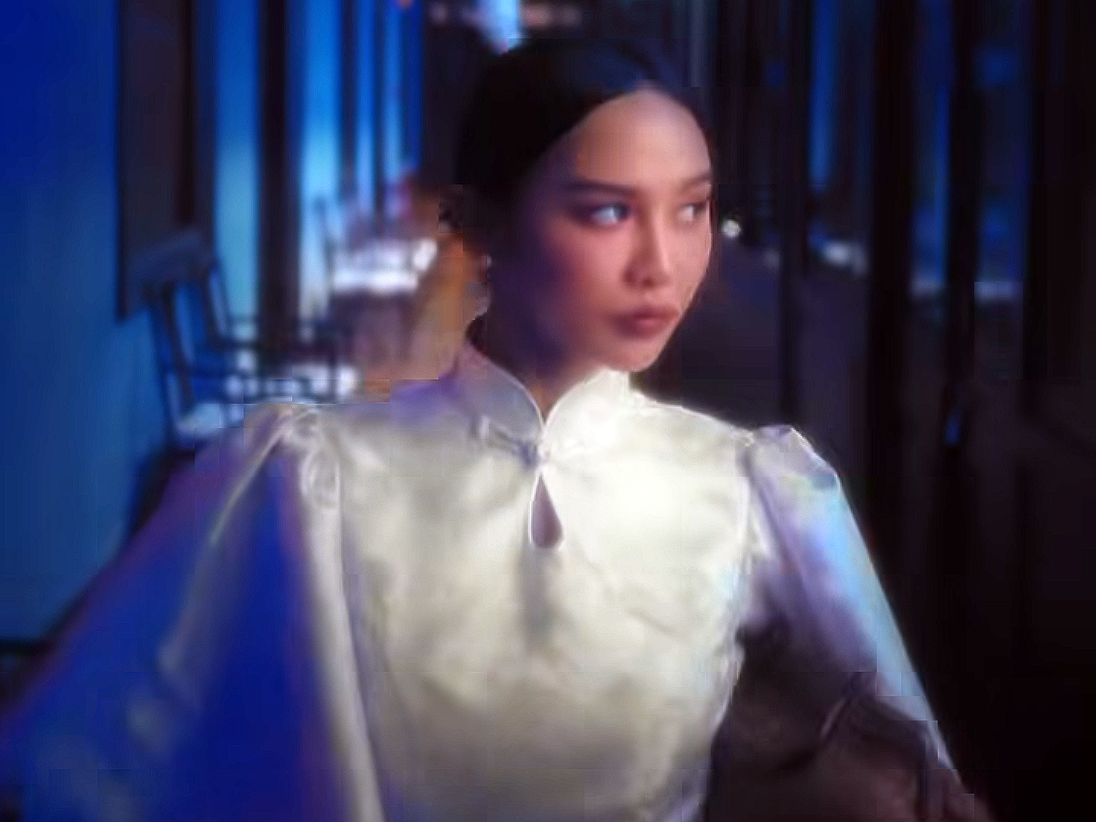
As Tan Tay Po, haunt-strutting the corridors of the Blue Mansion
Ms Kuan is cast as Tan Tay Po (陈锦宝, Chen Jinbao) or “No 7” (the title of the short film too), so called as she was the 7th wife of Cheong Fatt Tze and was famously the only spouse—and the only one he reported loved—explicitly named in Mr Cheong’s will, in which she was identified as Chan Kim Po. She married the then 70-year-old when she was 20. And later bore him a son. The Blue Mansion was willed to mother and child and it was explicitly stared that the residence must not be sold until his sole offspring with her dies. This ‘favored’ status is often summarized by her rank rather than her name. By casting Ms Kuan as Tan Tay Po, a woman of survival, strategic favor, and maternal legacy, the campaign moves from just questionable fashion into the territory of questionable storytelling. Using a real, historical figure—one who lived a complex life within the indigo walls of that mansion and known a numeral—as a backdrop for Behati’s fashion reels feels incredibly reductive. Ms Kuan thought it was high jinx in a doll house.
In the sole reel that Behati shared, she arrives as the imaginary granddaughter at the Blue Mansion in her blue Porsche Taycan electric. The sports car then morphs into a 人力车 (renliche) or rickshaw from which Ms-Kuan-as-Tan-Tay-Po emerges and catwalks into her home. She found a letter addressed to “No 7”. A emotionless voiceover, presumably of the influencer’s own voice, narrates its maudlin content in Mandarin, clashing against the soundtrack of Rebecca Pan’s (潘迪华, Pan Dihua) Orchid Lady (兰花女, lanhuanu). The film cuts to the present and shows Ms-Kuan-as-the-granddaughter entering the mansion. The TikTok-native family member prances gleefully in the ancestral home while the other-era woman continues to catwalk purposefully on a corridor. This after she discovers her husband is dead—“不回归 (buhuigui, not returning)”? Or was it jubilation upon learning that she gets to keep the mansion? A collision of TikTok energy and archive vanity. Ms Kuan isn’t playing two individuals; she was playing herself. And she mistakes acting for loitering, an activity she perfected at the Grammys.
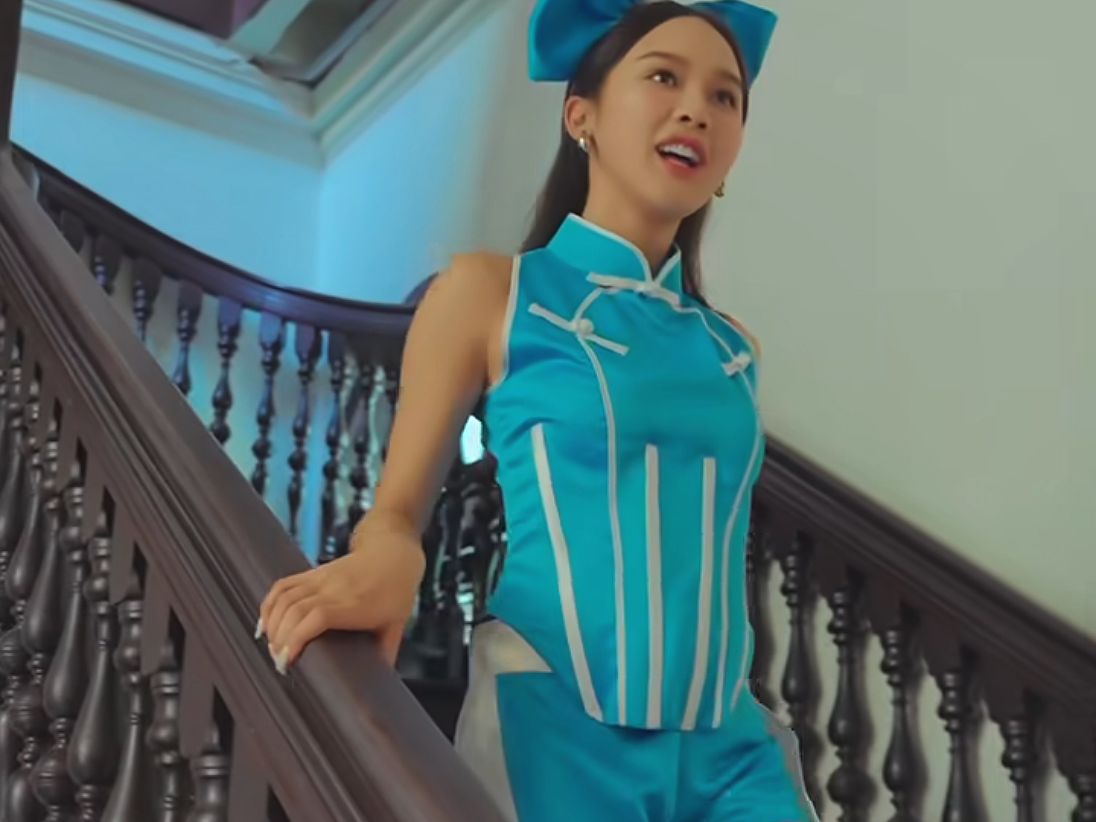
As the fictitious, unnamed granddaughter exploring the mansion
Whether she is on a red carpet in LA or a heritage corridor in Penang, Ms Kuan is effectively doing the same thing—occupying space without contributing substance. And the space, the Blue Mansion, despite its heritage, has become a regrettable tourism cliche, shifting from a site of deep Hakka/Teochew history, especially for Penang, to a ho-hum commercial stage. It is not helped by the mahjong scene in Crazy Rich Asian, a film that exoticised Singapore for an American audience. Even the people who used to inhabit it and their sad personal stories are co-opted for Behati’s brand enhancement. A label without cultural heft trying to co-opt the past is like a toddler wearing their grandfather’s medals: it’s cute for a second, but nobody’s actually going to follow them into battle. It’s a shame because the Blue Mansion’s restoration was a labor of love by locals who wanted to save it from being turned into another high-rise. Now, seeing it used for a look-at-me social media dalliance feels like the mansion has been rescued from demolition only to be sold to the highest bidder for likes. Tan Tay Po’s story deserves to be told, but should it be used for others to augment their own fame?
But Ms Kuan’s deplorable turn as “No 7” is not the only glaring vanity. The blue-on-blue absurdity of her Porsche Taycan—the “unboxed” December 2023 purchase—sitting in the front of the mansion is the campaign’s most loud-mouthed affectation. In one photo, she was seen standing in front of the vehicle and waving four massive Behati paper bags in a similar colour. It reduces a century of history to a shopping haul. When your performance lacks subtext, you simply outsource the personality to a German engine and oversized branded paper bags. The Taycan isn’t a borrowed prop, but a part of her personal brand arsenal. She’s not just posing against luxury, she’s invested in it, turning ownership itself into content. The irony is that the car’s eco‑luxury narrative—electric, progressive, futuristic—gets subsumed into influencer flashiness. A prosthetic personality. Ownership becomes another stage for visibility rather than a statement of values. Ms Kuan, blue-paper-bagged intruder in a house-turned-hotel that probably missed its silence.
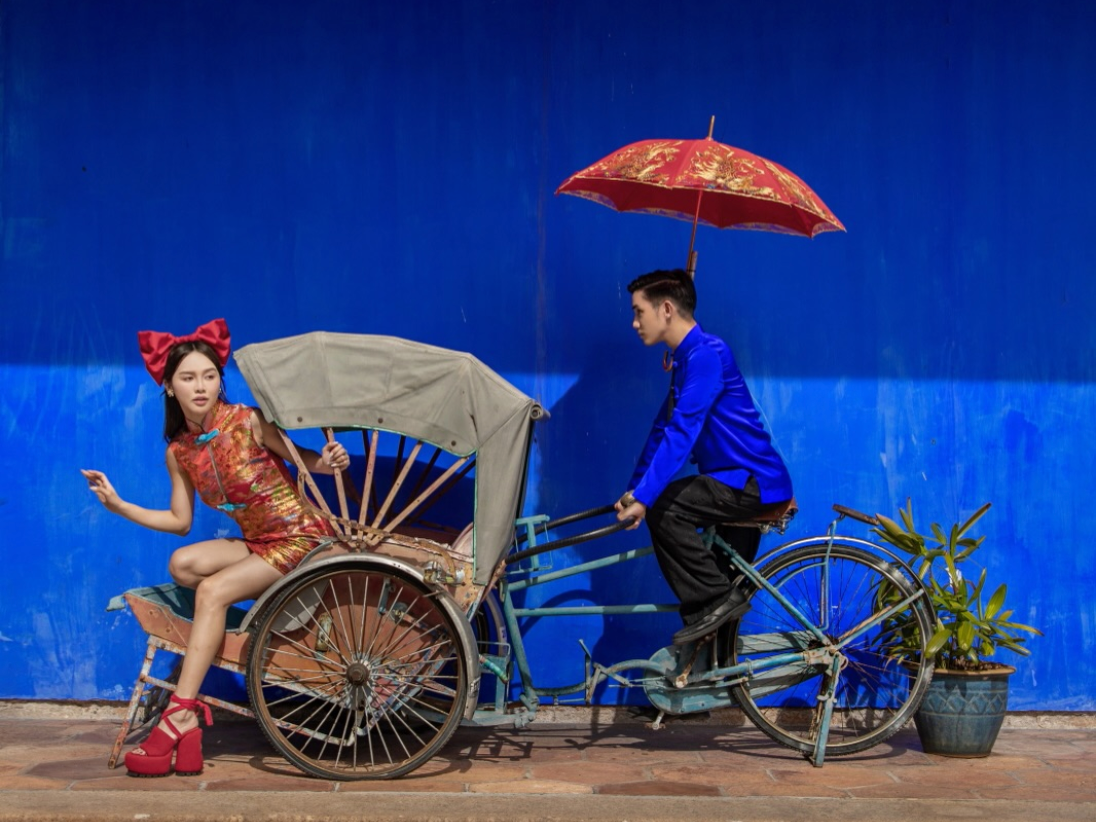
Back as Ms Kuan. Tourism ad as fashion branding
But quiet are not the garments. Ms Kuan is the quintessential clothes horse: she’ll wear anything if it keeps her silhouette in circulation and her image at peak friction. Behati, meanwhile, is the brand that thrives on mixing everything—textures, prints, cultural references—until the seams and trims become the spectacle. The co-conspirators in clicks enthusiastically embrace stitch-work for the clout-blind. As Tan Tay Po, she wore an era-dubious white qipao with oversized bell-sleeves, all with scalloped hems, including mules that looked like pilgrim shoes with the heels lobed off. As the absurd granddaughter, she looked Ms Kuan fresh out of one of the CNY music videos in which she appears with her siblings: a half-qipao trimmed to suggest a corset but with a hem of a stomacher. She pairs that with hot pants so loose they could have been deflated bloomers. Over them clung poorly-fitted, bell-bottom chaps—protection against the friction of a judgmental gaze, rather than a horse’s flank. But what is equestrian drag got to do with a visit to a historical landmark such as the Blue Mansion? We know it’s the Year of the Horse, but the equine excesses, including the Porsche logo, do not a rider make.
Ms Kuan has not transformed into Tan Tay Po in any meaningful way. She’s just brought her family-brand commercialism into a UNESCO site. And also to indulge the director of the video, Behati’s founder Tan Kel Wen in his multi-media creative endeavours. Or, visual gags. For Mr Tan, his exploration of indigenous themes isn’t about scholarship other than a scant appreciation that a hint of historicism may lend some cred to his ethnic frivoling. He uses the vibe of high culture without truly understanding its frequency. But just because you add some gula melaka (palm sugar) to the Penang cendol does not make it authentic. Behati has found a willing partner and her dumb Porsche. It’s a parasitic glamour exchange—Behati doesn’t need to buy the car, they just need Christinna to stand in front of it. The spectacle works because audiences rarely distinguish between owned and borrowed; the image erases the difference. It is loan affluence and influence. Berhati’s brand strategy is essentially to wear Christinna Kuan wearing. It’s not just the car that is borrowed; it’s the heritage, the mansion, and the history of Tan Tay Po. If the Grammys gave her international sheen, Berhati imbued her with Malaysian cahaya (glow). In a spectacle economy, authenticity is irrelevant, borrowed shine is enough.
 Style on the Dot