María Corina Machado gave Donald Trump what he has desperately wanted. No, not Venezuela
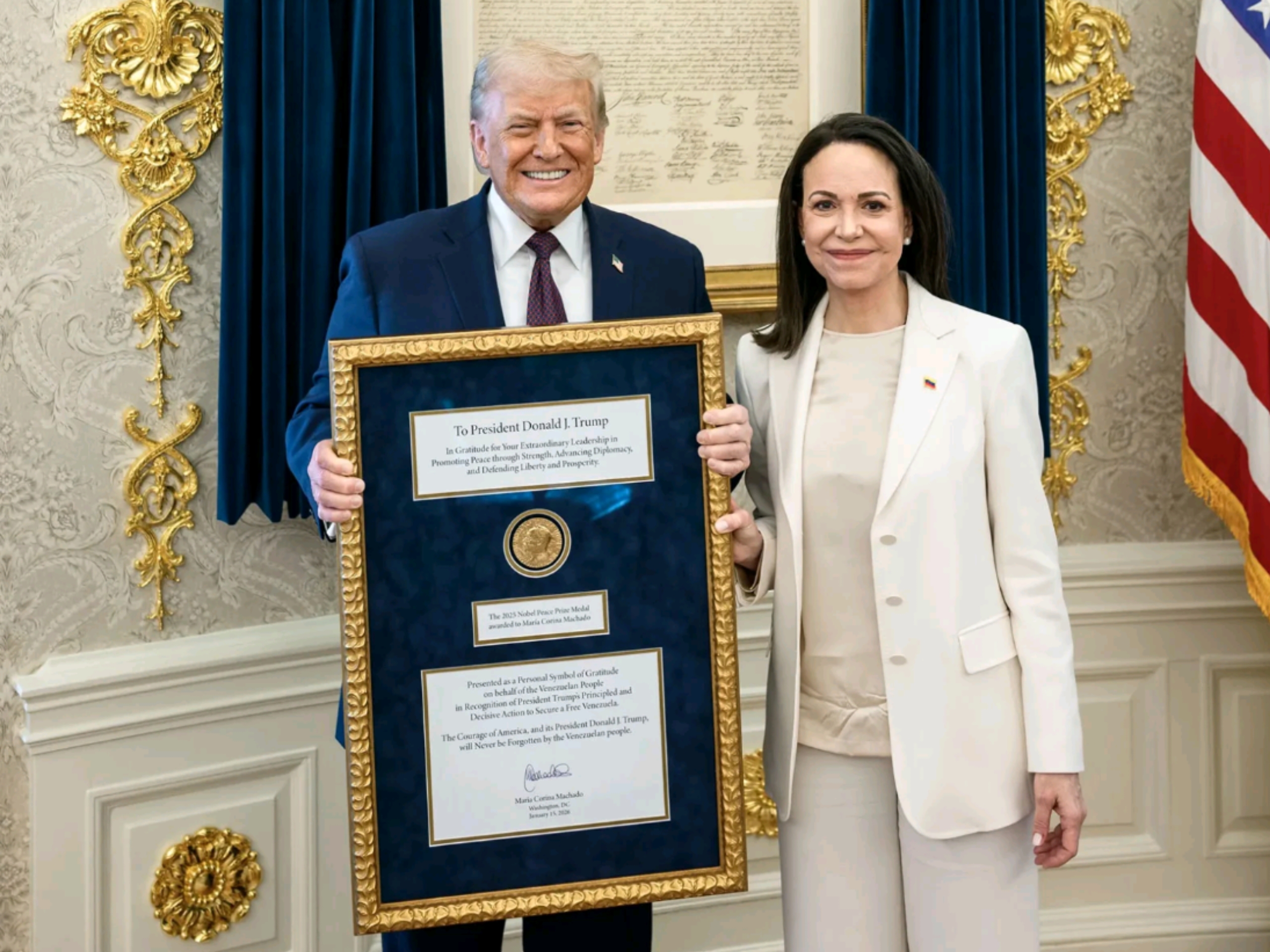
The Nobel Peace Prize finally in his hands: Donald Trump and Maria Corina Machado. Photo: thewhitehouse/X
After she managed to escape Venezuela, prevailed to collect her Nobel Peace Prize, and give an interview, María Corina Machado found a beige pantsuit and went to Washington, straight to the White House as courier service and delivered her prize, all framed up, to Donald Trump. He was happy to receive, probably delirious, when he saw the one thing he craved all his presidential life. She was not only there to use her international standing as a 2025 Nobel Laureate and to advocate for the release of political prisoners and a return to the results of the 2024 election, but also to ingratiate herself with Mr Trump. And she came bearing a prized gift, with the keenness of an envoy of a very amenable vassal state.
Ms Machado turned up for the presidential audience in what a White House guest is expected to wear these days: a suit. It’s a seemingly inexpensive, cream-coloured two-piece with three-buttons on the jacket, which was of a relaxed cut (including nonchalant lapels!) that was kept even more casual with the untucked and creased shell top underneath. The one-tone look was not bleached of symbolism. It’s a colour that recedes rather than dominates. While it suggested calm, and, like white, purity, it also pointed to intentionality and approachability. If Ms Machado was in India, the colour would have meant auspiciousness and new beginnings, which was what she went to the White House to gain. Desperation can appear in the most extreme form, however pale it looks. A non-threatening suit and a peace prize are the perfect last-gasp penance.
Desperation can appear in the most extreme form, however pale it looks
The irony of her colour choice is that for Trump, neutral is not his tone or, crucially, his stance. Trump thrives on aggressive chromatic lucidity: red ties, red caps, gold anything, all declarative, and chosen to dominate the frame. He interprets muted tones as absence rather than presence. Would his guest be noticeable or noted if she did not coming gearing a gift of a gold medallion? Ms Machado’s beige becomes almost ironic in Trump’s White House made gaudy: a gesture of neutrality in a space defined by spectacle. Sure, Ms Machado thought that her beige can project calm, but the creases on her blouse introduce noise—they disrupt the clean neutrality she may have been targeting. It’s almost as if her outfit embodied the paradox of her gesture: trying to play neutral in a theatre in which neutrality has not been cast. In a room where gold leaf punctuates, beige isn’t calm; it’s a void.
While Ms Machado treats the Nobel Peace Prize as tradeable as Pokemon cards to yield a political deal, the Nobel Committee, probably seething in their disgust, had been quick to step in to protect the integrity of the prize, reminding the world that laureateship is not transferable. There are no stand-ins. This keeps the “real” prize separate from the symbolic one. Mr Trump may now own the medallion, the citation and Ms Machado’s own sycophantic dedication, all framed—in gold, of course, but the recipient is still not a Peace Prize notable other than with the FIFA fake. By giving him the medal, Ms Machado was signaling gratitude and dependence on his backing. Except we know what he had previously said about her behind her back.
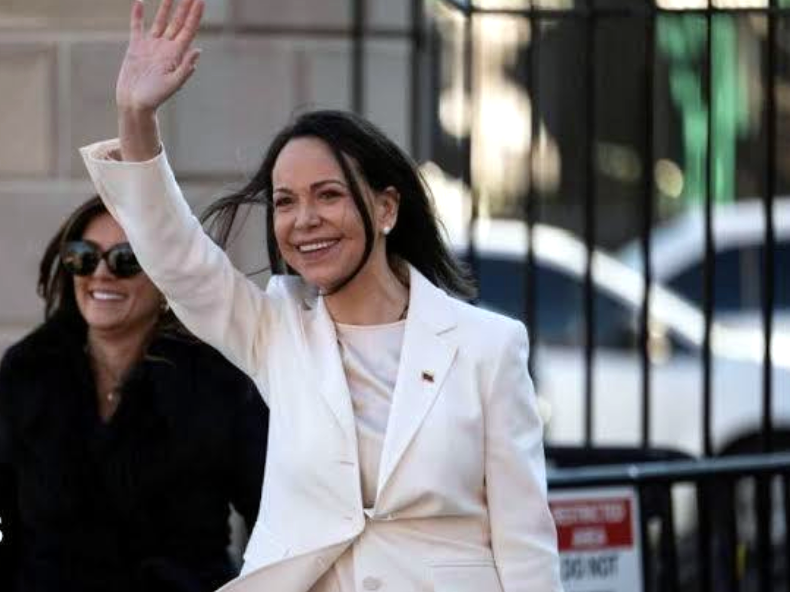
María Corina Machado basking in the rousing cheers of her supporter as she left the White House. Screen shot: bbc/YouTube
The Nobel Peace Prize is meant to be a shield for the oppressed and those who champion their cause through non-violent ways. By using it as a gift for a sitting U.S. President who just conducted a massive military incursion (Operation Absolute Resolve) into her motherland, she has arguably transformed the prize into a spoils of war. Trump is no better off with two awards—one created for him, the other not in his name. He won’t be a better president. As he thrives on props and endorsements, this duality lets him claim recognition while sidestepping the fact that he was never chosen by the Nobel Committee. What he’s leveraging is the optics of dual possession, a pair of bribes accepted as admiration of peace brokering that has not happened, yet.
One thing conspicuously missing in Ms Machao’s White House attire is the rosary. She did not even wear a cross, such as the one Karoline Leavitt tends to adorn herself with. The absence of a rosary is telling, especially given how much religious symbolism often permeates her street-as-stage political theater. When she spoke to the BBC in Oslo after her Nobel win a month ago, she wore not one rosary, but four strands. By leaving out the beads at the White House, María Corina Machado’s outfit lacked a cultural signifier that could have connected her neutral shades to a deeper moral stance. Instead, the cream suit and creased, untucked blouse projected casual restraint rather than spiritual authority. For a faith‑anchored advocate, the missing rosary is like the Nobel laureate’s absent call for military restraint. Costumes, as it were, do outlive convictions.
 Style on the Dot