Nicki Minaj has now done a large political rally. The once never-Trumper enthusiastically sang the praises of Donald Trump, in full conservative garb. You almost forget that on several occasions in the past, she had no qualms flashing a breast, or both

For someone who made headlines at Paris Fashion Week in March 2017, when she attended the Haider Ackermann show with her left breast shielded only by a jewelled pasty, Nicki Minaj now prefers the fortress of a turtleneck. At the recent Turning Point USA’s AmericaFest convention, the rapper was welcomed onto the stage wearing an Alaïa mini-dress that was shorter than her hair. It was rendered in a colour so solemn that a faith-based paint company might call it repentance plum. Her covered neck and upper arm, in a thick, unyielding knit, were concealment she hardly sought in the last two decades of her colourful career. Nine months after that front-row stunt, she appeared on the cover of Paper magazine with two breasts exposed in a composition that was best described at Minaj à trois. She and fabric have, until now in Phoenix, always had a distant relationship.
To the Barbz (the Minaj equivalent of Swifties), the shift in their idol’s wardrobe—from Pinkprint latex to a plum knit—must have been baffling. How did Ms Minaj, who proudly holds a Trinidad and Tobago passport, turn from Harajuku Barbie to MAGA Miss? Appearing on stage with Erika Kirk, who had not wavered from her unambiguous trad-wife aesthetics (now complete with very defined crimped locks), the Trump-fawning rapper looked curiously ready for church or tea at Mar-a-Lago. Her fans are now viewing her fashion sense as a calculated “visual pivot” that goes hand in hand with her new political identity. It has achieved the near-impossible of uniting the fervid fashionistas and her die-hard fans in a rare, synchronised moment of collective cringing. And it has nothing to do with an exposed breast, or two.
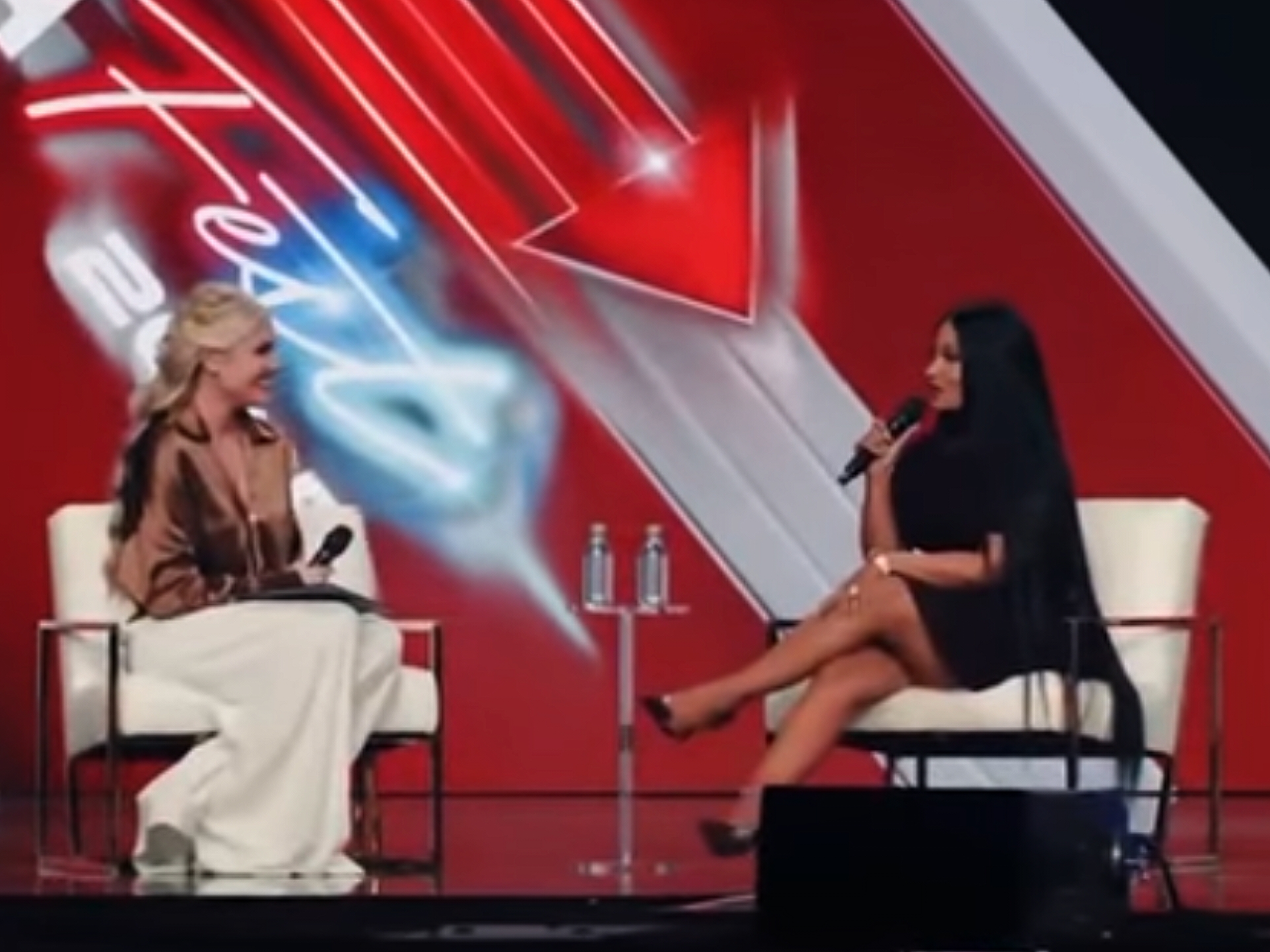
There is much to wonder about the transition from using a pasty for total coverage to post-modern modesty, with much of her thighs and legs remaining revealed, as opposed to Mrs Kirk’s pants, so long that they pooled at her feet when she was seated. What does the conservative cut of Ms Minaj’s dress, higher necklines, and avoidance of breast exposure really say about her new positioning? That she’s respectable enough for a political stage, but still pop enough for selective exposure? Even in seeming modesty, Ms Minaj keeps a visual reminder of her roots in provocation. Bare skin was not abandoned; it was merely re-emphasised by relocation. To see the woman who rapped “My anaconda don’t want none unless you got buns, hun” sitting across from Erika Kirk, the widow of a man slain just three months ago, who once said Ms Minaj’s “not a good role model for 18-year-old Black girls”, was an absurdity so brazen it leaves even the most seasoned political observers grasping for a narrative.
The seemingly simple choice of wearing something less revealing is hardly life-changing, but given her past fashion preference, it’s a window into how she is now togged to undo her past. Her dress sense aside, there was also the tenebrous praise of Donald Trump and description of JD Vance. She called Mr Trump “handsome” and “dashing”, but not an anaconda. And shortly after, referred to Mr Vance as an “assassin” (American, ’hood slang for being ‘deadly’ or efficient), the kind of faux pas that makes PR teams break into clammy sweats. But it was the irony that stuck out, one so thick, even a satirist couldn’t invent it, no matter if the speaker immediately covered her mouth in embarrassment. There were no instant boos. The woman who once built an altar to ‘buns’ (even her Alaïa handbag she brought on stage was a heart-shaped derriere) was now being canonised by the very people who spent a decade praying for her downfall.
 Style on the Dot