Thirty eight birthday candles, a school award, and one bailor crisis: How Vivy Yusof turned a standard court procedure into a high-velocity mood event
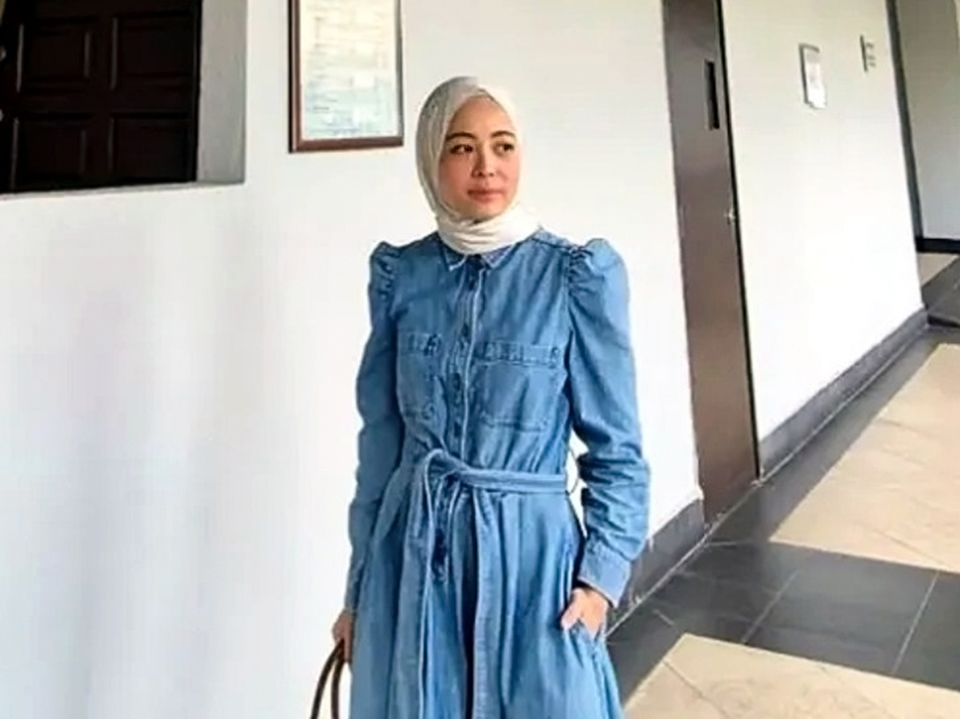
Vivy Yusof in what looks like the corridor of the state court. Photo: vivyyusof/Instagram
These days, there is a kind of spectacle-making that turns what was once private, even shameful, into a sharable badge of visibility. We’ve really moved past TMI and straight into ‘Look at me, I’ve been through a lot’—the new status symbol for the chronically online. In her latest Instagram Stories, blogger extraordinaire Vivy Yusof shared a teaser for her upcoming post. It recounted how a court appearance launched a couple of dramatic obstacles that sent her carefully curated life into a tailspin of Shakespearean proportions, or at least a very viewable Instagram post. There were three main dramatic issues due to the court appearance:, a son’s award ceremony, a new bail at a late hour, and her own birthday. You can’t get more theatre out of a court date.
She opened with “I need to tell you the context of why we were there in court”. She has already celebrated her first anniversary of “getting charged in court”. And then she was back there? The court appearance itself is not inherently public; it only becomes part of the collective consciousness because she chooses to narrate it. If she hadn’t told us, we wouldn’t have known. But that’s the point: the telling is the event. The court appearance is raw material and the Instagram post is the product. As if a show in court was not enough, she told us she has a “new” bailor. The change is not public information, nor is it socially consequential outside her immediate circle. But in influencer logic, need-to-know is irrelevant; what matters far more is content-to-share. As the popular analogy goes: If a tree falls in the woods and nobody hits the ‘like’ button, did it even make a sound?
The court appearance itself is not inherently public; it only becomes part of the collective consciousness because she chooses to narrate it
We are also told that her new bailor is “a special lady in my life”. Now, the bailor is not just a guarantor. She is conferred “a special lady”, which makes the legal requirement feel like a touching relationship moment. It is influencer speak for intimacy or someone important, leaning on what is known as “feminised sentimentality”, nudging her followers to admire the bailor’s sacrifice and, equally, the defendant’s gratitude. But the latest bailor is not merely a different person. It comes with a new RM100,000 (or about SGD31,609) bail, which led to Ms Yusof‘s self-broadcast consternation. “We found this out at 6pm so we were panicking. Where are we going to get the money?” The mention of the bailor change is clearly a plot device. Without it, the panic over RM100,000 bail has no setup.
Ms Yusof has openly admitted in her own autobiography, The First Decade, and interviews that she and her boyfriend-turned-husband, Fadzarudin Shah Anuar, started FashionValet with RM100,000. That figure must be familiar to her; it was her seed money. When someone has built an entire brand around luxury and success, the claim that they were “panicking” to find RM100,000—especially with their family background (her father owns a construction company)—feels highly inconsistent. Even while under investigation, the couple was granted permission by the court to travel to Istanbul and Bosnia (October 2025) and for umrah (December 2024). These international trips require significant funds, which rather contradicts the idea of a financial “emergency” over bail money. It’s hard to sell a narrative of financial desperation when your passport is getting stamped in Europe and the Middle East while you are awaiting a CBT trial.
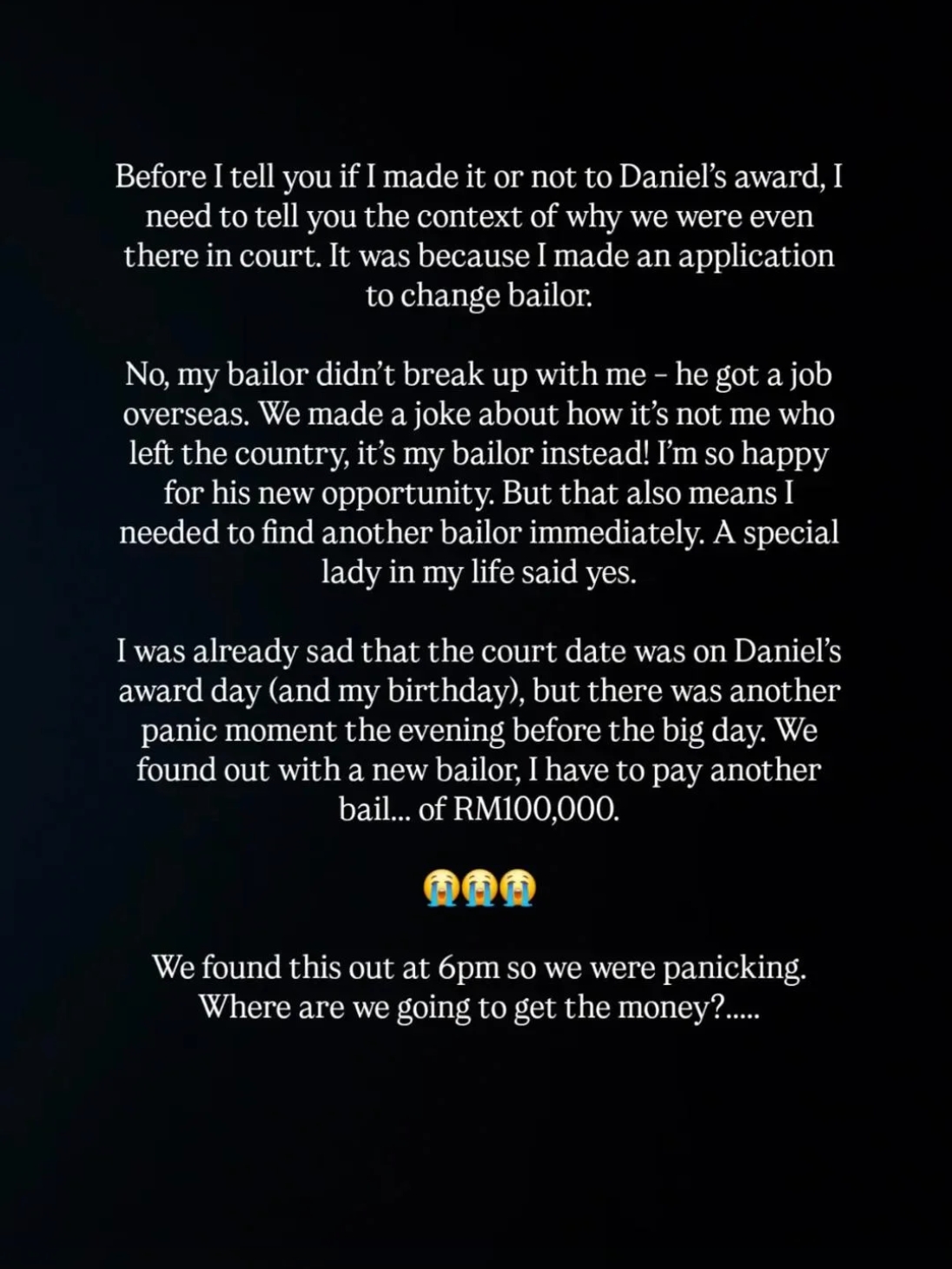
Vivi Yusof’s post on Instagram Stories. Screen shot: vivyyusof/Instagram
In her post, she claims she was told at the inconvenient hour of 6pm that RM100,000 was needed for the following morning. Critics argue that if you are a high-profile defendant facing charges involving RM8 million, you and your legal team should already be prepared for financial contingencies like a change in bail condition or bailor. The panik she describes is viewed by many as a narrative tool to make her seem like an orang biasa (regular person) facing an impossible hurdle, rather than a wealthy entrepreneur with a massive safety net. Her critics see her complaint about finding RM100,000 while the public lost RM43.9 million through her company’s failure as a slap in the face. If the OED has crowned ‘ragebait’ as the word of the year, ‘sympathybait’ should at least get a nomination for Best Costume Design.
Vivy Yusof has cleverly pinned the exact moment where a legal obligation is stripped of its gravity and repackaged as a consumer product. She is still selling a ‘lifestyle’ (certainly through her subscribable blog Sincerely, Vivy), even if that lifestyle—more life than style—now includes a yet-to-happen criminal trial. She even joked that it was her bailor rather than she who “left the country”. Her chatty charm offensive was a strategic attempt to treat the defendant status as a quirky personality trait. In some ways, the game plan is similar to what she adopted as a Proudduck—the personal blog that eventually inspired/launched the e-commerce platform FashionValet. We can now easily see that every pond is cross-continental portable, and audience attention follows wherever one waddles.
 Style on the Dot