Without the Golden Horse best actor award to bring home, Richie Koh is lauded by the media for the S$642,700 watch (as well as other expensive accessories) he wore to grace the night in Taipei. Whose socks are blown off?
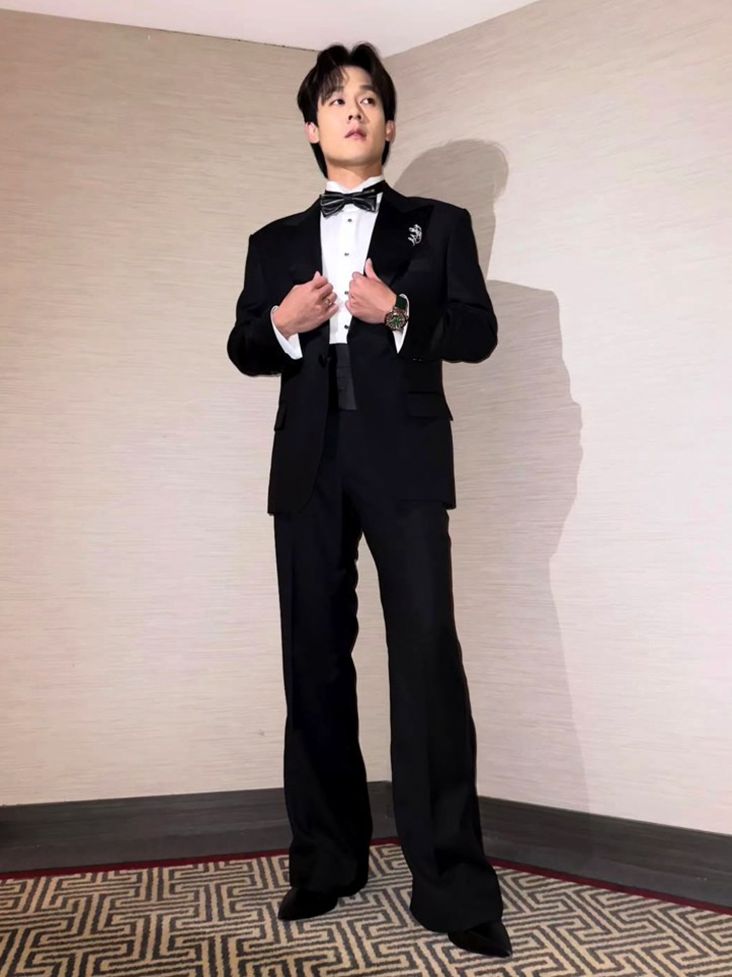
All decked-up. Richie Koh in his expensive threads and accessories. Photo: richiekrq/Instagram
Actor Richie Koh (许瑞奇, Xu Ruiqi) came home with the tragically mundane burden of being empty-handed, yet his defeat has been turned from a Golden Horse loss to a golden price tag win. Our local media is so enthralled by the total cost of his outfit for that one night in Taipei that it has become a cover story of the day. At least at Shin Min Daily News (新明日报), it was. As ridiculous as it is, it successfully generated the brag-worthy nationalistic headline that a simple “He lost” story couldn’t. His watch alone, reportedly with the asking price of S$642,700, carried the weight of Singapore’s cultural aspirations. The Jacob & Co. Casino Roulette Tourbillon, together with other items, including an ill-fitted Q Menswear tux, totalled S$726,820, an amount that 8 Days claimed to be “almost the cost of a brand new 5-room BTO flat in a prime location”, rather than one that could partly bankroll the possible sequel to the movie that landed him the Golden Horse nomination: A Good Child.
Forget the triviality of independent cinema, acting skill, or a story based on an actual person. That’s just pedestrian nonsense. Instead, our local press zeroed in on the true national victory: the glorious, boastful total cost of his outfit because nothing says “cinematic achievement” like a balance sheet. The biggest and most cutting irony of the entire situation is the fact that the overwhelming majority of the pieces of that S$726,820 value was on loan. Sure, going there and coming home as a nominee is the glamour of stagnation not many actors can deal with, especially newbies of international awards, but in pivoting Mr Koh as a spectacle of consumption, the media didn’t celebrate an achievement; they lauded a successful product placement deal (it is no coincidence that the Jacob & Co flagship in Takashimaya S. C. will officially open this Tuesday). The sheer fiscal audacity of his threads is framed as proof of success, even though it’s unrelated to his craft.
The biggest and most cutting irony is the fact that the overwhelming majority of the pieces of that S$726,820 value was on loan
But it was CNA who did better. In fact, they truly outshone the rest. While others settled for price tags, they elevated the art of consolation by declaring a wefie with 李安 (Li An) the pinnacle of Singapore’s cinematic triumph: “Richie Koh didn’t win a Golden Horse award, but he did score a photo with director Lee Ang” went the headline. We’re supposed to be thankful that Mr Koh managed to snag the true prize of the evening? After all, who needs a Golden Horse trophy when you can stand next to someone who has one, or five? In our grand ledger of national achievements, this wefie now ranks just below Olympic medals and just above pharmaceutical exports, proving once again that proximity is prestige and JPEGs are the new currency of cultural success. Local cinema has really come to this: not telling stories, but proving you were there.
From the moment Mr Koh’s nomination was made public early last month, we knew he would not win, not because he failed to embody the transformative role, but because he was, we believe, merely included for the mathematical exercise of elimination. Sometimes, we think the Golden Horse nomination committee can be cruel. Why pitch a newbie against a formidable name of Taiwanese cinema, such as Chang Chen (張震, Zhang Zhen)? Mr Chen winning role in 幸福之路 (Lucky Lu) was not just a performance, it was palpable lived experience. His acting was so convincing that, during a scene where he searches for his stolen e-bike, a passerby approached him out of concern because his performance looked so real. It’s the kind of gravitas that makes juries nod solemnly before they even finish their longjin tea. To place Richie Koh beside him was less a competition than a ritual sacrifice, a reminder that Singapore’s hopefuls should really show that they can play better parts than bad drag.
 Style on the Dot