Three days, five gowns, and one couture demo: More like a pop-up activation than a museum-grade exhibition
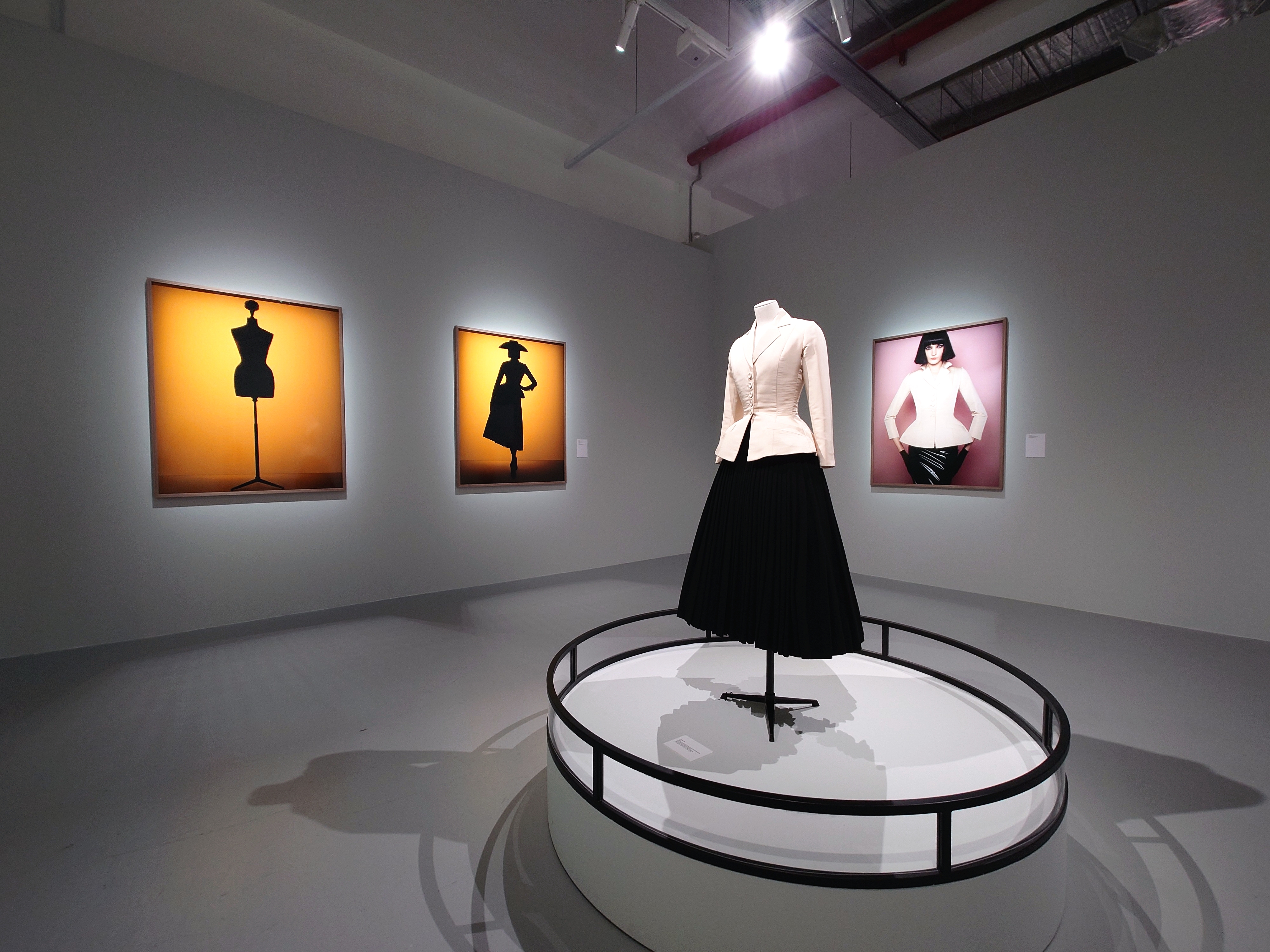
Christian Dior’s unmistakable ‘Bar’ jacket from 1950’s Corolle. Collection
What’s a bank got to do with a fashion house? We were at the New Art Museum in Tanjong Pagar Distripark to find out. As it turned out, not much. The UBS House of Craft X Dior exhibition was tiny, but the press machine made it sound monumental, a cathedral-scale rhetoric, the perfect illustration of UBS’s well-spent PR choreography outpacing reality. Dior’s name carries such weight that the mere announcement of the exhibition feels newsworthy. In a media landscape hungry for luxury spectacle, the promise was enough. We rarely get couture‑branded exhibitions (we’re lucky if we get a cruise show). The novelty itself is treated as substance.
The minute you arrive at the visitor-unfriendly Distripark, an industrial complex turned into an arts hub, you’d see red velvet ropes and stanchions, and you’d know immediately this is going to be the holding area. A lift takes you up to the fifth floor of block 39, where Singapore Art Museum is the anchor tenant. Inside, the car rumbled like one in a horror movie. Coloured light alternated and curiously when red came on, it was accompanied by a bloodcurdling sound, so terrifying that a fellow rider told the suited lift attendant: “I wouldn’t take it if I were alone.” What prelude had Dior conceived? A final loud and palpable roar before the door opened vertically to reveal the lobby of the exhibition, conquered by an installation of gold polygon framework descending from the ceiling. An opulence of scaffold.

Opéra Bouffe dress in silk faille by Christian Dior from the 1956 autumn/winter haute couture

Marc Bohan’s ‘Caniche’ wool day dress from 1961
The entryway had nothing to do with the exhibition proper, which was less ornate, less industrial, less avant-garde-as-euphemism-for-lacklustre. In fact, it was so elemental that we wondered if even an exhibition supported by a European bank could be this good-enough-for-the-community club. The minute you stepped away from the registration area, you walked straight into the exhibition proper. There was no vestibule or transitional space. You came straight to the legendary Bar jacket ensemble from the La Ligne Corolle of autumn/winter season of 1950. Yes, the real deal, although surprisingly unpressed. You saw the garment’s rounded shoulders, the cinched waist (so constricted, the entire bodice was puckered), and the basques, so dramatically arched, it defined the Dior silhouette of the era.
Surrounding it were poster-sized photographs of the jacket and bits and pieces of old sketches, photographic close-ups of some details of selected dresses, all facsimiles. These included two looks supposedly inspired by Singapura because our island is the only Asian leg of the exhibition’s global tour (it debuted in New York five months ago): a Singapour dress from La Ligne Flèche of 1956 and another, the Singapour ensemble from La Ligne Libre of 1957. There is another dress named Singapore, in the third room, where Yves Saint Laurent’s brief tenure for the maison is highlighted (curiously, without an actual dress to show for): the Nuit de Singapour, a cocktail number with a beaded bodice and a dramatic, orb-like skirt.
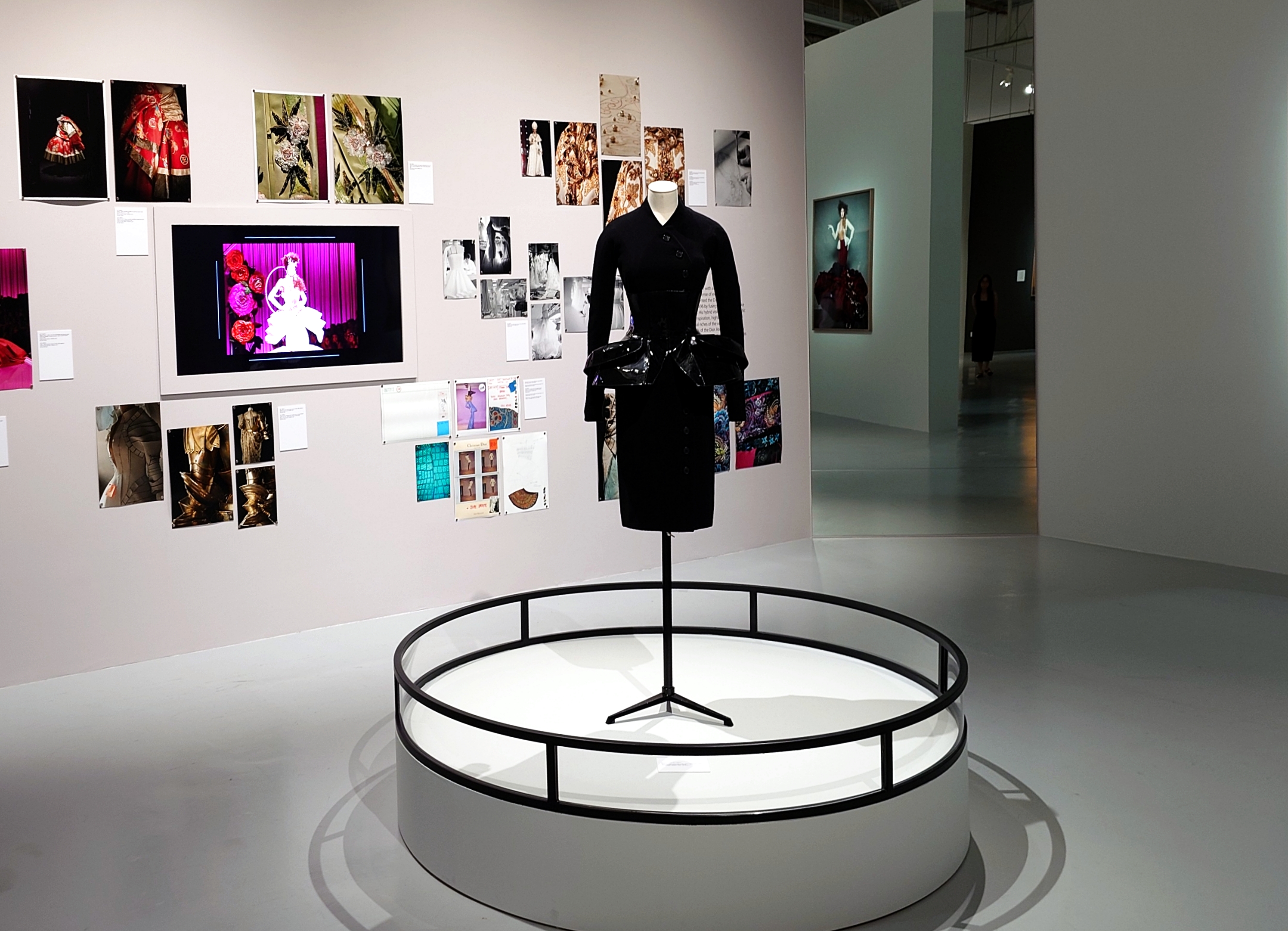
John Galliano’s reimagining of the ‘Bar’ silhouettes with a patent-leather “belt” and the familiar basques from autumn/winter 2008

Raf Simons’s vaguely ’60s silhouette with a dramatic tear-drop keyhole inset of green silk from haute couture spring/summer 2015
There is no explanation as to why the dresses were named after our island. In the ’50s and ’60s, Singapore was hardly a tourist attraction; it did not register a blip in the world radar. That the name was used thrice and featured in the exhibition seems to suggest that our island-state had a starring role in Dior’s global heritage. According to Dior’s own chronicles, there was no record of Mr Dior or Mr Saint Laurent having been to Singapore. The naming seemed to be part of the house’s convention of exoticising foreign locales, not evidence of cultural exchange. That is, regrettably the hollow center of the narrative. Dior and UBS seem to be performing a rather strained act of historical revisionism, frantically trying to sew Singapore into the historical lineage of the house that is as tagged on as the said images thumb-tagged to the walls—yes, as if on a school announcement board.
For an exhibition dedicated to haute couture, the apex of garment-making, the labor-intensive art of hand-sewn fantasy, the audience gets… six dresses: two original Christian Diors, and one each from Marc Bohan, John Galliano, Raf Simons, and Maria Grazia Chiuri. Six dresses feel less like a tok panjang than a sampling tray. The bulk of the show was 37 photographs, not garments. Dior’s haute couture was mediated through Carine Roitfeld’s styling and Brigitte Niedermair’s lens, turning high fashion into editorial imagery rather than lived craft. UBS’s investment in the program is probably enough to claim “couture heritage” without the logistical nightmare of transporting and insuring five dozens (60 would look better than six) of fragile gowns.

The weakest link: Maria Grazia Chiuri. Here, a gown from spring/summer 2019
We can see that it’s hard to squeeze nearly 80 years of Dior into a six-dress exhibition that can be completed in ten minutes, and stretched over three days, but this was the toile rather than the complete garment of a show. If you were hoping to do a deep dive into haute couture, this is barely the CliffsNotes—summary. Instead of gowns, the exhibition leaned on Carine Roitfeld’s styled photographs. Couture became imagery, not fabric, even less, construction. Carine Roitfeld isn’t really required to curate; she’s there to credentialise. The icing on the cake that nobody eats anyway. Her name carries the aura of Vogue Paris and the high-gloss world of fashion publishing. “Curated by Carine Roitfeld” is a press release hook that distracts from the fact that the exhibition is six dresses and walls of photos and memorabilia. A gesture toward couture without the full weight of it.
An exhibition this lite feels less like cultural enrichment and more like corporate optics. UBS is curating more its image than couture. Finance is abstract, cold, and often distrusted. Haute Couture is tangible, glamorous, and aspirational. By sponsoring Dior, UBS borrows cultural warmth to soften its corporate edges. The exhibition is presumably less about the public and more about UBS’s high-net-worth clients. It’s a velvet‑roped networking event passed off as cultural patronage. The irony is that the exhibition is free to visit and open to the public. Anyone can walk in, see six dresses, thirty‑seven photos, and leave in ten minutes. The openness creates the illusion of democratised access—couture for all, courtesy of UBS. Looking at the attendees, it is understandable why the exhibition is the way it is. Depth would have been a waste of time.
UBS House of Craft X Dior opens today and runs till 23 November. Admission is free, but online registration is required. Photos: Chin Boh Kay
 Style on the Dot