Thanks to Chanel, one of fashion’s favourite stars breezed through town recently and every smartphone camera turned her way, churning a thousand frames of the same fleeting moment for the algorithm altar
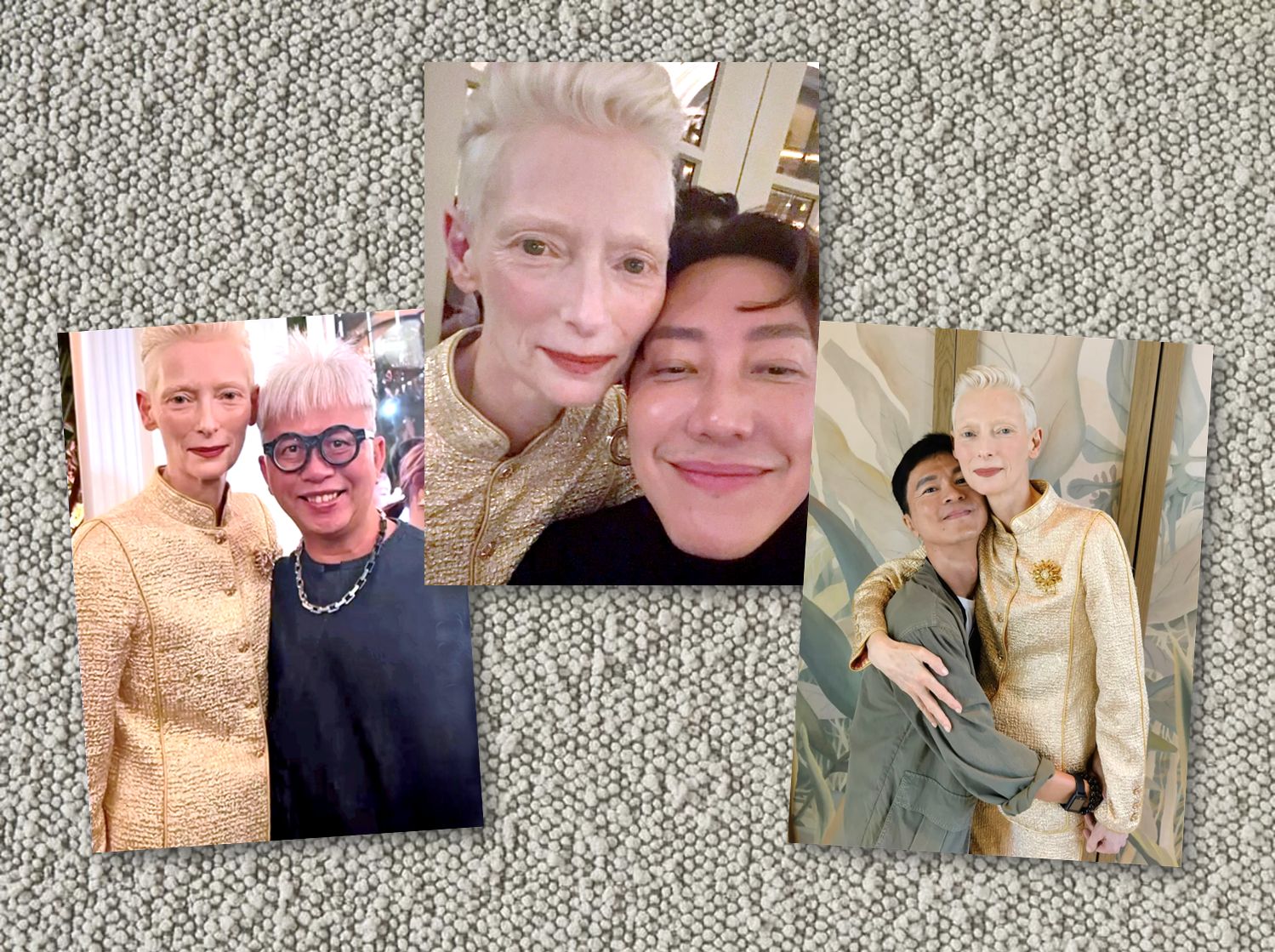
The usual suspects of composition. Tilda Swinton with (from left) Lianhe Zaobao’s star reporter Ng King Kang, Vogue SG’s star editor Desmond Lim, and make-up artist to the stars Clarence Lee. Photos: k2359k/Instagram, monkiepoo/Instagram, clarence_lee/Instagram respectively
Last Tuesday, the legendary Raffles Hotel wasn’t just hosting guests; it was hosting history. Tilda Swinton arrived, naturally, because where else would the actress/brand ambassador be for the Chanel Cruise 2026 show? It was only the second time the cruise collection has graced our shores since the 2013 outing at Dempsey Hill (that’s the best we get). This wasn’t just a high-profile event on our island’s social/fashion calendar, this was the opportunity for local celebrities and media stars to prove they know the real VIP room, even if they may not be able to tell bouclé from burlap.
Ms Swinton’s real job, it seems, wasn’t just sitting front row of a show she has seen before. It was being the gravitational center for an eager orbit of local media types whose only mission was to snap, tag, and meet their social media quota. Those scrambling for a photograph weren’t searching genuine connection; they were seeking inclusion in the spectacle, capturing the sacrificial frenzy of digital spectatorship. For them, presence was only valid if it was seen in the company of a Chanel-grade celebrity, captured, replicated, and offered up to the gods of engagement. Compulsory it was the proof of proximity.
Ms Swinton real job, it seems, wasn’t just sitting front row of a show she has seen before. It was being the gravitational center for an eager orbit of local media types whose only mission was to snap, tag, and meet their social media quota
It looked to us to be a kind of social parasitism, but dressed in the language of fandom. The eagerness (some call it desperation) isn’t about her, but what she represents: access, virality, and the illusion of significance. The pose is rehearsed to death and the smile is beyond mere reflex. It was less admiration than content co-production. The thinking behind each photograph seemed the same: Look at the camera, not at her. You are not a fan; you are a co-presence. Ms Swinton’s pervasion was less about her and more about what she triggered—an uncontrollable choreography of phones, filters, and FOMO.
Each bystander became a node in the algorithmic supply chain, producing bland, redundant images that did not differ in angle, nor meaning. They hugged her as if she was their dearest friend, she towering over them like a totem of borrowed relevance, their arms wrapped not around her but around the idea of being seen with her. Paradoxically, the fleeting moment is eternal, an endlessly looped, reposted, and recontextualised until it becomes a meme of itself. A million shares for a minute of fascination, but zero trace of the context that made it true because in the economy of spectacle, truth is too slow, too quiet, and far too untaggable.
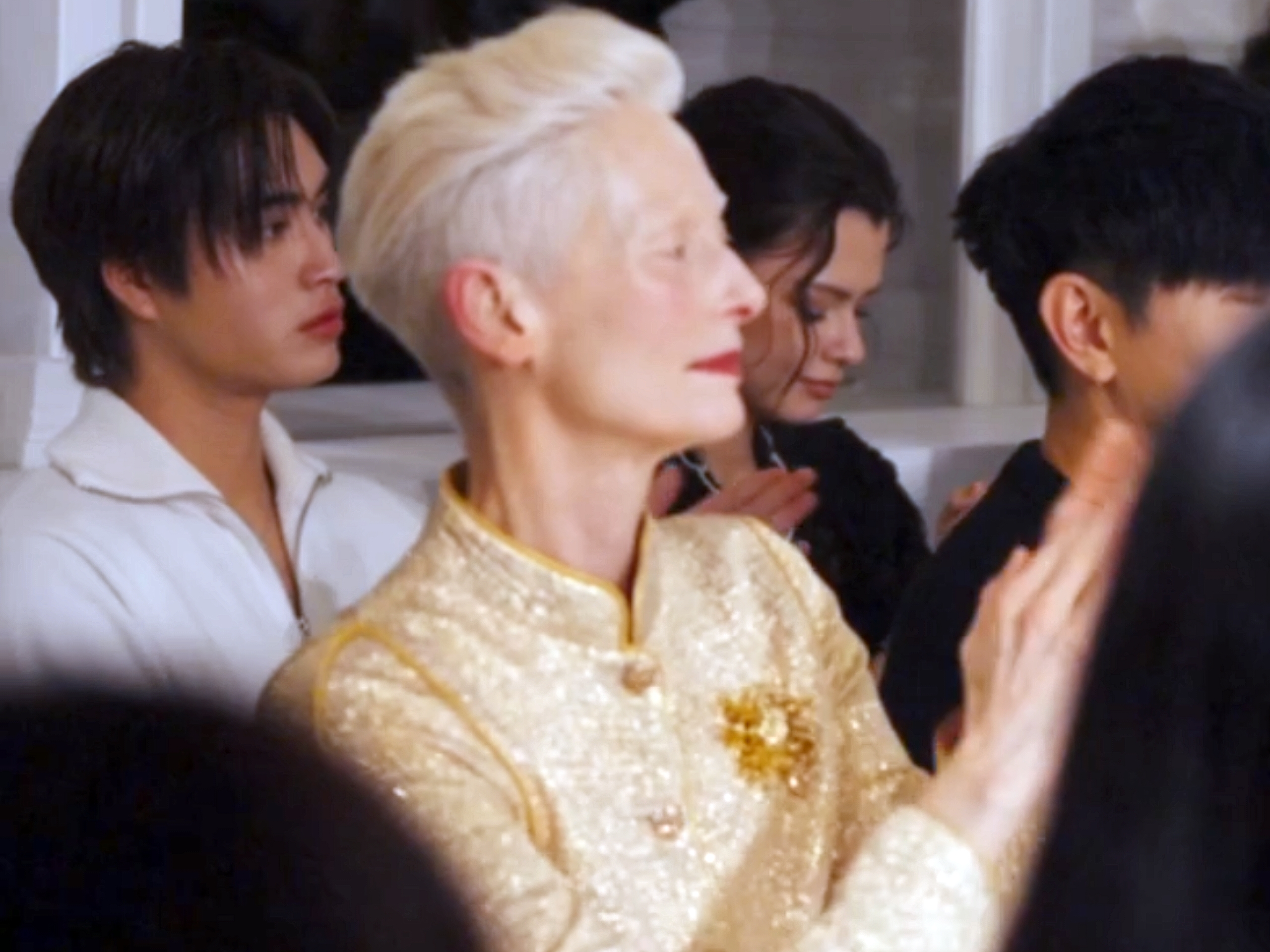
Tilda Swinton clapping during the show’s finale. Screen shot: chanel.com
Ms Swinton, as expected, wore Chanel—a gold Nehru jacket and and matching pants, unaware that she was in present-day Singapore, not Raj India. Her look, equal parts high fashion and historical cosplay, shimmered with the kind of oblivious confidence only a global fashion house can afford. It wasn’t so much a nod to the East as a nostalgic bow to colonial aesthetics, repackaged for the equatorial region after it was rinsed of context. We had to remind ourselves that the look was pre-Matthieu Blazy, a product of the interim studio era of Chanel. This was not the black and white sleekness she was strikingly swathed in last month for the new designer’s debut. This whispered opulence while muttering orientalism under its breath.
The Chanel cruise show in Singapore wasn’t merely a backdrop for local media to prove their clout; it was the strategic gathering point for the brand’s real assets: a curated demographic map, a breathing balance sheet of Asian market potential. With key ambassadors and high-profile influencers flown in from Thailand, the Philippines, Indonesia, and Hong Kong, it was high-net-worth data points, all of them. Their presence transformed the Raffles Hotel into a high-efficiency digital activation hub, launching the mid-season collection simultaneously across every corner of Southeast Asia, while the rest of our city, re-routed, stood sweating and steaming behind barricades, watching guests arrive—a spectacle so exclusive it was designed to require foot traffic to come to a halt as proof of impact.
 Style on the Dot