“Fall” is a seasonal misfit in Southeast Asia, yet international retailers here keep using “fall” in their marketing communications when we only have one constant state of simmering heat
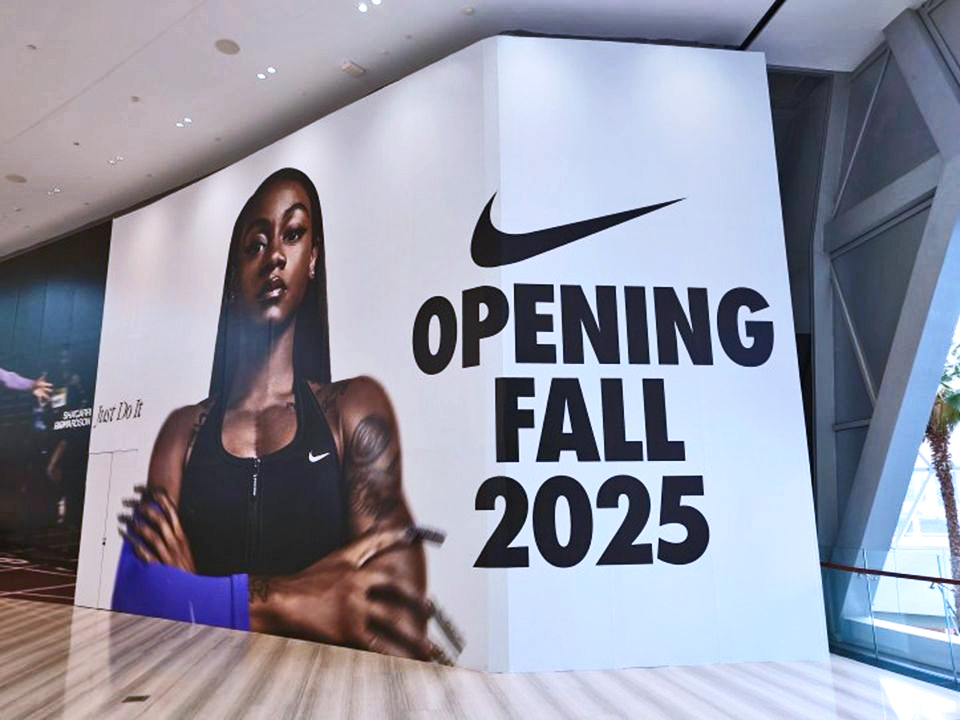
Hoarding of Nike’s store at Jewel Changi
It began, as all absurdities do, with a promise or portent: “Opening Fall 2025”. We were walking without a mission at Jewel recently and this message on a hoarding suddenly loomed before us. In the face of clear competition from immediate neighbour On that opened in July, Nike has decided to renovate their one-time largest store here. The hoarding was unmissable in the most kiasu way. But what really caught our eye was the timestamp “fall”. Never mind that we live practically on the equator. Never mind that seasons are a myth here, and leaves don’t change colour; only when they dry up and shrivel. Never mind that “fall” is an Americanism and climatically irrelevant to most of Southeast Asia. Who was Nike’s Jewel store refurbishment announcement speaking to? Or did they mistake Changi for Chicago? Perhaps, preempting someone doing a gravity check? Seriously, even before the store removes its hoarding, there could be an “opening fall” is clearly inauspicious!
According to the Meteorological Service Singapore MSS) “observations from stations with 40+ years of data reveal that Singapore’s climate has undergone notable changes recently. Explore how temperatures, rainfall and humidity have changed since the 1980s.” MSS also confirmed that Singaporeans have not only experienced weather inconsistent with what the Americans call “fall“, we are going through “warming over the last 40 years at a rate of 0.24°C per decade. The days are becoming hotter and nights are increasingly warmer. Our coolest month [usually December] now is hotter than our warmest month in the 1960s.” Heat—punishing, sweat-irrigating heat—is all we ever know. Nike’s gleeful “fall” landed like a joke; the absurdity of the corporate disconnect immediately heat-sealed when you walk out of the exit next to its store and pay full atmospheric fine.
Who was Nike’s Jewel store refurbishment announcement speaking to?
Yet, Nike still chose to be possessed by the hantu of “fall”. One marketing consultant explained to us that Nike is an American brand, where “fall” is a major retail season. It is “often easier and more cost-effective to use global marketing campaigns and visual assets with minimal localisation,” he said. While it is true that global fashion marketing runs on a Northern Hemisphere calendar, it looked to us that symbolic prestige trumps local relevance. He also said that Nike’s word choice “is not literal seasons”, but “industry shorthand” for production and release timelines. But this was not about product seasons; this was communicating when a store will open. Was it inevitable because nothing says equatorial relevance like seasonal delusion? To us it is a textbook case of global branding steamrolling local context.
The use of the American“fall” rather than autumn that we are familiar with was not just announcing a date—they were asserting a worldview where American seasonal language is presumed to be universal. An American-centric heart that overrides the reality of the periphery. It looked to us that by favouring “fall”, Nike was effectively imposing a calendar that serves its internal balance sheet (Q3/Q4 reporting) onto a climate that is defined by the upper scale of the thermometer. This silent adherence to a foreign seasonal default is a form of corporate domination, even when, as we understand it, Nike has a local marketing team here. “Fall” doesn’t just sound foreign, it sounds lazy—a copy-paste job that assumes the audience will either not notice or not care. Perhaps “opening fall” is more atas than the perfectly usable “opening year-end”, “launching Q4” or the ever reliable “coming soon”?
The use of the American“fall” rather than autumn that we are familiar with was not just announcing a date—they’re asserting a worldview where American seasonal language is presumed to be universal
Regrettably, the global fashion calendar is US-centric. We are constantly reminded that the most powerful and financially dominant market drives the global fashion and luxury goods industry is the United States. American retail spend and their fashion media landscape hold significant influence, even when the rest of the world care less about them. Their terminology and calendar definitions often set the global standard for media and corporate communication. This could explain why we are seeing more “fall/winter collection” than autumn/winter collection (which we at SOTD still use). The transition from autumn/winter to “fall/winter” in global fashion is a classic case of economic power dictating linguistic choice. The language of the dominant market, even if it is grammatically wonky (such as the missing preposition in Nike’s “Opening Fall 2025”) or culturally inaccurate for much of SEA, becomes the lingua franca of retail.
Before the Nike Jewel store closed for renovation, they sold what turned out to be quite a piece of irony: a T-shirt with the Swoosh across the chest, underscored by the word Singapore. It is interesting that the brand desired to appear locally attuned, yet communicate in American marketing speak. The ‘Singapore’ Swoosh tee, also available at other stores, is a symbolic nod to a place—designed to appeal to tourists and locals who want a sense of identity, yet when it is not in sight, American marketing flavour overwhelms. A brand that claims local relevance while enforcing global coherence is really no different from a tourist who wears a batik shirt, but insists on ordering—to capture the spirit of the season—pumpkin spice. Every visitor knows that in Jewel, the air-conditioning is nowhere near fall temperature. And, in this phantom season, the only leaves falling are from the indoor ficus.
Reminder: There are no seasons here, but there is branding. Please adjust your climatic expectations accordingly
Photo: Chin Boh Kay
 Style on the Dot