Obituary | Beyond supporting her husband’s nationwide charitable work, the late Queen Mother Sirikit’s most visible contribution was the influential promotion of Thai silk, which she championed by wearing the fabric abroad with unparalleled style
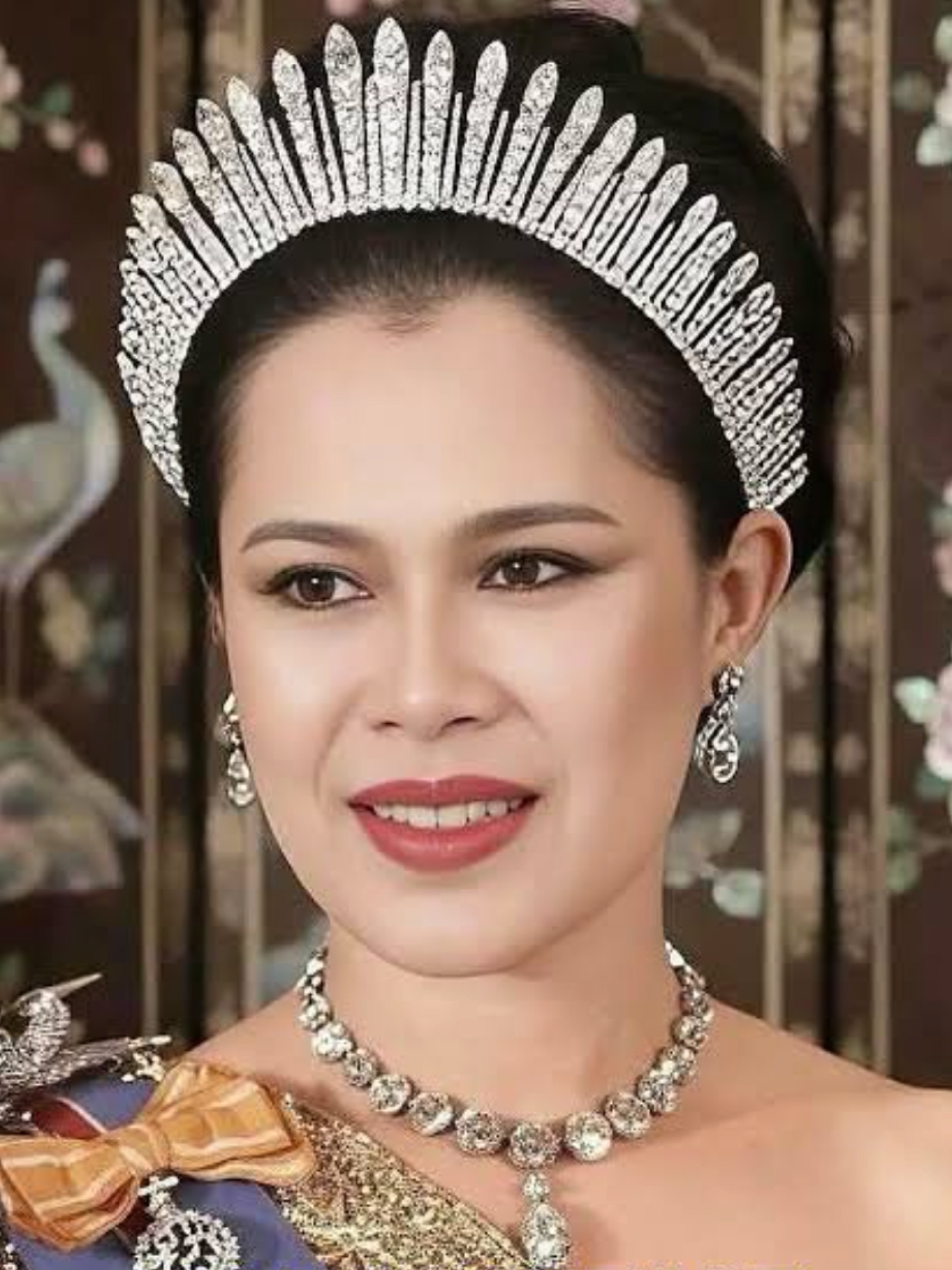
The late Queen Mother Sirikit in a February 1965 Vogue editorial shot by the American photographer Henry Clarke. Photo: Condé Nast Archive
Yesterday evening, when Blackpink opened their three-day concert at Bangkok’s Rajamangala National Stadium, whispers were heard that serious news would be announced by the palace soon. It was not until this morning that the Thai Royal Household Bureau revealed Queen Mother Sirikit has passed away. She was 93. According to the palace, she had been hospitalised since 2019 due to several unspecified illnesses. She has not been seen publicly since 2012 after suffering a stroke. On 17 October, she developed a bloodstream infection and succumbed to the illness on Friday evening. The Thai government has declared a period of national mourning and urged the public to wear black for 90 days. Entertainment venues and events have been told to tone down their programs, but Blackpink’s sold-out Deadline tour is allowed to proceed. However, it is not clear, if any of the members, in particular Lisa (aka Lalisa Manobal), who is Thai, will be shrouded in black.
The announcement marked the end of an era for Thailand, as the then Queen had been a central figure in Thai public life for decades—not only as the consort of King Bhumibol Adulyadej, but also as a cultural ambassador and fashion icon. Just as Lisa commands the spotlight today with what she wears on and off stage, Queen Sirikit was the fashion luminary of her day. It remains unknowable, of course, how the her majesty would have reacted to a pop subject’s style that often features more skin than seam. By contrast, the Queen blended calculated elegance with cultural pride, leaving a legacy that reshaped Thailand’s global image. She helped modernise and popularize the chut Thai, traditional Thai dress, by adapting it for contemporary use and formal occasions, and proved that ethnic styles can hold timeless significance on the world stage.

The Queen comfortable in Balmain and in the presence of the paparazzi. Photo: Getty Images
To achieve this modern, yet distinctly Thai aesthetic, Queen Sirikit formed what remains arguably the most consequential diplomatic pairing in fashion history: her collaboration in the ’60s with French couturier Pierre Balmain. There is no definitive story of how they met and what prompted their cooperation. The Queen would have heard of the designer when she was schooling in Paris. Her father, Prince Nakkhatra Mangala, was the ambassador to France at the time, and she attended boarding school there, studying languages, music, and literature and gaining fluency in French and English. The affluent sphere in which she moved would have necessitated a thorough familiarity with the fashionable dictates of the era. Although it is said that she wore mostly Western-style clothes in her Paris years, it is not known if she was partial to any designer back then.
The origin of Queen Sirikit’s collaboration with the house of Balmain is really wrapped in multiple retellings—some regal, some romanticized, all symbolic of a monarchy seeking modernity through couture. There was even reports that before Balmain was in the picture, Dior, then designed by Marc Bohan, was considered. One popular version recounts Mr Balmain stopping in Bangkok in 1959 on his way home from a holiday in Australia. He was introduced to an influential French interior designer living in Bangkok, François Duhau de Berenx. That let him to move in the expat beau monde, leading to an introduction to the famous and mysterious American with a Thai silk business, Jim Thomson, rumoured to be a CIA agent. And somehow, that led to an introduction to the royal lady-in-waiting, Princess Vibhavadi Rangsit.

It is such an image—shot by Henry Clarke—that appeared in an editorial in Vogue that sealed her standing as one of the most beautiful royals of her time. Photo: Condé Nast Archive
While most accounts attributed the clothes the Queen wore during her state visits of 1960 and 1962 to Pierre Balmain, there were two key figures behind palace walls in Bangkok and those of the Balmain atelier in Paris. The first was Princess Vibhavadi Rangsit, one of those rare figures whose influence was profound, but quietly woven into the fabric of royal diplomacy, fashion, and literature. She wasn’t just a lady-in-waiting; she was a stylistic steward, a cultural interpreter, and a logistical mastermind. And, more importantly, the conduit between the palace and the maison. Yet, her name rarely surfaces in mainstream accounts of Queen Sirikit’s global image. Also a writer, who gave voice to modern Thai women through fiction, she helped translate Thai silk into diplomatic couture, ensuring Balmain’s designs honored tradition while dazzling foreign audiences. To us, she was the ghostwriter of Thai glamour.
And there is the Queen’s court dressmaker, Urai Lueumrung, who brought to her attention the likely difficulties their “in-house sewing team” would encounter when making wool or fur clothing since such garments were never required in Thailand. To complicate the situation, he stated, not incorrectly, that the Thai artisans they worked with were unfamiliar, not only with climate requirements, but also with the intricacies of Western royal protocol. The Queen concurred with his reservations. He would eventually worked closely with Pierre Balmain to adapt the latter’s designs into garments using Thai silks that the Queen was eager to promote. Moreover, as her trusted dressmaker, he had firsthand experience with the limitations and potential of Thai silk, especially in the context of couture.
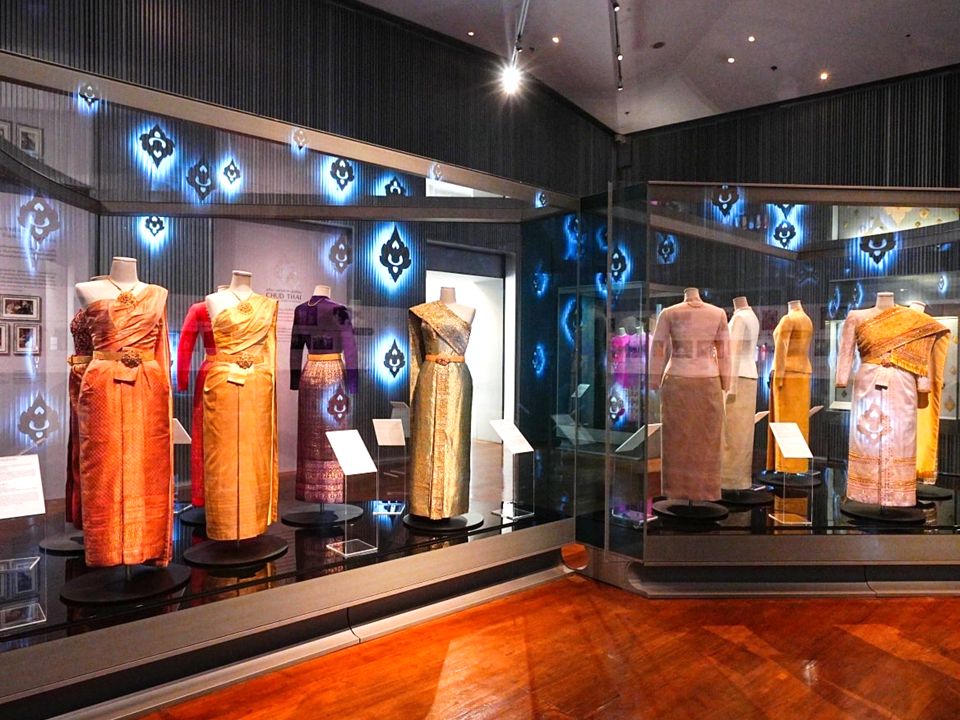
Some of Her Majesty’s clothes on display at the Queen Sirikit Museum of Textiles. Photo: Queen Sirikit Museum of Textiles
The logistical complexities in putting a wardrobe for a royal that comprised a reported 150 pieces during a time without the FedEx Jumbo Box can barely be imagined. Unlike the regular couture customer, Queen Sirikit was unable to go to Paris for the minimum three fittings famously required of a couture outfit. Mr Balmain and his right-hand man, the Danish designer Erik Mortensen (who took over as creative director of the house when Balmain died in 1982), flew to Bangkok for the fittings. Each visit reportedly required a three-week stay (whether they were accommodated in the palace is not known). It is not clear if the adjustments, if any, were made in Bangkok or in Paris. Timing shipments, fittings, and adjustments across continents added layers of complexity to the entire transatlantic operation.
The connection to Paris was not just through Pierre Balmain alone. The embroidery, often inspired by Thai motifs, was sourced from the house of François Lesage and the bespoke footwear from the couture shoemaker René Mancini (every outfit required its own pair of heels!). As each look that Mr Balmain created came with hats, shawls, jewellery (apart from the royal jewels) and footwear, the sheer amount that would be travelling with the Queen was staggering. To ensure that everything was intact and not creased, the clothes were organised into custom Louis Vuitton trunks, which were ordered by the house of Balmain, and also used to ship the garments to Bangkok for fittings. Each trunk was reportedly numbered to make the identification of the contents easier. On every piece was a royal cipher and painted with stripes in the colours of the Thai flag.
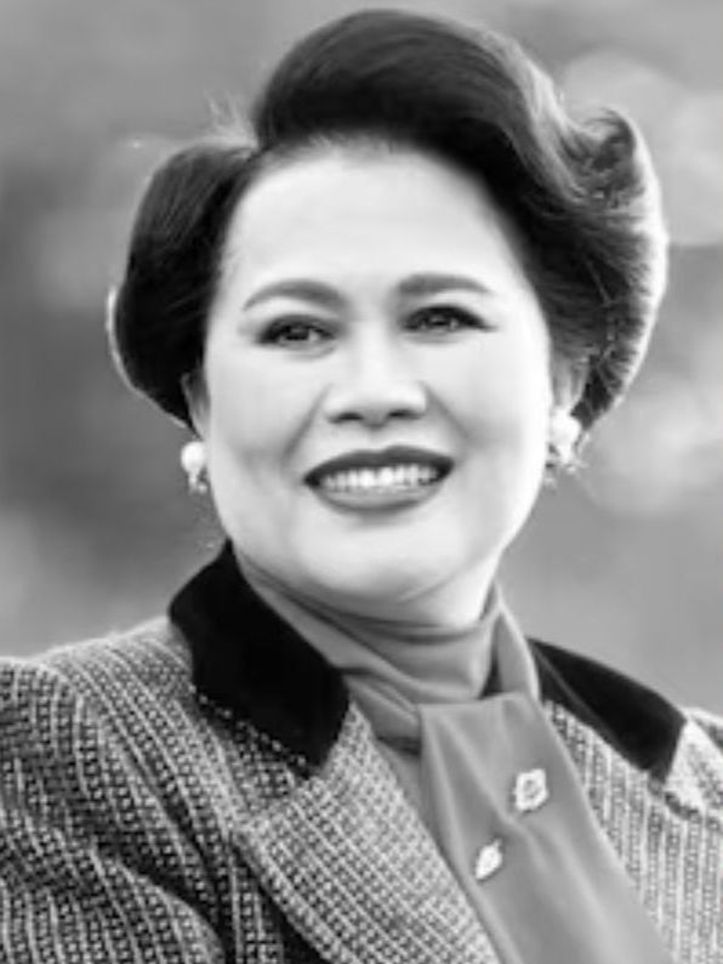
Queen Sirikit in her later years. Photo: Getty Images
Despite the later emphasis on modernising the chut Thai, it is an important historical distinction that the garments for the 1960 tour were not, in fact, mostly modern interpretations of Thai styles. The vast majority of the pieces were Western, unabashedly Balmain vernacular of the era, chosen to assure European and American audiences of Thailand’s modernity and sophistication. The Thainess was not primarily in the silhouette, but in the fabrics: the best Thai silks, believed to be sourced through Jim Thompson, and often in jewel-toned colors or unimposing pastels. This strategic choice was paramount: the Queen was adhering to the mandates of Western fashion while quietly leveraging her visibility to introduce her nation’s exquisite material culture to the world. It was a diplomatic maneuver disguised as a fashion triumph.
Queen Sirikit didn’t just wear fashion; she wielded it. Her wardrobe was a diplomatic arsenal, a cultural manifesto, and a textile love letter to Thailand. She fused Thai silk with French couture, modesty with modernity, and sovereignty with softness. That kind of legacy isn’t just hard to follow, it’s almost impossible to inhabit without being swallowed by it. Her legacy cast such a long shadow because she was really the last Thai Queen of the analog age. Her granddaughter Princess Sirivannavari Nariratana Rajakanya appears to be forging her own path in fashion as a designer. But her work lacks the symbolic density of her grandmother’s era. It’s fashion as self-expression, not statecraft. She operates in a postmodern, post-monarchical media landscape, where royal mystique is diluted by Instagram, and where fashion is more about branding than nation-building. Sometimes one has to be in the shadow when the original light was so incandescent.
 Style on the Dot