When empowerment wears a push-up bra and thonged panty
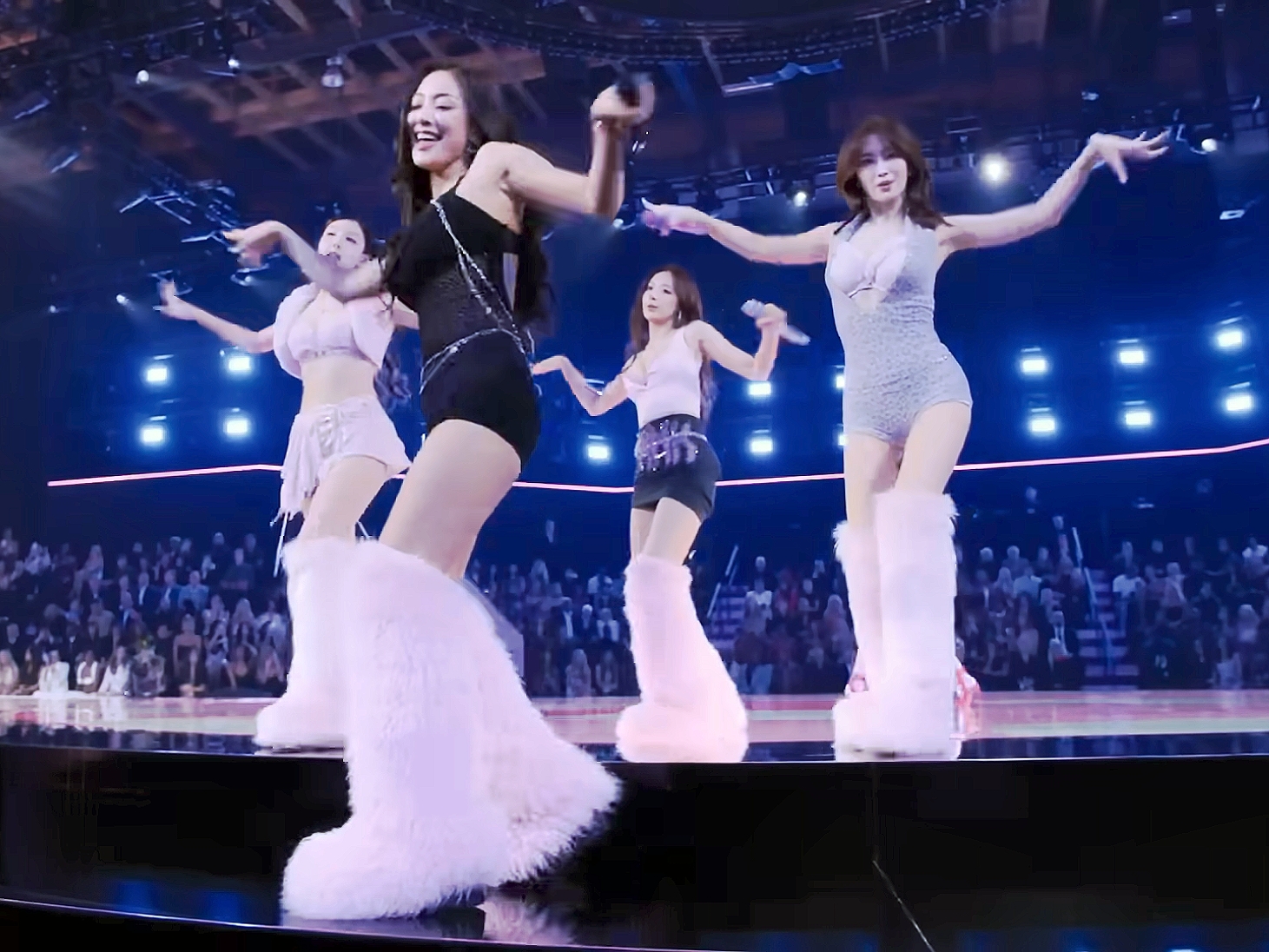
Just four members of Twice performing
At the Victoria’s Secret Fashion Show (VSFS) two days ago, the Korean pop group Twice performed, as a group that was less than half their usual line up of nine. They were reduced to a quartet (too expensive to pay all nine of them?) . It was their first VSFS performance. Although Twice did their best, they did not look doubly empowered—a key Victoria’s Secret rallying call. To make matters worse, some Netizens, post-show, criticised the girls’ for singing “off-key”. As it turned out, one of the vocalists, the sole Taiwanese in the nonet, Tzuyu (周子瑜, aka Chou Tzu-yu), was not feeling well. According to a CNA report, she took the stage despite the heavy burden of a cold, her voice hampered by “phlegm stuck” in her throat. This coughed up a critical shift—Twice’s magic was downgraded to a mild suggestion of sparkle.
Twice is a K-pop group, appreciated for its polished, precise, and emotionally calibrated performances. Here was the first K-pop girl group to perform at the show, a move Victoria’s Secret clearly intended as a global validation of its new, diverse platform. Yet, on the its stage, Switch weren’t just performing as themselves—they were performing within a fantasy that wasn’t theirs. Twice’s brand of sensuality is rooted in cute-sexy duality (or sexy-cute), a choreography of charm, playfulness, and emotional nuance. Their performances often balance flirtation with sincerity, and their appeal is built on relatability, not raw seduction. For VSFS, their costumes were recontextualized to fit the show’s emotional grammar: in-you-face sexiness. The girls were not performing K-pop—they were performing compliance with a legacy fantasy.
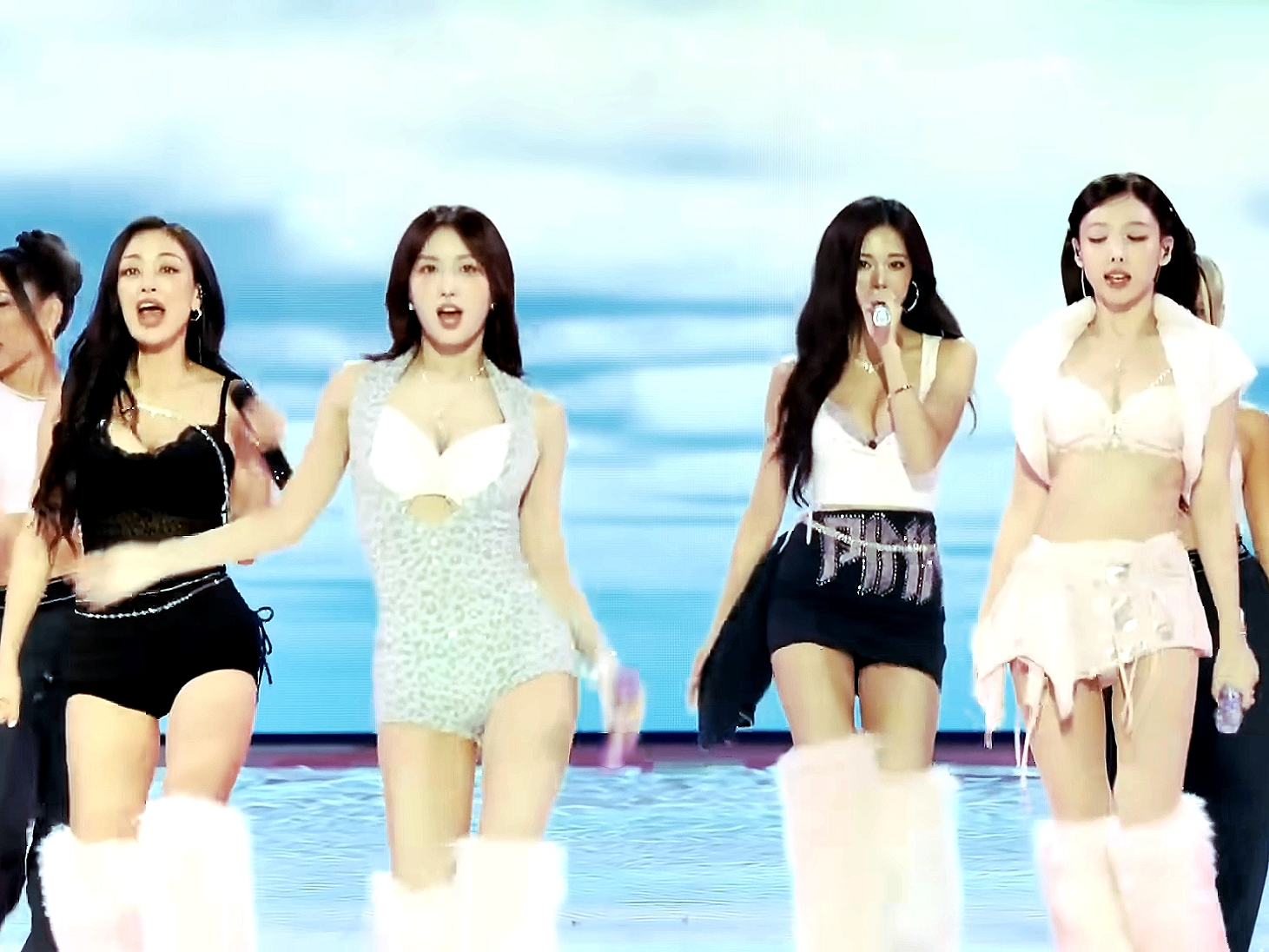
A nearly halved Twice singing during the segment that promoted the Victoria’s Secret’s clothing line Pink. From left, Jinho, Momo, Tzuyu and Nayeon
The ten-year-old girl group’s presence was not about cultural exchange, rather it was how they had emotionally assimilated (not too well since one of them was sick). The show didn’t ask what Twice represents in their own context. Rather, it asked how they could be repurposed to validate a fantasy built on American ideals of empowerment: (overtly) sexy, confident, consumable. It was not about celebrating difference, but about absorbing it. It looked to us that Twice was brought in to fill the mandatory ‘slay’ quota of American branding. However, the more Victoria’s Secret tried to sell the quartet as “empowered femininity”, the more it sounded like euphemism for palatable seduction. The bras and more bras, micro-mini shorts-panties, furry knee-high boots that Twice were assigned to wear appeared disempowering, but when they’re the only tools used to express femininity, they flatten its complexity.
This is compounded by how the media has viewed the event. ABC News was over the moon: “What a show it was”—the equivalent of we were so stuffed with sequins we could not ask questions. USA Today was impressed with “the powder pink glamour’ as if they had quoted a Mattel press release, circa 2023. Bang Showbiz announced that “they’re bringing sexy back” with no ringing irony, possibly because the last two decades of feminist discourse never happened. Harper’s Bazaar helpfully tendered “all the… runway looks”, offering the same weight in reporting as they would Paris Fashion Week and validating its fantasy than questioning its intent. Marie Claire even declared that VSFS is “what an inclusive runway looks like”. What it really applauded wasn’t structural change—it was diversity of the optical kind. A few non-white models, a pregnant woman, a couple of athletes, and a global pop group are enough to trigger the “inclusive” keyword, while the emotional architecture of the show remains unchanged. The show, to us, was tacky, performative, and incoherent, but the media saw it as glamorous, empowering, and sexy, then the audience is left gaslit by glitter.
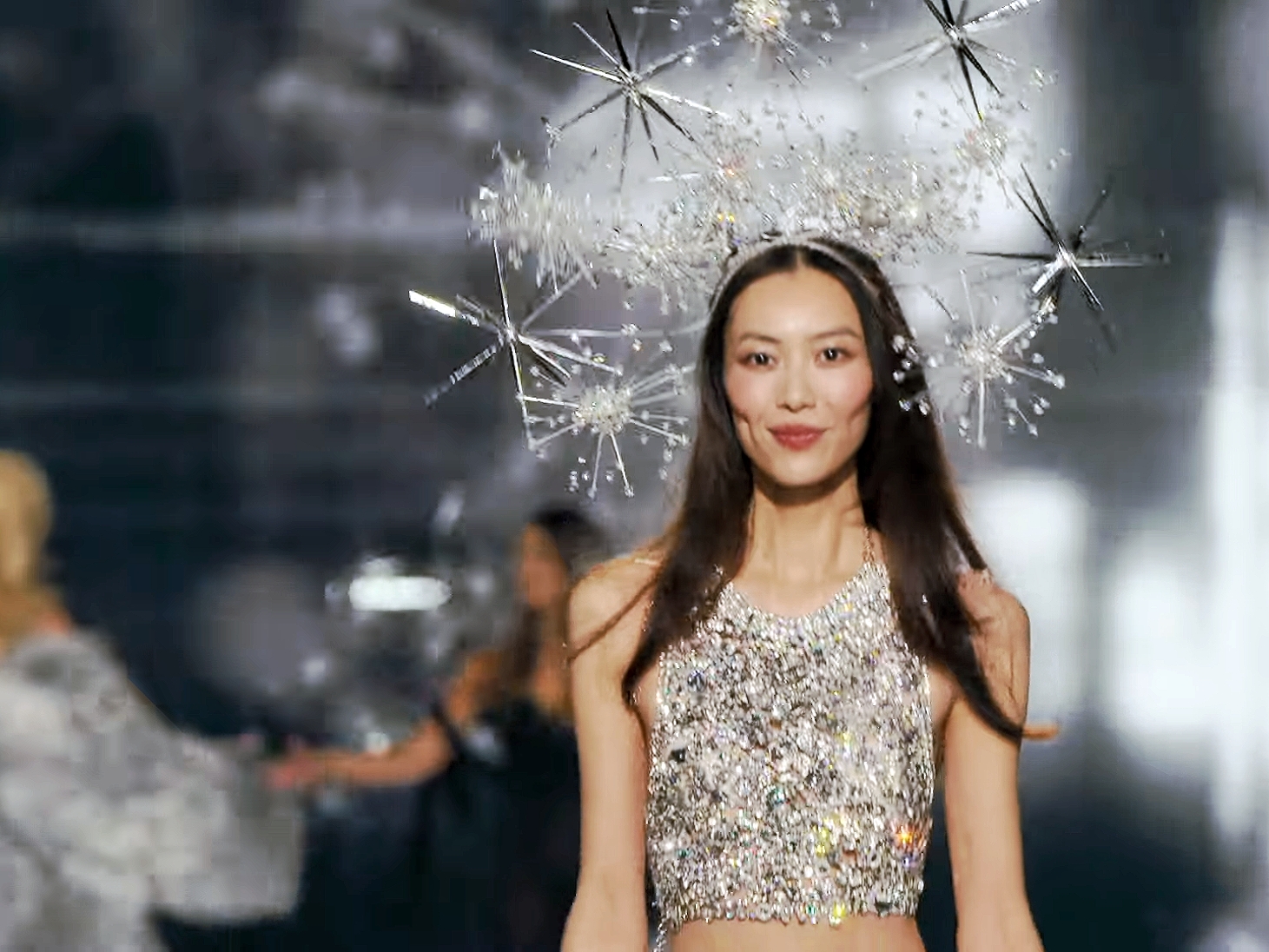
China’s most recognisable face in fashion, Liu Wen
The most jarring thing is that in all the coverage that we have read, there was scant mention of the show’s Asian models. In fact, virtually none. Apart from Twice, which was really there more as a brand ambassador than cultural disruptors, there was a tokenistic mention of the Hmong-American gymnast Suni Lee and total omission of China’s most recognisable model Liu Wen (刘雯), even when the Yongzhou-nese (永州人) was the first Chinese model to walk a VSFSH, back in 2009. It’s a symptom of how representation without narrative becomes emotional invisibility. This is where the fantasy reveal its limits: it can accommodate difference, even if modest, but it struggles to centre it. The fantasy’s blind spot was evident: When Asian icons are seen, but barely mentioned.
It is hard to say that outside the U.S., the Victoria’s Secret brand of empowerment persuasively appeals. The argument we have seen is that Victoria’s Secret is a multinational corporation with a presence in approximately 70 countries. The world must have loved VS to the extent that the revival of the VSFS after an hiatus of 6 years, is warranted. It is hard to be convinced that that while VS’s brand of empowerment told women that their power came from buying specific lingerie and performing a narrow, hyper-sexualized idea of beauty, it is not prioritising the brand’s profits over genuine female agency. Or that they were not using Twice to sell unapologetic, carnal confidence to teenage girls worldwide. Buy this bra, become these women. Pose this way, earn your wings. The enlightened calls it ‘femvertising’.
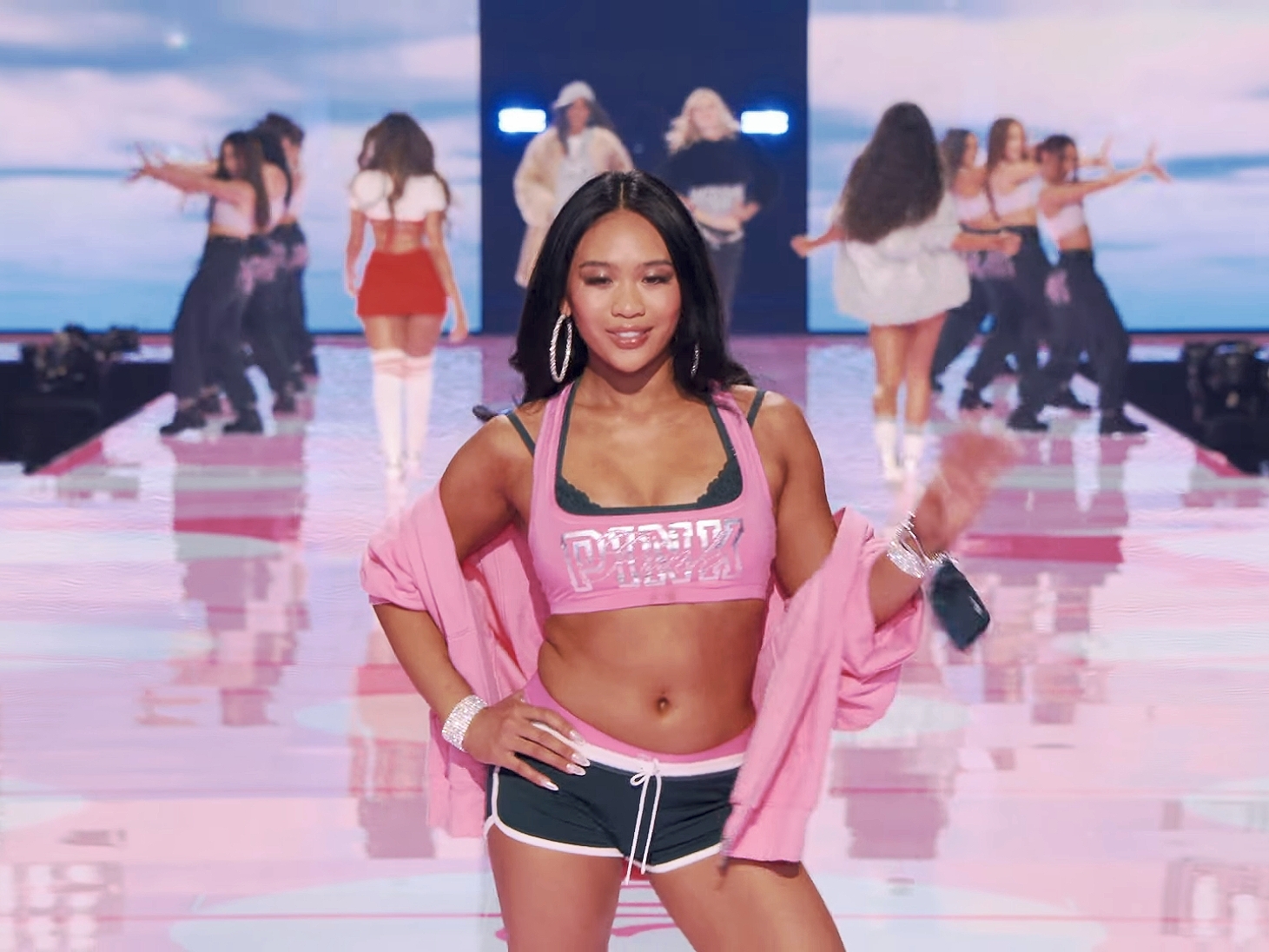
Hmong-American gymnast Suni Lee
The American sexual maximalism inherent in the VSFS does not translate well into the K-Pop idol machine, where the focus is often on tightly controlled perfection, youth, and a lighter form of sensuality. In fact, outside the U.S., Victoria’s Secret’s hypersexualized branding is increasingly seen as outdated, culturally tone-deaf, and out of step with global shifts toward authenticity, body diversity, and emotional nuance. In Asia, where cultural codes around sensuality are often more nuanced, the brand’s maximalist sexuality can looks jarring or misaligned. Back in 2021, when VS to was going through what was described as rebranding, The New York Times headlined a report: “Victoria’s Secret Swaps Angels for What Women Want” and listed those things Victoria’s Secret was going to discard. They included angles and wings. And the time, they showed seven women who will guide their rebrand. That didn’t stick.
VSFS’s return continues to graft its unchanged fantasy as world view. Just as with the first series of shows, the present operated on an American-centric fantasy: that its vision of beauty and sexiness is the universal and aspirational global standard. The show itself became a platform for projecting this exceptionalism by featuring the angel archetype and the spectacle of excess. If there is one thing it proved to be true, it is that American tacky is a real thing. And VSFS was practically it’s runway manifesto. We know ours won’t be a popular opinion. We already hear the hit-back: that we ingested the clickbait and got our panties in a knot. We have nothing against the bras and panties; we are just not convinced that the performance of progress being sold as revolution is nothing more than the same old fantasy given a fresh coat of powder pink. Victoria’s Secret Fashion Show tried to have it both ways, and ends up pleasing no one, but its own near-naked myth.
Screen shots: victoriassecret/YouTube
 Style on the Dot