Meghan Markle was desperate to attend the Balenciaga show. She found a way in even when she had not initially received an invitation. As it turned out, she asked for it. Kudos to persistence?
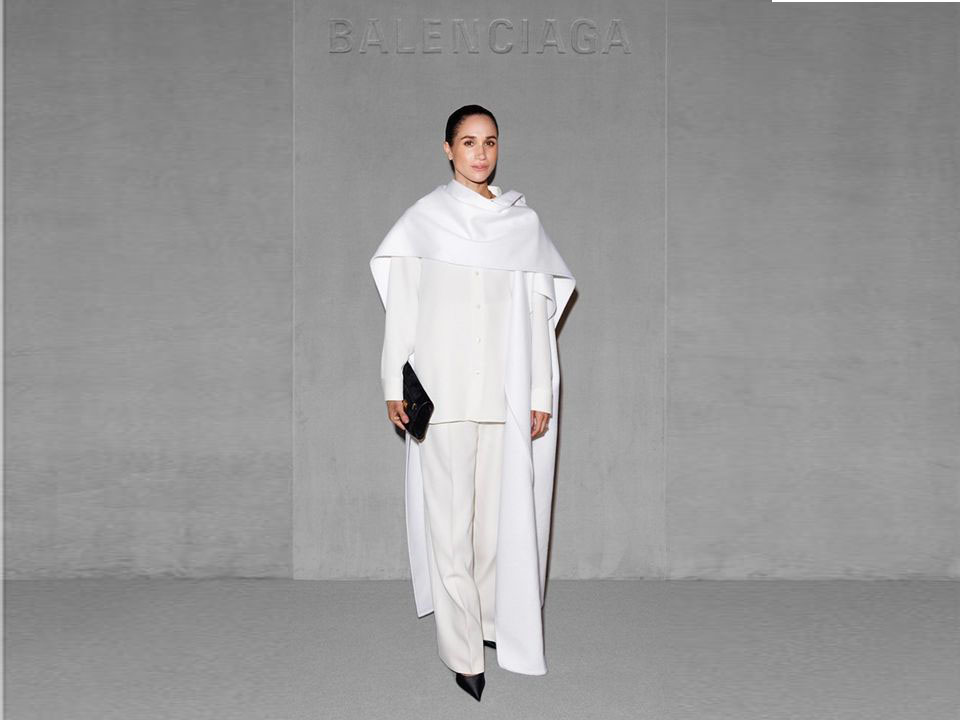
Meghan Markle at the photo wall of the Balenciaga spring/summer 2026 show. Photo: Balenciaga
You have to give it to her. Meghan Markle knows how to make her presence felt. Now, for that to happen, she needs to be seen. Visibility is currency, and she pays in proximity. Last week, she unexpectedly attended the Balenciaga spring/summer 2026 fashion show—a pointed exercise in trading elite access for popular appeal. The negative fanfare that resulted was not just about the strange walk as she entered the show venue or the lacklustre clothes she wore, but something far worse: her natural place there. As it turned out, she personally requested to attend the Balenciaga show—she was not formally invited. She was, in fact, RSVP-less, but she would not have it that way. She contacted designer Pierpaolo Piccioli personally and told him she wanted to go. What could the guy do other than say yes? In one fell swoop, she went from exclusion to inclusion.
In an interview with The Cut, published three days ago, Mr Piccioli revealed that she was initially absent from the guest list. “She reached out and said she’d love to come to the show,” he said. “There was no strategy or big orchestration.” It was she who paved the path to proximity. And the rest, as the world saw, is scrollable. So, too, another point that was made. It contradicted what Ms Markle PR team put out publicly: that she was there because she wanted to support Mr Piccioli, who was debuting his Balenciaga collection, and her appearance, they enthused, was “the culmination of many years of artistry and friendship.” Mr Piccioli clarified that, saying: “Meghan and I met some years ago, and we’ve been texting ever since.” He did not once use the word “friend”.
“She reached out and said she’d love to come to the show. There was no strategy or big orchestration”
Pierpaolo Piccioli
This new revelation fits neatly into the kind of media choreography we have frequently seen with Ms Markle. Her essentially self-invitation flips the usual power dynamic of fashion week (certainly in Europe, if not in the U.S.), where exclusivity is currency. By assertively inserting herself into the Balenciaga narrative, she not only disrupted expectations, but also reframed the event around her own brand-building. The ambiguity—was it friendship, strategy, or spectacle?—mirrors the tension between authenticity and performance that defines much of public life, one that she had earlier tried to minimise when she had valiantly sought “privacy”. She is a woman who refuses to be low-key or sidelined, even if it means bending the rules of prestige. And the Balenciaga show made it clear: Her preferred working environment is front and centre.
The resulting spectacle was not just a case of inflated self-importance; it was a visible failure of social execution. As seen in a video now circulating online, she was largely ignored by many of the guests, especially Dame Kristin Scott Thomas, who was seen walking away when Ms Markle was speaking mid-way. This reminds us of the time Ivanka Trump was snubbed at the 2017 G20 Summit by European leaders, such as Christine Legarde and Emmanuel Macron. On both occasions, American exceptionalism, disguised as female might, did not land. In fact, Ms Markle’s star power was not even flickering as reports have emerged that she enthralled no one. In hindsight, even Anna Wintour’s compliment of her look—“very chic, indeed”—an oddly archaic expression that now sounds a tad sarcastic when we think of how her looks were devoid of the heritage fluency expected at Balenciaga. Ms Markle did not command the room in the way some had expected. She was not the belle of the ball, but a determined guest.
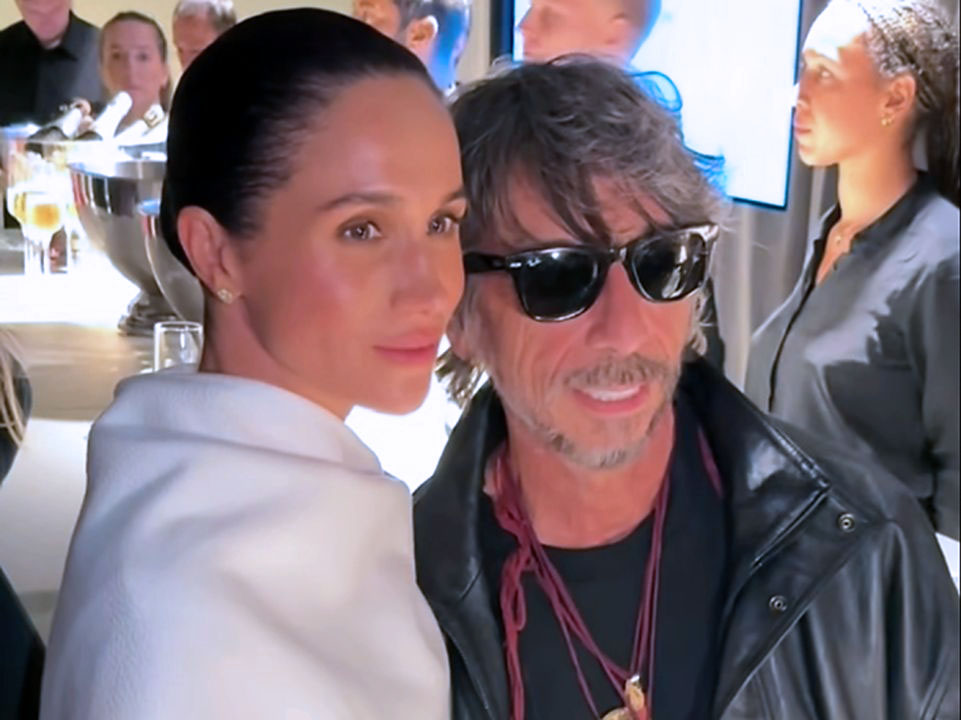
Meghan Markle posing with Pierpaolo Piccioli. Screen shot: TikTok
Ms Markle’s very appearance in Paris quickly devolved into a series of faux pas from the moment she asked for that invitation. The immediate evidence was the much-derided reel shared on Instagram, showing her riding in her limousine with her legs up. This posture evokes more than bad manners—it’s a demonstration of emotional entitlement that reeks of the Ugly American abroad. It is regrettable that no one reminded her this was Paris Fashion Week (PFW), not spring break. As many observers of Asian culture know, where feet are considered symbolically low (especially in countries like Thailand), pointing one’s feet toward something—even a site of death—is deeply disrespectful. But the cultural insensitivity was quickly dwarfed by the emotional offense: the vehicle was passing the Pont de l’Alma, the very tunnel where Princess Diana died. There were no flowers, no silence, no emotional gravity, and certainly no tribute. It was just a moving visual, one that felt curated for engagement, not remembrance.
Beyond the crass performance at Pont de l’Alma, the Duchess exemplified the export of a largely American cultural mode: emotional maximalism. Feeling to her is performance, and performance is proof of authenticity, as demonstrated in the Bloomberg interview two months ago. She did not just expressed emotion, but amplified it to the point where it becomes spectacle, strategy, and identity. Think Oprah Winfrey’s televised catharsis (it was cathartic, too, for Ms Markle when she was interviewed), Taylor Swift’s confessional lyrics, or political rallies that feel like revival meetings. Ms Markle’s Balenciaga moment sits at the top of this cultural export. By asking to attend, she inserts herself into a space that did not choose her, then re-narrates it as “a culmination of friendship”, one seemingly one-sided. Her first PFW appearance was not about fashion, but an emotional narrative construction.
The Duchess exemplified the export of a largely American cultural mode: emotional maximalism
In the hallowed grounds of the Balenciaga show confines, she was not just expressing herself, but reframing spaces through her own emotional lens. She brought the American logic of visibility to a place that did not embrace it, to a post-2020 world, where that untranslatable emotional grammar is increasingly met with skepticism. For decades, America exported not just products, but emotional styles: the confessional memoir, the reality TV breakdown (America’s Next Top Model!), or the TED Talk epiphany. These modes promised that visibility, vulnerability, and reinvention were not just possible—they were virtuous. Add to that, the Markle self-branding, and cultural insensitivity, you get convergence of persona that feels exhausting, intrusive, and tone-deaf.
Despite her claims of the lost of privacy when she was briefly living in the U.K., Ms Markle’s entire public persona is built on the American ideal of be seen is to matter. Her ability to narrate herself, fumbles included, is to claim power. But when she introduced that verity to PFW, a space that thrives on curated mystique and symbolic restraint, it didn’t land as empowerment more than clumsy proximity. At the risk of sounding harsh, her missteps were not just personal; they were nationally inflected. Under the Trump administration, American cultural exports have lost their aspirational sheen. Now, the world mostly sees emotional excess without accountability, self-branding without substance, and freedom of expression without social tact. Cultural clout isn’t just about media dominance—it’s about emotional resonance and symbolic literacy. The backlash against Meghan Markle elucidates one thing: America best keeps its therapy sessions to itself.
 Style on the Dot