Viewpoint | For her first senate hearing, Pam Bondi gave quite a performance in confrontation, with an opening statement entirely from her turnout: unassailable in the deepest shade of black
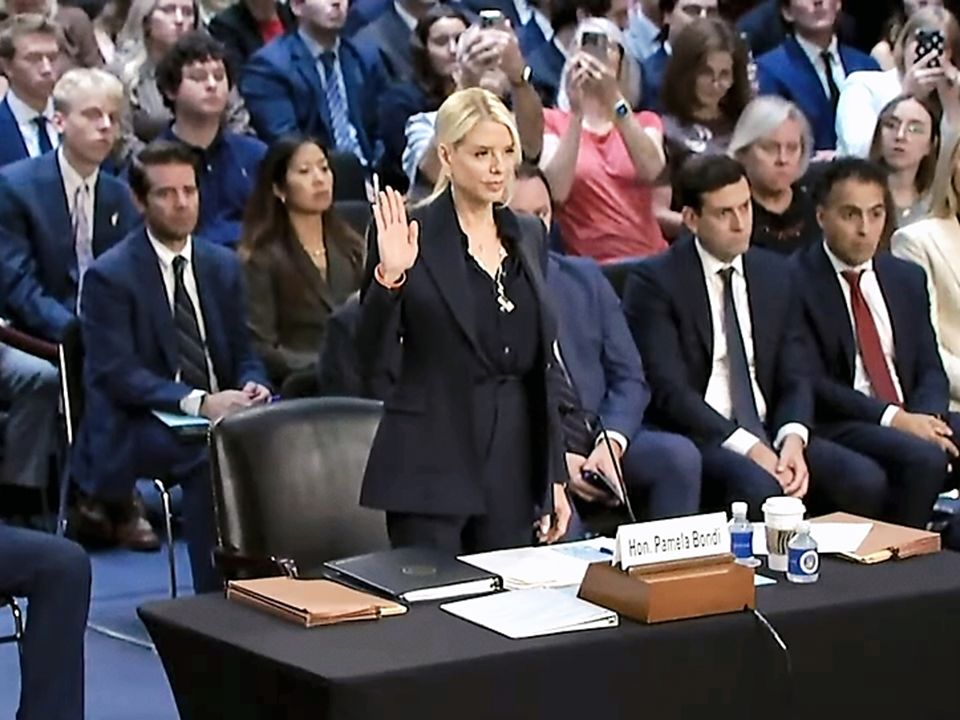
In the end, Pam Bondi’s appearance at the first Senate hearing was a performance, but she was really posturing for one. A solo partisan spectacle, she turned a political hearing from a forum of accountability into a stage of allegiance. We saw a good part of the nearly five-hour show (and it was), and what we witnessed was not just a political exchange, but every facet of Ms Bondi’s unnerving delivery—the defiance, the selective empathy, the refusal to engage with legal nuance. Every action was meant to resonate with one. She wasn’t trying to persuade the Senate, the public, or even the media. She was signaling loyalty, strength, and ideological purity to the person whose favour matters most in her giddy political orbit. Donald Trump must have been very, very pleased.
In a harsh political landscape where women are expected to soften their authority (or at least appear to), Ms Bondi’s powerful attire, and the aggression it framed, was a deliberate visual strategy. As she walked in to face the senate judiciary committee, we could see that she was attired in total black—a surprisingly soft suit and a matching shirt beneath, with at least three buttons unfastened to frame a pair of necklace, one of them with a cross pendant. Rei Kawakubo famously said, “I work with three shades of black.” Ms Bondi’s, conversely, did not offer such variations. She had chosen the deepest raven, which reminded us of what Wednesday Adam said: “I’ll stop wearing black when they invent a darker colour.” It does not exist, much like Ms Bondi’s capacity for even a sliver of shame.
Donald Trump must have been very, very pleased
There is no doubt that Ms Bondi was aware that black is often associated with control, seriousness, and dominance. In a high-stakes political arena, she could—and she did—signal “I’m not here to play Miss Congeniality”. As a prosecutor, she is probably used to wearing black, just like judges. All-black can be used as emotional armour, and in the hostile environment of the senate hearing that she created, it likely served as her psychological shield. She is partial to suits that assert a certain image. Her typical pin-striped suits had been compared to mafia bosses and 1980s TV cops. Her all-black this time appeared, as it had when she hosted a press conference at the Drug Enforcement Administration (DEA) headquarters in Arlington, Virginia in July, to have been a part of an effort to craft a tough-cookie persona. Only now, it was clearer: I’m here to dominate, not explain.
As she talked, argued, berated, deflected, and her hands gesticulating with the dexterity of an ASL interpreter, a bangle in the surprising shade of kumquat could be seen on her right wrist. According to the Post Register, that bangle was specifically worn to commemorate the second anniversary of the Hamas-led attack on Israel. A visual cue, as it were, was not enough. Ms Bondi opened her senate testimony by asking for prayers for the Israelis; she did not mention the Palestinians. By acknowledging only Israeli adversity, she executed a masterstroke of selective empathy: nodding to her base and performing the deliberate erasure of Palestinian plight through silence. She looked pleased with the strategy. For those who believe in human dignity across borders, it is a painful reminder that political rhetoric can strip empathy of its universality.

The unvarnished disdain of Pam Bondi, unlike her nails. Screen shot: cnbc/YouTube
But the kumquat bangle on her wrist was only the beginning of her signaling. Pam Bondi was ready with a combative tone and a clear ideological posture. By explicitly asking for prayers for Israelis and omitting any mention of Palestinians, she signaled not just political alignment, but emotional allegiance. In a setting meant to uphold neutrality and legal clarity, that kind of selective empathy reads as deeply political. What’s truly revealing is not what she said. Rather it’s what she chose not to say. In a moment where the humanitarian crisis in Gaza and her boss’s peace plan for the region was dominating headlines, her silence on Palestinian suffering wasn’t accidental. This selective moral framing is a powerful tool in political theatre. It tells the audience who matters, who deserves compassion, and who does not.
When she got that out of the way, the rest of her speech was as black as her outfit and the ace of spades. Her senate hearing felt less like a legal oversight session and more like a primetime political showcase. The posture and the punchlines: they were all choreographed. She wasn’t reacting; she was executing a strategy. Sitting behind the desk that was assigned to her, she conducted herself defensively and contemptuously. From the way she leaned back in her chair with a smirk, to the exaggerated eye-rolls to using the back of her hand as chin rest, she signaled that she didn’t consider the hearing a legitimate exercise in oversight. She was there to hold court, not to engage. Her facial expressions often bordered on theatrical mockery. When Democratic senators pressed her on serious matters, such as the politicisation of DOJ prosecutions or the Epstein files, she didn’t just deflect with words. She used her posture to telegraph utter disdain.

On more than one occasion, she treated the questions posed to her as a personal affront. When questioned by senator Peter Welch about an alleged tape concerning border czar Tom Homan and the transfer of $50,000 from undercover FBI agents, she snapped at him loudly: “Don’t call me a liar.” Total antipathy. When senator Richard Blumenthal questioned her about a former lobbying firm, she grew angry and accused him of lying about his military service. “I cannot believe that you would accuse me of impropriety when you lied about your military service. You lied, you admitted you lied to be elected a US senator,” she declared. By claiming offence, she avoided answering direct question, a strategy right out of the playbook of Karoline Leavitt. Ms Bondi was not defending herself, she was presenting herself as exemplar of a warrior for Trump-era politics. In what would otherwise be a placid formal inquiry, she knew she had to create a cock fight.
Perhaps this wasn’t just about Pam Bondi. It appeared to be part of a larger transformation in how Republican women are positioning themselves in the post-Trump era. Others such as Karoline Leavitt and Kristi Noem often embrace belligerence as branding, too. Their gender didn’t soften their posture; they amplified it. As we watched her fire away, face etched with scorn, we could not help but see a Karen—the archetype of the middle-aged, often white, entitled woman who uses her privilege to demand that she gets her way, often by being unreasonably confrontational, and showing little respect for rules or the authority of others, especially those she perceives as being beneath her. Ms Bondi’s tendency to use her index finger to point to senators she already referred to as “you” is insolent, and flagrant disregard for paramount oversight role of the chamber, but also those who are older and politically more experienced .
Her senate hearing felt less like a legal oversight session and more like a primetime political showcase
Ms Bondi’s belligerence, her shouting, emotional outbursts, gestural aggression—these are behaviors that, if enacted by a man, would be swiftly labeled as bullying, sexist, or aggressive posturing. Yet, when Bondi does it, the reaction has been fragmented. Some see her as “tough” or “unapologetic.” Others call her “shrill” or “unhinged.” The inconsistency reveals a double bind: women in politics are often punished for being too soft and too hard. But here’s the twist—Bondi weaponised that double bind. She leaned into the aggression, into shouting, knowing that her gender might shield her from the full backlash a man would no doubt face. She exhibited strength in a way that a guy couldn’t without triggering accusations of toxic masculinity. And that makes her hearing not just a political event, but a clear gendered spectacle.
The U.S. attorney general attended the senate hearing as if she was mourning, but, in the end, she was really celebrating the demise of civility. Beneath that unassuming but unyielding suit, she wasn’t grieving the erosion of democratic norms, she was embodying it. Her invocation of prayers for Israel, her combative tone with Democratic senators, her smirks and clipped retorts were not spontaneous reactions, but rehearsed percussion meant to echo her boss’s own rhetorical style: confrontational, unapologetic, and emotionally-charged. And that’s what makes it so fascinating. Rather than testifying, Pam Bondi was auditioning, with costume intact. Not for a legal role, but for continued relevance in Donald Trump’s political abyss. She understood the assignment clearly: don’t explain, don’t concede, don’t soften. Simply put, just perform.
 Style on the Dot