Why did Elle UK trim this group photo so that Rosé was removed from the shot?
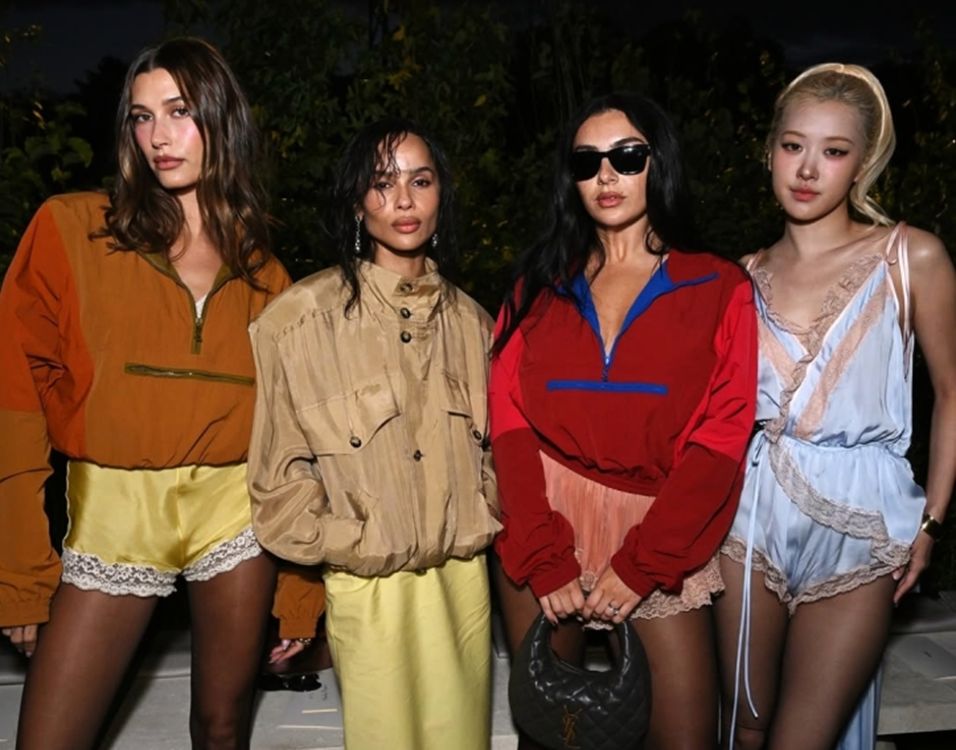
The four that became three (from left): Hailey Bieber, Zoë Kravitz, Charli XCX, and Rosé Photo: wmag/Instagram
The backlash was swift. You can’t make someone as visible as Rosé go missing. And at—of all places—a Saint Laurent fashion show, without making international headlines. But that was exactly what Elle UK did. In a photo that the magazine shared on their Instagram page, what should have been a quartet mysteriously became a trio. A day after the bow-dacious Saint Laurent show on 30 September, attended by many stars, including two of the brand’s ambassadors Zoe Kravitz and Rosé, Elle posted on IG an image of Hailey Bieber, Ms Kravitz, Charli XCX, minus K-pop’s biggest female singer-songwriter of the moment. Clearly, front rows of fashion shows are where global influence gets lobbed off, and social media makes sure everyone sees the edit. It was an unambiguous erasure. The fan response was on-brand for digital meltdown.
Elle UK was just as expeditious in their response. The day after the furore, they removed the ill-advised post and replaced it with a three-photo set of Rosé at the fashion show. But, the collective fury remains undiluted. In K-pop fandom, you can’t put an awakened Kraken back to sleep. The day after that photo substitute, the magazine released an apology, claiming that the cropping was the result of “the resizing process”. We crop photos all the time. That was not a crop, that was an editorial amputation, conducted by a visually handicapped photo editor. They took an image featuring a global ambassador for the brand they were covering, and decided, in a triumph of speed over sense, “You know what this picture needs? One global superstar less.”
We crop photos all the time. That was not a crop, that was an editorial amputation
With zero latency between input and more outrage, the fans argued that Elle UK’s explanation was bunkum. They quickly pointed out that other publications, such as W Magazine and Harper’s Bazaar, had easily accommodated the photo in its entirety. The message taken by her legion of fans was simple and damning: Elle UK’s editorial policies—they laud Western stars, Asians not. That Rosé’s and K-pop fans saw this as racially-motivated is not beyond comprehension. The decision by Elle UK to specifically crop the photo to omit only Rosé—the sole Asian celebrity in the group—was what led fans and critics to believe the choice was an intentional editorial decision rather than a simple lapse in resizing.
To believe Elle UK’s excuse is to accept that the world’s most powerful fashion media outlets are slaves to their own digital platform. The old square format of Instagram that necessitated strict cropping to conform to the equilateral, and brought about tensions among its adherents, has largely been replaced. Since 2015, the platform has offered more flexible portrait and landscape orientations. The newer rectangular profile grid was introduced in January this year, and widely adopted because the standard 4:5 aspect ratio better accommodated vertical content. Yet, this has somehow created an even greater obsession with a one-size-fits-all neatness. Elle UK’s shifting of the blame onto a self-imposed technical constraint exposes its editorial failure: a commitment to the tyranny of the grid over the basic courtesy of recognition.
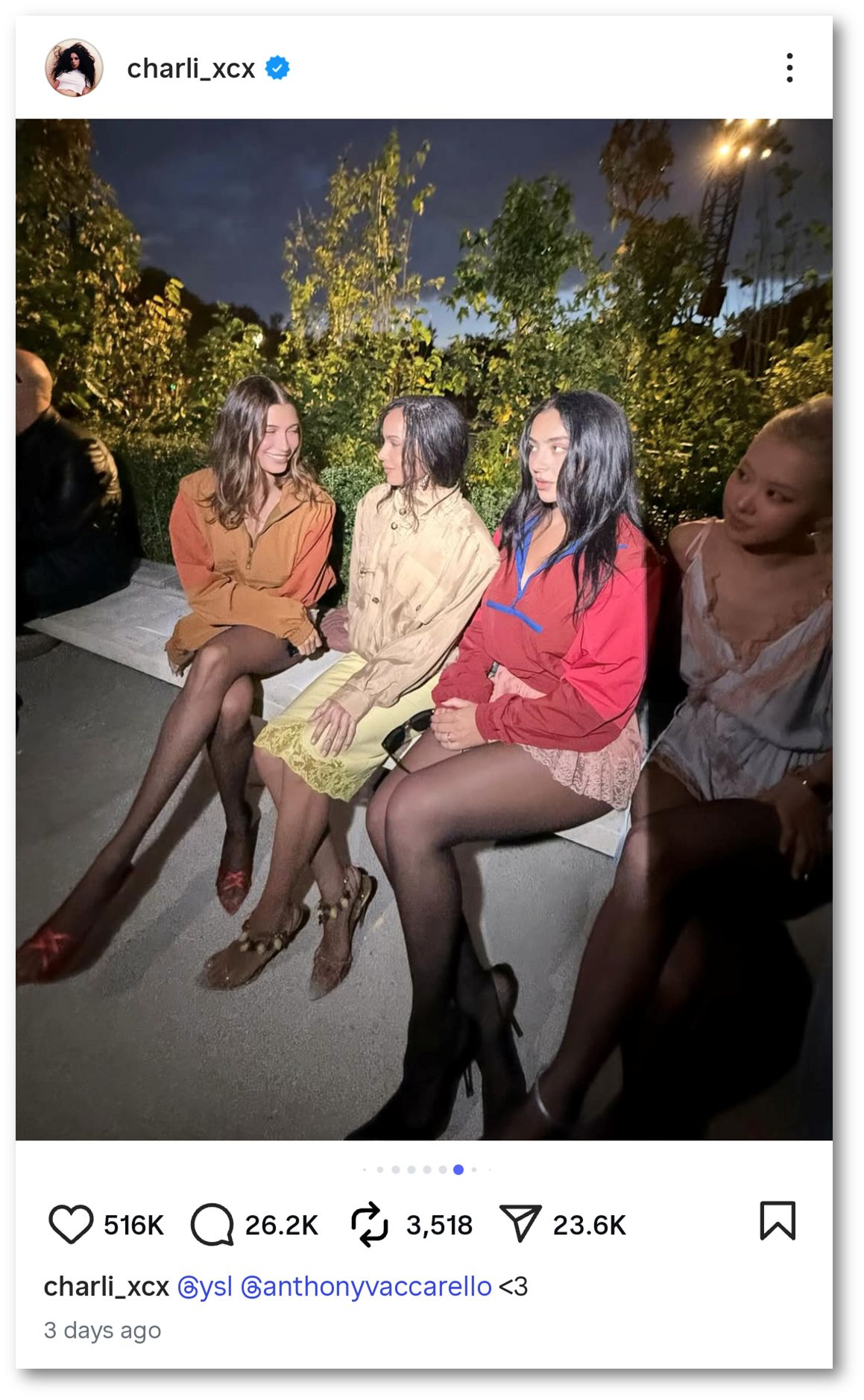
Charlie XCX’s IG post with an inexplicable darkened bar over Rosé. Screen shot: charli_xcx/Instagram
The suspicion of racial bias was further confirmed when another photo showing the four stars appeared, but this time, with Rosé and the vertical space she occupied unmistakably shaded, as if to dim her visibility. It appeared in Charli XCX’s Instagram photo dump, also from the Saint Laurent show. In one of the nine images, the foursome were seated in the same sequence as in Elle UK’s post, and Rosé was again on the right side, but this time, a very distinctive, darken, vertical bar was placed over her, possibly a deliberate vignetting, except that it was not a soft blur towards the periphery. It showed a very discernable hard edge, separating her and the rest. The visual effect was a pointed obliteration of the subject, creating an immediate, uneasy suggestion that this was more than mere coincidence.
In a climate where Western cultural dominance often asserts itself—especially in the US, following the xenophobic political rhetoric of the Trump administration—this incident reaffirmed a painful truth: Asian talent, even standing shoulder-to-shoulder with Western stars, can still be routinely looked down upon, ignored, or simply cropped out. This persistence of Western-centric editorial standards and social media bent prove that no amount of global success can shield an Asian celebrity from being seen as less important than their Western counterparts. Charli XCX’s post added a layer of bitter irony, too. The British pop star is biracial (half-Gujarati). Her sidelining of an East Asian peer only spotlighted the reality and the internalizing of the bias. The fight for Rosé’s place within the frame is, ultimately, the battle for Asian dignity in the global spotlight.
 Style on the Dot