The former Versace designer has totally skipped Dario Vitale’s first collection for a bouse that still bears her family name, which, in reality, is now a brand, not a bloodline
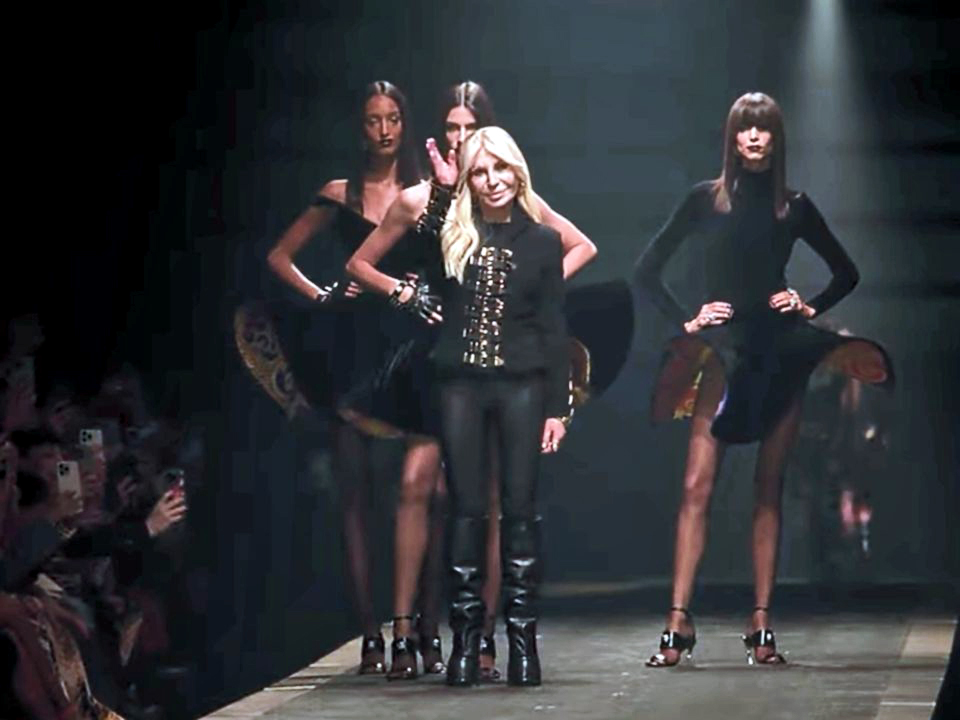
Donatella Versace (centre) at her final collection for the house her brother founded. Screen shot: versace/YouTube
The spectacle of Dario Vitale’s debut collection for Versace was very soon eclipsed by one glaring fact: Donatella Versace was MIA. Her absence has prompted at least one report to describe it as a result of the “Vitale-Versace politics”, hinting at a possible friction from the shift in creative power and the brand’s dramatically changed identity, as well as the ideological tensions it might have sparked. She was in Milan, but apparently with Anna Wintour, reported to be her good friend. Ms Versace’s no-show at the first non-family creative director’s collection is seen as a symbolic commentary on the new phase of the brand. Or, as we see it, an official mic drop on the previous era. Mr Vitale’s raw, imperfect, borderline geeky collection appeared to obliterate her 28-year legacy of polished, unapologetic high-glamour. But the one who stops talking first may not be the one who’s lost.
In March this year, it was officially announced that Donatella Versace was stepping down from her role as chief creative officer after nearly 30 years, and would assume the new position of chief brand ambassador, a seemingly non-executive, non-creative role. Since then, speculation has been rife that the stepping down was, in fact, a kick out. The sale of Versace to Prada Group has been agreed upon, but the final closing is in the works and will reportedly be done in mid-October, subject to the usual closing conditions and regulatory approvals. But even before that happens, the Prada Group was quick to reboot Versace, so rapidly that the pace made fast fashion look stationary. This has led to the suspicion that dropping Ms Versace from the creative equation was a strategic move. Some reports linked the creative leadership change to a broader strategy by Capri to potentially sell the brand, with then rumours of talks with the Prada Group. We even heard that her change of role was a non-negotiable condition related to the sale.
The Prada Group was quick to reboot Versace, so rapidly that the pace made fast fashion look stationary
Donatella Versace’s absence from the show brings to mind Yves Saint Laurent’s own non-attendance at the debut presentaion of Tom Ford’s Saint Laurent Rive Gauche ready-to-wear line in 2000. YSL had already retired from the ready-to-wear side, but remained in charge of haute couture for a brief time before retiring completely. Crucially, he made no secret of his utter disdain for Mr Ford’s work, which he found too commercial and overtly sexual—a “betrayal” of his sophisticated legacy. Mr Ford later revealed he received a letter from Mr Saint Laurent stating the former had “destroyed 40 years of [his] life’s work in 13 minutes”. Similarly, while Ms Versace claimed she was supportive of the new era and “championing young designers”, her absence strongly suggests a deep discomfort with the transition and the loss of creative control.
Days after what was touted as an “intimate event”, which took place in Milan’s oldest museum, the Pinacoteca Ambrosiana, Mr Vitale’s collection was equally adored and declared a hate crime. Many who are old enough quickly sussed out the inspiration to be from the very first Versace show in 1978, but the looks were muddled for an audience who demands maximal content in minimal duration. For us, it was the spring/summer 1981 collection—later immortalised by Richard Avedon’s season campaign that pioneered the popular use of up to five supermodels in one image—that first drew us to Gianni Versace. The collection marked a clear step away from his earlier, more conservative beginnings and towards a more body-celebrating aesthetic.
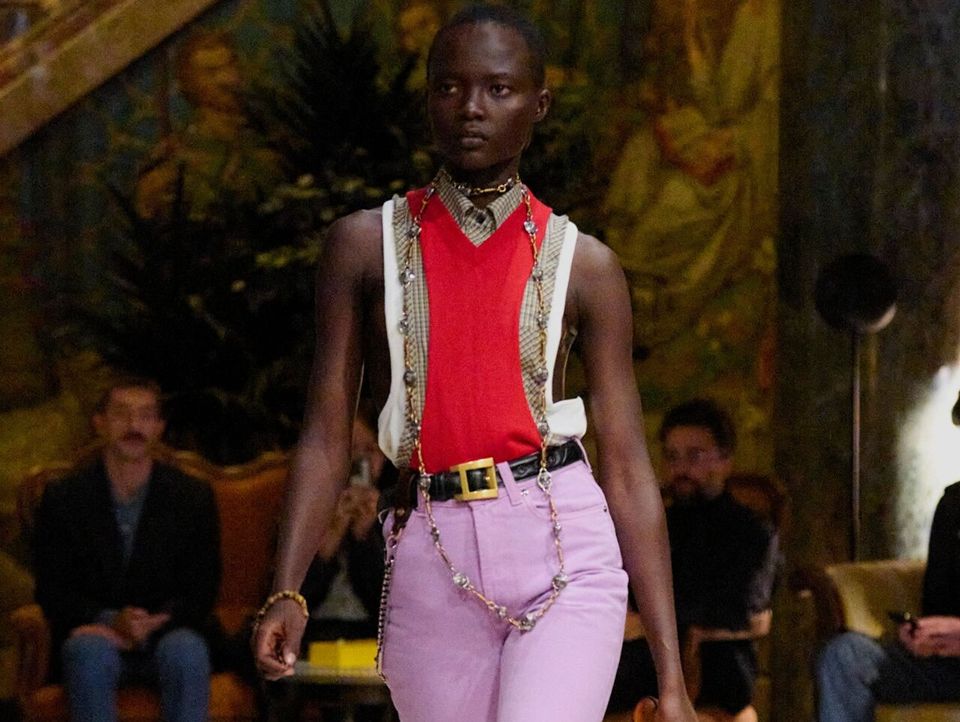
A look from Dario Vitale’s spring/summer 2026 collection for Versace. Photo: Versace
We remember clearly those Richard Avedon photos that featured Kim Alexis, Kelly LeBrock, Lisa Taylor, Beverly Johnson, and Rosie Vela, all togged in olive silk jersey separates that featured a leather palm leaf edged in gilt thread for the neckline. It was not the visual brashness that most today associate with the brand. This was before Mr Versace decided to go for high-octane glamour that led to the George Michael, supermodels-galore Freedom! ’90 music video. It, in turn, inspired the designer to create the iconic moment for his Fall 1991 runway show, where he had those same models, Naomi Campbell, Linda Evangelista, Christy Turlington, Cindy Crawford, brandish that aggressive sexy-glamour the brand was charging ahead with.
The visible result of the corporate un-sequel is, to us, best described as the Miu Miu-ification of Versace. Fresh from his role defining the intellectual, deliberately awkward, ‘cool girl’ aesthetic at Prada’s sister-brand, Mr Vitale did not put himself through a decompression chamber before working on Versace. We had thought he would balance Donatella Versace’s legacy with his own vision, and potentially navigate a creative direction that satisfies the new corporate structure and existing Versace custoers. But he did not. Out went the glossy, bombshell, Amazonian glamour; in came a new, almost aggressive kind of realism that re-contextualized the early Gianni Versace archives, opting to highlight unflattering high-waisted denim jeans and their lumpy crotches; the barely tanks tops; and slouchy power-suiting. This seemed to us that he wanted to be seen as a successor to Gianni Versace, not his little sister.
Out went the glossy, bombshell, Amazonian glamour”; in came a new, almost aggressive kind of realism that re-contextualized the early Gianni Versace archives
It is true that however legendary the past, designers resuscitating legacy maisons are increasingly declining most historical invitations. Ultimately, Versace is sold by the family. Their name remains, but the family doesn’t. Although the Versace name is still stitched into every garment, the soul of the house is being rewritten. This is the cold reality of luxury fashion in the 21st century: once the founders or the family sell, the financial owners call the creative shots. Donatella Versace’s new role as chief brand ambassador is really diplomatic and ceremonial. The real power now rests with the new chief creative officer, Dario Vitale, and ultimately, the executives at the Prada Group, the soon-to-be new owners. Her very public absence from the debut was a subtle, but clear signal that while her spirit is in the DNA of the brand, as she stated, her hand is no longer on the wheel. The Versaces have no more say, even if their former brand were to be the next Benetton.
The two events—Donatella Versace stepping down and Dario Vitale’s subsequent aesthetical actions—perfectly align with the motivation behind the acquisition by the Prada Group. Buying Versace is largely strategic; Prada needed the brand to grow its smallish conglomerate, one that has been outpaced by its French rivals. Luxury today is a war of scale. By adding Versace to its albeit small stable, Prada can extend its robust supply chain, manufacturing capabilities, and retail operational expertise to a brand that needed that industrial platform. The cold, hard logic of the luxury business is that conglomerates thrive on scalability, not sentiment. Versace offers instant recognition, but, under Prada’s lens, it becomes a vessel for reinvention, not preservation. Prada doesn’t need Versace’s past. It needs its future. And Dario Vitale is the architect of that future—whether that’s promising, we don’t know yet.
 Style on the Dot