Gucci’s fashion film in place of a runway presentation focuses a satirical lens on the rich. But does it make the clothes look good?
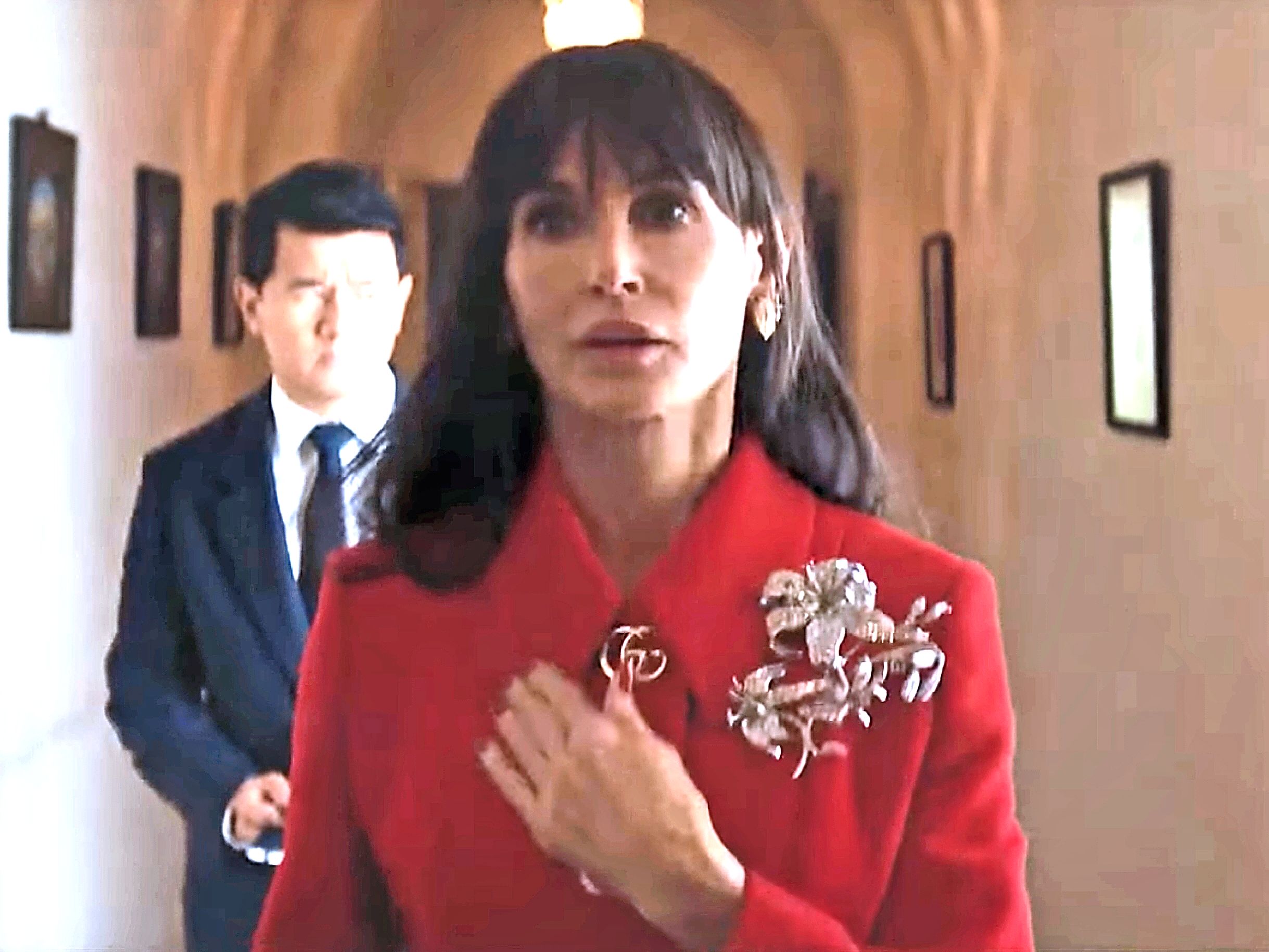
Demi Moore in The Tiger. Scrren shot: gucci/Facebook
In reintroducing Gucci’s identity under its new creative director, Demna Gvasalia, the brand chose a film, rather than a runway. Titled The Tiger, it premiered last night (this morning, our time) at Milan’s Palazzo Mezzanotte, which houses the Italian stock exchange. The procession before the main event—attendees arriving, some looking marooned, on the maroon carpet (or dark chocolate?)—was, in fact, the runway that Gucci did not stage. These are familiar tropes. At Balenciaga, Mr Gvasalia had employed similar ideas to communicate his unconventional approach to communicating the brand’s image. He used a film, too—the animated short, based on the TV series The Simpsons in 2021 for the aptly-themed spring 2022’s ‘Red Carpet Collection’. There, too, was a premier for that season, at the Théâtre du Châtelet, shown also during fashion week, that time in Paris. A year later, for the spring 2023 show, he staged it at a stock exchange too—New York’s. Mr Gvasalia was not doing anything startlingly new. His approach for Gucci is a near-perfect copy of the playbook that made him a phenomenon at Balenciaga.
As with the The Simpsons outing, his new, also-satirical film is similarly about a dysfunctional American family. And one that finally burst at the seams in a single evening, presumably, a universally understood motif. The characters of The Tiger appear to be those seen in the look-book photos that Gucci has shared—La Famiglia, the theme of Mr Demna’s debut Gucci collection. For those familiar with the turbulent and tragic history of the real Gucci family, the trenchant jokes write themselves. In the film, the matriarch of the family is a Gucci named Barbara. She is played by Demi Moore who looks like she has not left the set of The Substance—the film that had earned her an Oscar nomination for Best Actress, which she did not win. She still looks like Elisabeth Sparkle, the faded fitness guru in need of a quick fix to restore her sellable youth and sexiness. The film even included a bathroom scene in which she asked, bewildered, “What’s happening?”
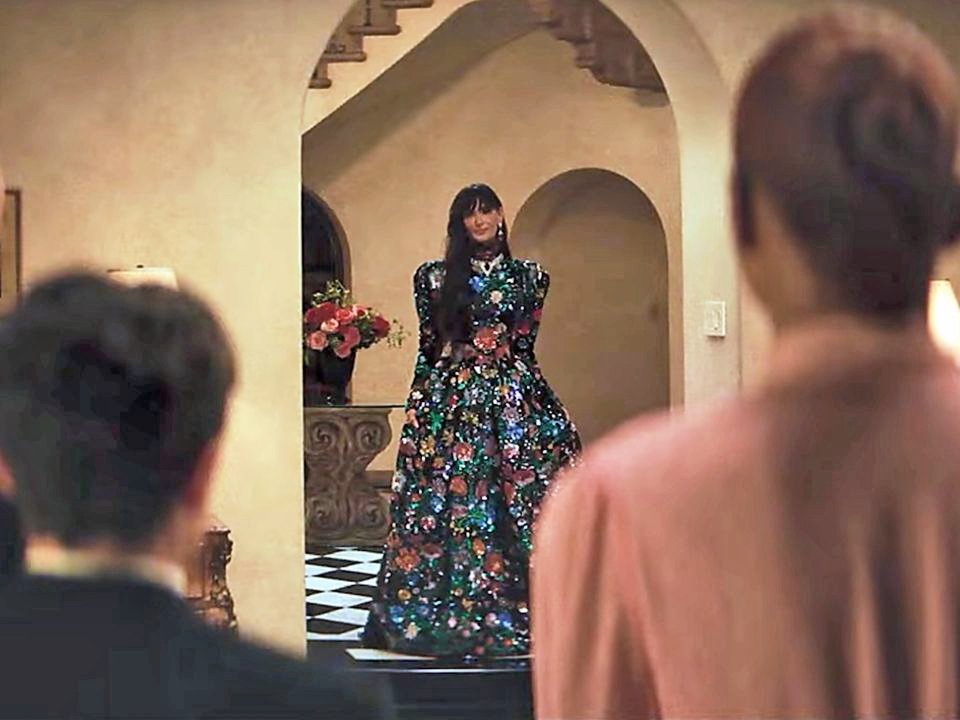
Ms Moore’s character dramatically appears to have dinner with her family. Screen shot: gucci/YouTube
What happens is not easy to explain without understanding the intent. This is not a film conceived to win the Best Director award, not even Best Costume. It won’t even earn a Rotten Tomato score. Although a straightforward telling is not expected, it is not an easy narrative, but a series of awkward and bizarre (in the America of today, perhaps not) vignettes. The wealthy family gathers for a dinner and is appropriately attired, everyone in Gucci, of course, as if the mother demanded it. The dinner soon turns into chaos, thanks, in no small part, to a “tincture”. The use of a chemical agent, again, reminds the viewer of the Substance itself. With the additive, it becomes even clearer that the characters do not connect. They explode in each other’s faces in the presence of a Vanity Fair journalist who is there to profile the mother. The film has the veneer of a narrative, but in reality, it is a series of choreographed moments/movements and poses, designed to unsettle and confuse the viewer.
It is hard to resist the thought that the clear, untinted “tincture” administered surreptitiously to the family is the metaphor for the unseen hand guiding the transformation of Gucci, Mr Gvasalia himself. Just as the potion forces the family’s true selves to the surface, the designer as the ‘truth serum’ strips away Gucci’s polished, even stale, image of perfection to reveal the flaws that Mr Gvasalia is often attracted to. The result is a seemingly unapologetic new identity, except that it is not quite. This is not the messy, raw, and authentic self that he has introduced to Balenciaga; this is something deceptively more polished, a catalytic element that forces a reaction, whether admiration or contempt, that hopefully shall transform the fortunes of a clearly ailing brand. The generational clash in the film that plays out emotionally—but not stylistically—is perhaps a dramatisation of Mr Demna’s belief that the brand needed to reject its staid legacy to move forward.
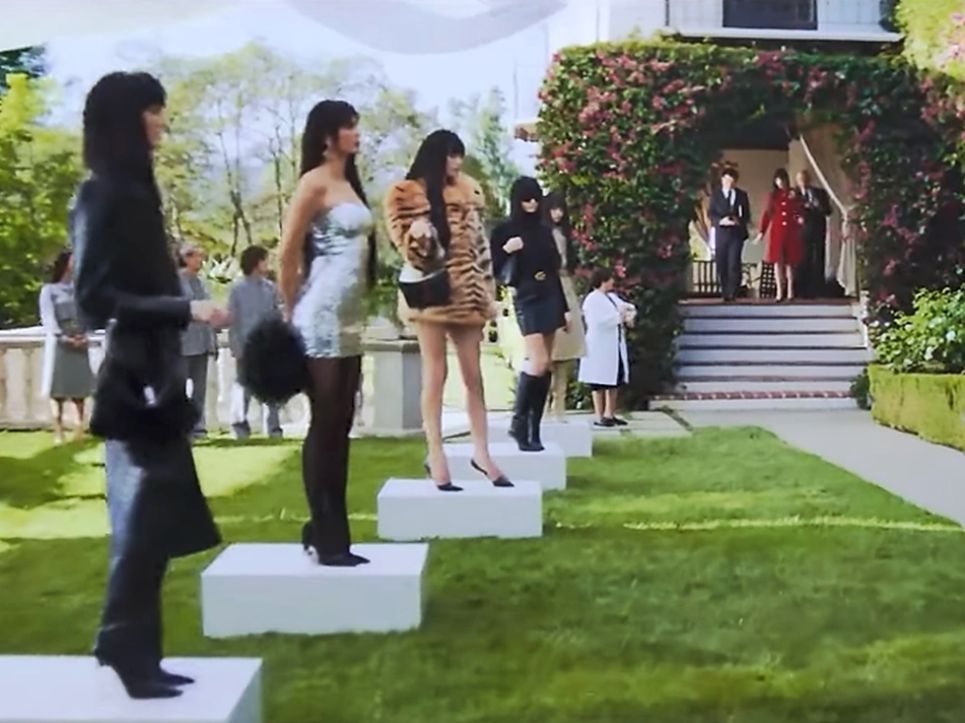
The film’s only fashion scene. Screen shot: gucci/YouTube
But it is still with Gucci’s legacy that Mr Gvasalia looked to the future with. The main collection itself pays tributes to Tom Ford, Frida Giannini, and Alessandro Michele. He did not ignore all of them before him, except, perhaps, Sabato de Sarno. Its purposeful inclusion of these references is the very point of the overhaul Gucci expects Mr Gvasalia to effect. It is an amalgam of familiarity, fabulousness, and fanfare. But ultimately, whether the clothes look as good as those in the images is best seen when worn on moving bodies. The Tiger provided glimpses of it. Although Demi Moore’s character changed thrice in the course of the dinner, they don’t say much except that she is more compulsive than a bride. It is curiously all-dressed-up to stay at home, primarily among themselves. The clothes looks alluring in the look-book photos, but in the film, on the characters, they are just costumes.
Oddly, there is only one scene that can be described as a fashion take. Barbara Gucci attends a “fitting”, in a front garden, with models curiously standing on a raised rectangular platform. She does not check the fit of each outfit, just makes superfluous comments about not liking a look that has “too much beige” (which is funnily self-effacing) or desiring “a different bag” for another. One of the towering girls, Alex Consani playing herself, speaks to Barbara Gucci uninvited, like a streetwalker: “Girl, I’m the young, hot, rich bitch”, in case the viewers do not know she is playing a character, an archetype. a bimbo. And another, Kendal Jenner, who also is playing herself. When asked how she likes the very abbreviated dress she has on, she replies: “I love it. It feels so good on my body.” Inane and glamorous go together.
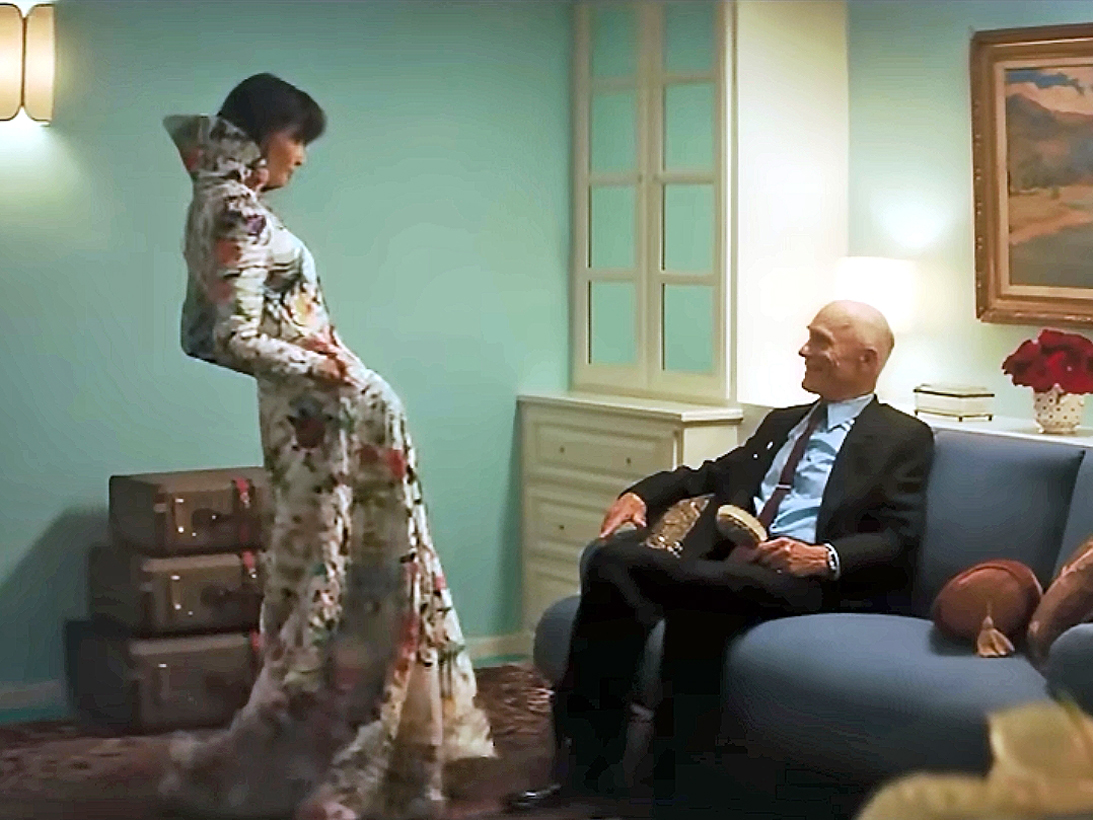
Showing off a dress to a reporter (played by Ed Harris). Screen shot: gucci/YouTube
Demi Moore has the privilege to wear the most clothes. The film opens to a Doechii song, but the scene itself is an old Hollywood staple: an heiress stricken with a mental breakdown… in a gold sequin dress. It ends with her in a more low-key gown—a bustier top and poufy skirt, looking barely a vestige of a fashion icon. For a film about fashion, with a central character who sits on top of a fashion empire, it is surprisingly lacking in many unforgettable fashion moments. Its message stands in sharp contrast with previous Gucci eras, especially under Tom Ford and Alessandro Michele, during which the brand’s power came from its ability to create hyper-glamorous, sensational moments. Mr Ford’s Gucci was defined by X-rated advertisements and sleek sensuality. Mr Michele’s was a maximalist, gender-fluid fantasy. These moments were designed to be instantly iconic and memorable.
Demna Gvasalia’s approach, however, is to deconstruct those ideas. He seems to now operate from a philosophy of less flash, offering an aesthetic that has been criricised online as “mundane”, “awkward”, or even “boring”. The unforgettable moment is not a beautiful gown, but the uncomfortable silence or the ironic, even fearful, glance. Could this be a critique of a society that has become jaded by endless spectacle? This is not for immediate enjoyment or gratification, as it would be in the case of what is seen on a traditional catwalk. The Tiger sells a concept, not clothes. The garments are not a focus of the action; they are a symbolic backdrop to the unraveling drama, except perhaps the conspicuous double G of the buttons on Barbara Gucci’s red coat and the earrings of her estranged daughter. It is hard to say if the high-concept, self-referential approach will actually succeed.
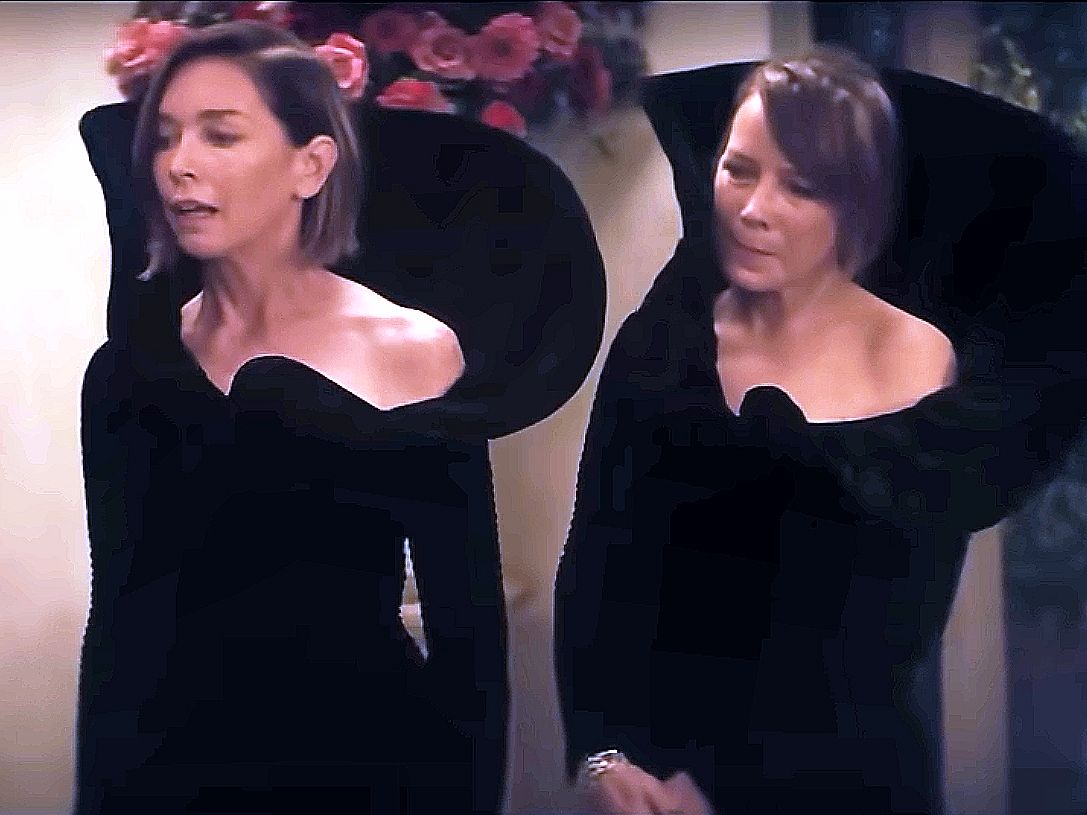
Probably the most striking dress in the film, worn by twin cousins who are fashion editors. Screen shot: gucci/YouTube
The tiger of the film, although unseen, is itself a multi-layered symbol with deep significance for Gucci, acting as a bridge between its past and future. The most direct connection is to an archival design from the late 1960s created by Italian artist Vittorio Accornero, who also designed the signature Flora print. This original design featured a tiger in a colorful jungle setting, and its present meaning is likely a strategic mix of heritage and new direction. In the film, Edward Norton plays Demi Moore’s son Colin, and he asks her what she would do if she were in a room with a tiger. As she struggles to give him a satisfying answer, he says coolly to her, “Don’t try to fight it off; don’t try to negotiate with it, like you always do. Just let it devour you completely”. It is tempting to consider that Gucci, under Mr Gvasalia, is the tiger and we should let the brand devour us, too. Totally.
One of the key characters in the film is the sardonic writer for Vanity Fair, Harlan Whitman, played convincingly by Ed Harris. In an odd moment of tenderness, even weakness, Barbara Gucci tells him softly over the dinner table: “I have this constant urge to be perfect, look perfect, wear the perfect clothes.” Is this, in fact, Demna Gvasalia speaking? But what the writer witnesses is quite the opposite. As the family unravels before him, he decided he has had enough. The story before him is not what he is hoping to convey. He tells the nerve-wrecked heiress straight in her face: “This is chaos. Your family is chaos… The way you behave, just so desperate. Just so desperate.” Perhaps, Gucci is, too.
 Style on the Dot