The recent Charlie Kirk memorial played to the gallery and the audience lapped it up. And the real star was the white-hot wife-in-mourning
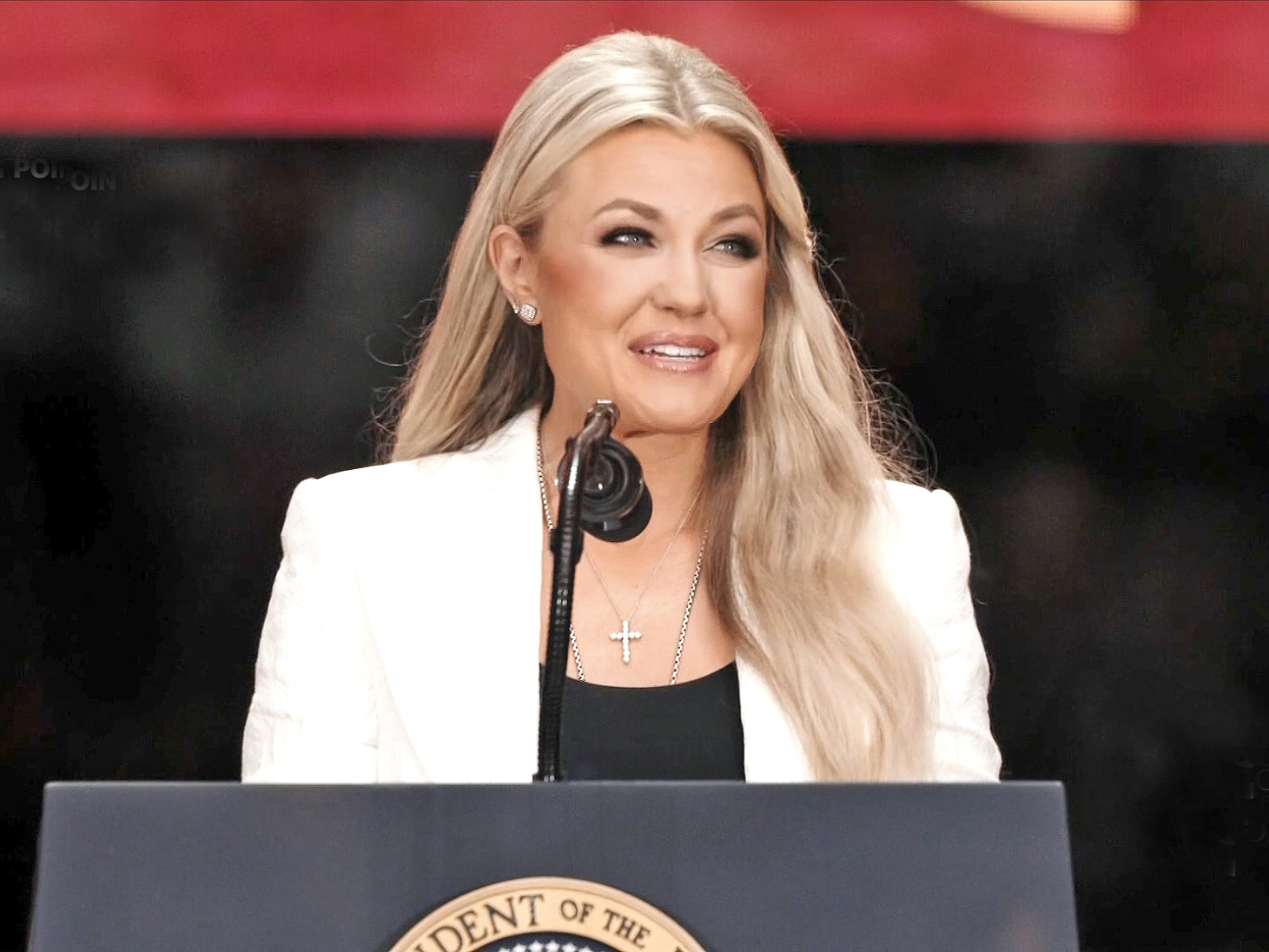
Erika Kirk delivering her eulogy. Screen shot: CNN
She arrived ready to let it slide. And then out it came: “That man, that young man—I forgive him. I forgive him because it was what Christ did, and it is what Charlie would do.” Although Erika Kirk did not mention the “young man” by name, it was clear that she was referring to the alleged killer of her husband, Tyler Robinson, now incarcerated. As many watched her grieving so publicly, and dramatically, at the State Farm Stadium in Glendale, Arizona, whether in person and online, it was certain she was the star of the event. Mrs Kirk’s eulogy was not just a personal moment of extreme grief; it was a public performance with significant political and cultural implications. It was put together to be remembered.
The eulogy was, unsurprisingly, well prepared. She did not just wing it; she was familiar with the rhetorical devices at her disposal. What was striking was her repeating “forgive” five times. Apart from the sentence quoted above, she also said, “On the cross, our savior said, ‘Father, forgive them, for they not know what they do.’ That man, that young man, I forgive him. I forgive him because it was what Christ did and it is what Charlie would do.” In the Bible, the number five is widely considered to be a symbol of God’s grace, goodness, and favor towards humanity: there is the the Pentateuch: the first five books of the old testament, and in the new testament, the five bleeding wounds of Jesus Christ during the crucifixion, the miracle of Jesus feeding the 5,000 with five loaves of bread (and two fish), and others. The appearance of five was not incidental.
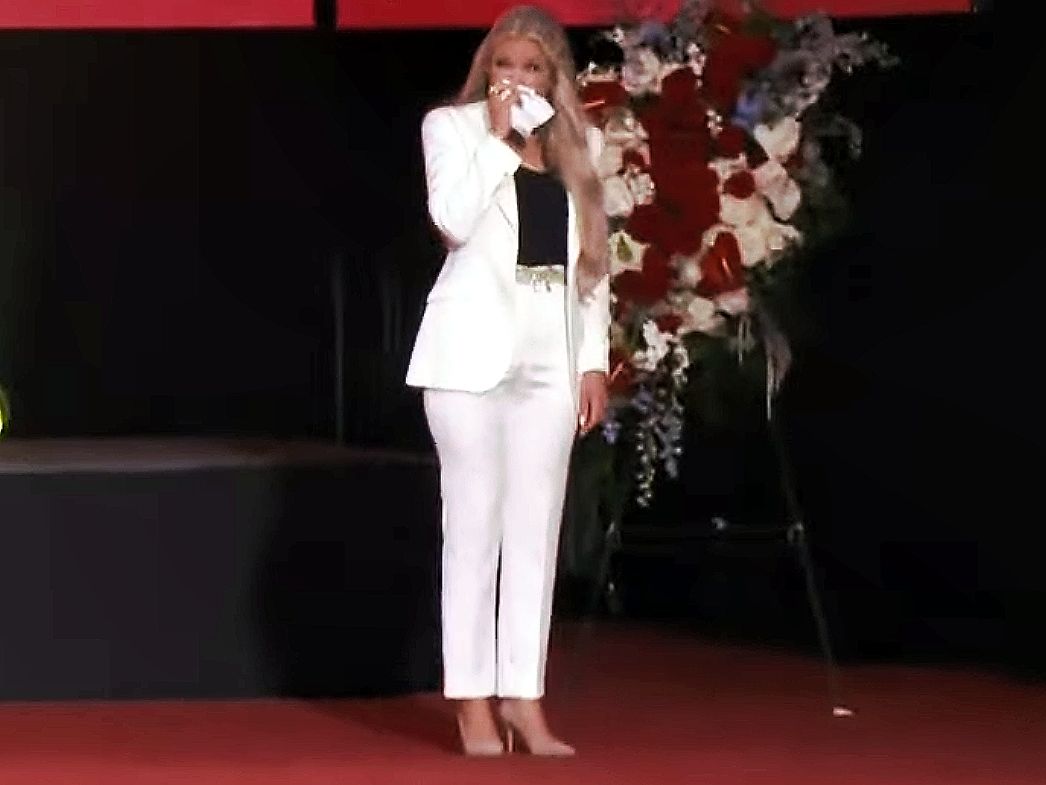
Mrs Kirk, wiping her tears, as she took in the adoration. Screen shot: Sky News
And she deliberately placed two names in one sentence: Christ and Charlie, and repeated the paring twice. This was not spontaneous either. While they have different pronunciations, the similar phonetic structure and alliteration—‘Chr’, a ‘k’ sound as in christmas, and ‘Ch’, a ch’ sound, as in church—subtly link the two figures in the listener’s mind. This is a subtle form of wordplay, using the visual similarity of the names on paper and the close sonic relationship in speech to build the aural and conceptual connection she was establishing. The effect was to suggest that the actions of the two—and their very being—are a reflection of one another, reinforcing the idea that Charlie Kirk’s life and death were a Christian martyrdom.
Such preparedness, including the highly absorbent white hankie’s cameo, potentially undermines the authenticity of the moment, suggesting it was crafted more for a political purpose than as a spontaneous expression of grief. This is not to say Mrs Kirk was not grieving, but between her tearing and smiling, her well-prepared eulogy was a strategic choice to convey a specific message to an audience expecting to see a memorable performance, rather than merely a raw outpouring of emotion. She was not putting on an act of inauthenticity, but it was a deliberate choice to use her personal grief to serve a larger political and cultural part. It was also a launching pad for the next phase of Turning Point USA, the organization her husband founded that advocates for conservative politics. She is reported to take his place as CEO.

Donald Trump embracing Erika Kirk who seemed comforted by his presence. Screen shot: Sky News
Part religious revival, part political rally, part feminist messaging, Mrs Kirk’s rendition on the stage reached out to a stadium crowd of some 100,000 people, according to the American media. She appeared the professional that her new CEO role would require her to be. Over a black, low-cut, tank top, she wore a suit of angelic white, not considered a colour of morning that traditional black is. More fascinating was the sparkly belt, a glamorous counterpoint to such a solemn event. Her white suit reportedly aligned with the memorial’s dress code, which was the colours of the American flag, planned to create a patriotic, political-rally-like atmosphere. Or perhaps it symbolised a clean slate, and a new beginning for her and the polarising movement she now leads.
Her pedantically styled appearance, from her hair to her makeup and clothing, was a visual alignment with what easily identified as the “MAGA aesthetic” or the conservative ideal of feminine beauty. This is characterised by the obvious foundation, over-rouged cheeks and the smokey eyes, as well as blonde hair cascading down naturally. In sum, a political statement in itself, signifying an embrace of traditional gender roles and a rejection of more progressive or “gender-fluid” styles. Mrs Kirk’s perfectly calibrated complexion is evocative of Karoline Leavitt’s. The White House press secretary’s makeup choices have been widely discussed to be a key part of her public image. Erika Kirk’s similar aesthetic placed her in this same visual and political category. Together with her emotional rhetoric, it signalled to her audience that she was not just a grieving widow, but a powerful, capable next-Charlie Kirk, even a more forgiving one.
 Style on the Dot