American tennis player Taylor Townsend met a dish of dead, skinned, and cooked frogs with pure revulsion. And she let the world knew. The blowback came as rapidly as her backhand

Taylor Townsend in bed and she filmed herself. Screen shot: tay_taytownsend/Instagram
It was a Fear Factor moment: the guileless American getting acquainted with some of the best delicacies of China, such as century eggs (皮蛋, pidan). This time, it did not take place in Florida, but the Chinese city of Shenzhen (深圳). And the incident, not a filming, involved the American tennis player (even U.S. news outlets such as CNN resist calling her a ‘star’) in China’s south being offered what she considered “the craziest thing[s] I’ve ever seen”. It was, for different reasons, evocative of the Dolce & Gabbana ad of 1018 that truly irked a nation. We know that when it comes to food, the craziest can be, and is, often the most delectable, such as the turtle, frog, and sea cucumber that Ms Townsend had the good fortune to be served with. These are not cheap food; they are considered by many of us to be good food. But she, on the other hand, believes the craziest are not comestible. They were a crime against cuisine.
And so, being an “authentic”, she took to Instagram Story—in a now-deleted post—to express her utter revulsion. She shared it two days ago, while she was in Shenzhen to compete in the Billie Jean King Cup. The second American woman after Melania Trump to make the news while overseas, Ms Townsend appeared to be spread on her hotel bed. She wore what could be a pyjama top, with the collar fashioned from the underside of the patterned fabric. There were coils of necklaces on a neck, a bedtime requirement that Meghan Markle probably shares. With her right arm above her head, she spoke while chewing something, audibly. It was multi-tasking her parents would not approve, but her fans and IG followers would find bursting with authenticity.
These are not cheap food; they are considered by many of us to be good food. But she, on the other hand, believes the craziest are not comestible. They were a crime against cuisine
She went on to describe, with something still in her mouth, her meal time in Shenzhen and her disgusting encounter with those questionable foods, “and people eating this”, giving a look that could curdle soya milk. It was not so much the repugnance that was unacceptable to so many in China and across the Chinese diaspora. Ms Townsend had emphasised “these people”—there is no ambiguity in who she was referring to while she slept on the China-made bed, mattress, and sheets. After JD Vance’s referring to the Chinese as “peasants”, Ms Townsend appeared to be another American with a calculated slight. No one is saying she couldn’t be put off by food she found disagreeable, but by framing the distaste as their gastronomic aberration, she was ardently championing her own ignorance and, in one fell swoop, insulted a nation.
Unsurprisingly, “these people”, a popular phrase among the conservatives of the U.S., triggered a backlash. She drew a clear line in the stew that disgusted her, separating herself and her culture/cuisine from her host’s. It was a subtle, yet powerful, act of ‘othering’—an easy reduction of an entire nation’s rich culinary tradition to a bizarre and alien practice. It is hard to know if this is inherent unknowingness (as her fans seem to suggest) or wilful blindness. But, the irony is especially delectable in view of the offence she took during the U.S. Open when, in a heated moment, her Latvian opponent Jelana Ostapenko told Ms Townsend that the American has “no education”. Perhaps Ms Ostapenko was not wrong? Even more exquisite is another irony: She was representing the United States as part of the U.S. team sent to foster international goodwill, yet her behavior was another example of the guest disrespecting her host.
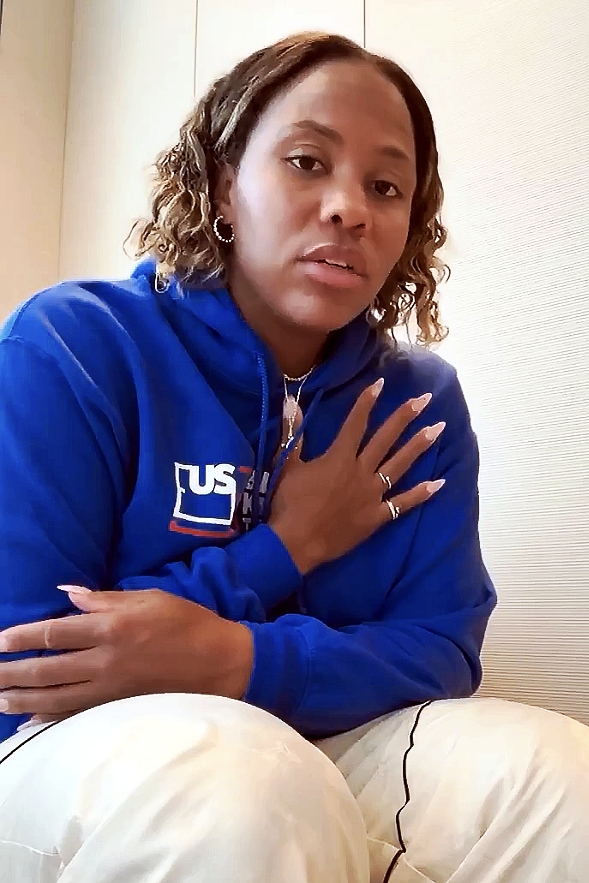
Ms Townsend in an ‘apology’ video minus the sleepwear. Screen shot: tay_taytownsend/Instagram
Ms Townsend’s no-filter flair reflects a larger American social and political climate of shoot-your-mouth-off as you please, even when abroad. It’s the brand of freedom of speech that the late Charlie Kirk promoted with total relish, for which led to his fatal shooting. This is not just a simple personal blunder, but a symptom of a much larger American cultural trend, where unfiltered authenticity is preferred to traditional decorum. We are seeing it—how “think before you speak” has become “don’t bother”. The filter button is permanently switched off since it is, in effect, uninstalled. There is utter disregard for shared humanity. Or, as Mr Kirk once said with pride, “I can’t stand the word empathy, actually. I think empathy is a made-up, new age term that does a lot of damage.” If empathy is a work of the imagination, it’s the most useful fiction ever conceived.
Facing a severe backlash, she posted a perfectly choreographed apology and feigned contrition on IG Story. Now, she was sitting on a chair, dressed in athletic gear, and not masticating, She said she was “sincerely sorry from the bottom of my heart”. But a truly contrite heart never has to announce its own sincerity. Especially striking about the post was the lack of specificity: She apologised for her comments without specifically acknowledging the food she denigrated or the attendant cultural insensitivity, or her use of potentially offensive language. She was called out, so she apologised, but it appeared more an attempt to walk back that behavior, rather than a change in attitude. Ms Townsend has said on The Pivot podcast: “I got to the point where I was like, I don’t need no friends… I have a warrior spirit, I love being out there, like me versus you.” Although she was referring to the on-court dispute with Ms Ostapenko, it could be the creed by which she lives.

In Shenzhen during the Billie Jean King Cup tournament. Screen shot: tay_taytownsend/Instagram
The final irony of Ms. Townsend’s story is a commercial one: a star who built her brand on rejecting tradition has found that traditional brands have, in turn, rejected her. She has publicly stated that she struggled to attract a clothing sponsor, but did not say why. Some feel that her problematic public persona or her disagreements with the USTA early in her career may have impacted her appeal among the big sporting brands although, to be certain, she is sponsored by Yonex for her racquets and equipment. In response to the lack of the likes of Nike knocking on her door, Ms Townsend took matters into her own hands by creating her own clothing line, branded with her ‘TT’ logo. This has been seen as a strategic and empowering move, with her wearing her own apparel at major tournaments like the French Open and the recent U.S. Open. The line has since become available for public purchase, fulfilling her stated goal: to “get my logo out there and people being able to see me branded”.
The spotlight on her brand, however, has shifted, and not with a ringing endorsement. Just as Ms Townsend’s absence of a social filter has tarnished her name, so too has a broader, no-filter rhetoric stained the American brand on the world stage. Recent polls show a significant decline in global favourability towards the U.S. In many countries, more people are no longer ardent believers in American virtues. In fact, some of the data shows that the U.S. image as a “positive influence” has fallen, and in some cases, China is now seen as a more positive force. Taylor Townsend’s off-court behaviour in Shenzhen offered another export of the kind of deplorable attitude very much associated with America today. Brand America and American brands have become indistinct. The world has finally taken a hint: the same disdain we saw in a tennis player is, in fact, a feature of America’s brand, not a removable bug.
 Style on the Dot