They came dressed to kill, but as usual, misread the metaphor

Ebony and ivory: Tate McRae (left) and Lady Gaga
The 2025 MTV Music Video Awards (MVAs) served as a unique but often chaotic incubator of innovation, where celebrity style exists on a spectrum from genius audacity to outright confusion. And this year’s action on the red carpet was expectedly a study in contrast. There was the very covered and the very not, a visual tug-of-war between maximalist concealment and minimalist exposure. From Lady Gaga completely smothered in a gothic, ruffled number by Marc Jacobs to Tate McRae in close-to-nudity dress by Ludovic de Saint Sernin. Both stars were as different as day and night, quite literally. And for the rest, everything between. Unlike the polished elegance of the Oscars or the “carefully” curated avant-garde of the Met Gala, the VMAs celebrate the unbridled with creative abandon, making it a crucial barometer for the evolving relationship between an artist’s persona and their public image.
While Lady Gaga wore New York’s most important designer’s hyperbole of a frock, it was Doja Cat, a master of self-referential performance, who was crowned by the media as the best-dressed. In a harlequin-patterned mini-dress, she appeared to be channelling Dolly Parton (so did Ice Spice!), but through Jeremy Scott, except that her bust-revealing dress was, in fact, by Balmain. The ensemble subverted traditional red carpet glamour (or, on the extreme end, trashiness) by embracing a theatrical, even cartoonish aesthetic that is synonymous with Mr Scott, especially when he was at Moschino. The towering butter-yellow platforms and an edible lipstick (which she proceeded to chomp on) were deliberate, clearly jarring accessories that amplified the ensemble’s absurd playfulness. It was definitely camp, a look that could have been borrowed from the wardrobe mistress of RuPaul’s Drag Race.

Doja Cat taking a bit of her lipstick
In contrast, other artists attempted lofty gestures that fell short. The tension between risk and reward was particularly evident in looks that avoided a discernible narrative. Sabrina Carpenter is a winning example of the night. She wore the obligatory ‘naked dress’ by Valentino made with nude stretch-tulle, on which beaded corded lace were strategically placed to obscure (but not entirely) her privates. She clashed all that blood-red open work with a lavender feather boa which was described as a clever “calculated clash”. This was not Mae West as her younger self; it was unthinking bordello-brash. The styling seemed to hint at a more rebellious direction for Ms Carpenter, yet the overall effect was a struggle between two competing aesthetics—Old Hollywood glamour and a punk-pop-princess eccentricity—that never fully resolved.
It was a banner night for Rosé from Blackpink, hot on the heels of the launch of her Puma collab. Last year’s tune that kept playing in our heads for the whole month of October, APT, won her the ‘Song of the Year’, a first for a K-pop artiste. And she turned up on the red carpet and went on stage to receive her ‘Moon Person’ in a pale yellow Oscar de la Renta bustier-dress with a fringed bottom half that shimmered on stage like a sea of fire flies. While her performance looks are often defined by a bold, rock-and-roll edge, her current red carpet choice showed that even a K-pop star can offer a compelling case for understated glamour. Unlike group mate, and fashion’s favourite flavour, Lisa, who prefers the meretricious excess of showy silhouettes, Rosé affirmed that a tasteful and refined choice can make just as powerful a statement as theatrical excess or see-through sensation.
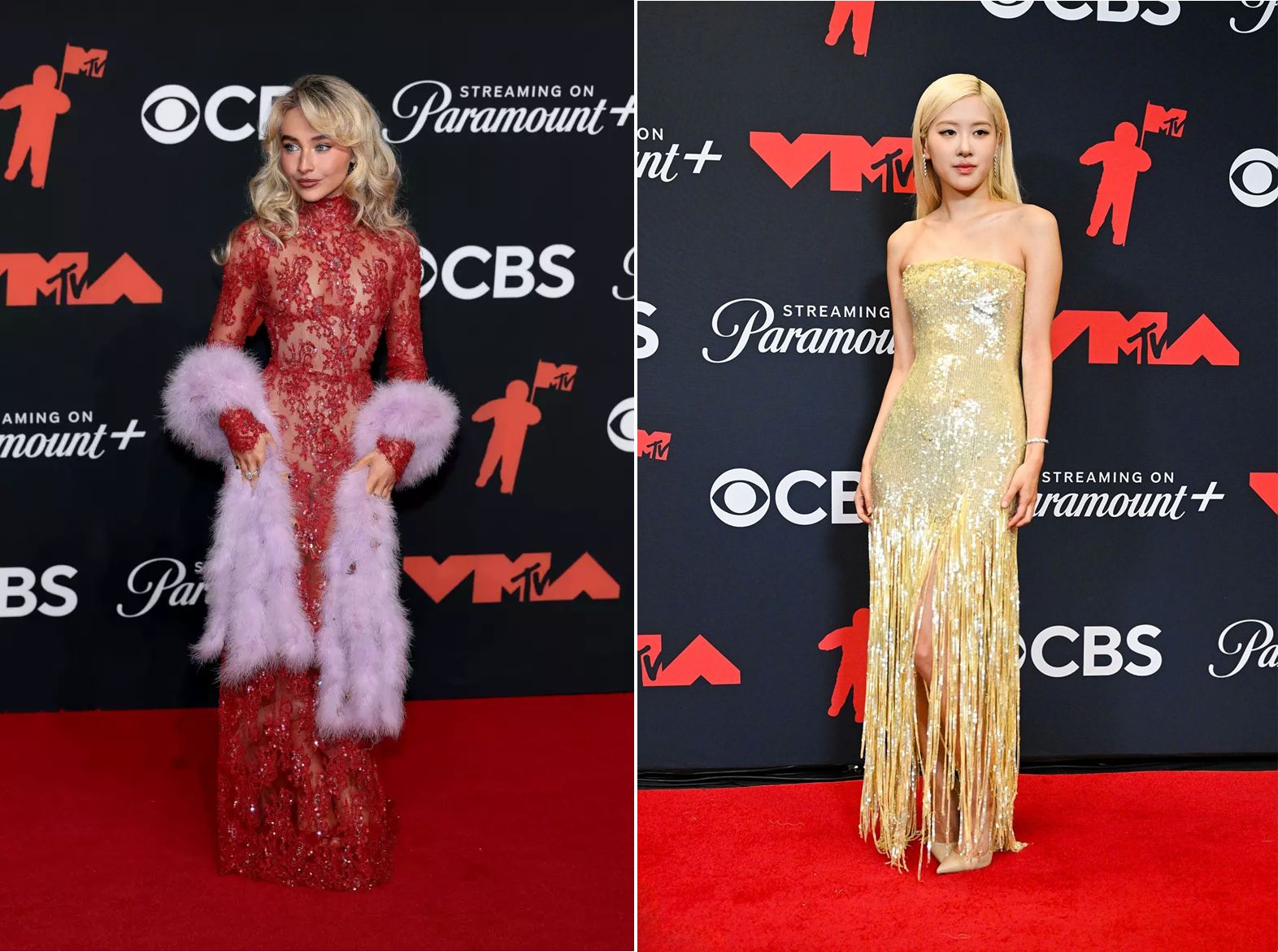
Shimmer versus shimmer: Sabrina Carpenter (left) and Rosé

Just clowning around? Meg Stalter (left) and Conana Gray
Every red carpet has its share of clowns, and this year’s VMAs delivered on that front with Meg Stalter and Conan Gray. Ms Stalter, known for her offbeat persona, showed up as a nurse in an oversized ensemble with a rhinestone-studded Dunkin’ cup—a look that was less about fashion than her as a walking, talking sight gag. Meanwhile, Conan Gray took the nautical theme of his new album, Wishbone, to show what the tide dragged in: a full-length gown by Erik Charlotte complete with puff sleeves, a corseted bodice, ruffled hem that could not decided whether it was sailor or pirate-inspired. Whether their outfits were ridiculed or talked-about, these performers understood that at the VMAs, the line between fashion icon and village clown is a thin one, and that a willingness to be the latter may ironically make one the former.
Ultimately, the red carpet of the VMAs is an extreme and frequently absurd reflection of our culture’s relationship with celebrity. It is a place where the rules are deliberately broken, where a sad excuse for a dress can be a lauded costume, and where success isn’t measured in elegance (no matter how it is redefined), but in headlines. When a look is designed for spotlight-loving appetites, it’s a fleeting spectacle, but when it becomes a deliberate act of compelling communication, it turns into something more: a piece of an artiste’s cultural legacy. The event that Vogue calls “the red carpet home of the brave ” affirmed that for a generation of pop stars, making a statement is no longer about looking good, but about being memorable, regardless of the aesthetic, a quest to prove that in the cacophony of celebrity, the biggest risk is playing it soft—and safe.
Photos: Getty Images
 Style on the Dot