Chloe Malle is appointed the head of editorial content for American Vogue. Not quite a household name, Ms Malle has, nevertheless, secured fashion’s top job. However, she won’t be at the apex of the food chain, yet

American Vogue’s newest pick to head the magazine: Chloe Malle
Chloe Malle is officially the woman to take over Anna Wintour as the head of editorial content at American Vogue. This morning, one SOTD reader texted us with this message: “Crawl out from where, huh?” While her name may not jog most people’s memory, she did not slither forth from an obscure place. In fact, Ms Malle, until her current appointment, has been the editor of Vogue.com (she was the one who put Lauren Sánchez on the cover) and a co-host of The Run-Through with Vogue podcast. She joined the title in 2011 as a social editor and has held the role of contributing editor. That Ms Malle is an internal hire who has worked her way up at Vogue for over a decade suggests a desire for keeping the ship steady rather than a radical new vision. She is seen as an abiding hand who understands the clunky “Vogue machine”; she can, therefore, ensure a smooth transition while operating under Ms Wintour’s continued global benevolence.
While Ms Malle’s extensive experience provides her with a deep understanding of the Vogue DNA, culture, and operations, she is considered by many to be a fashion wildcard, whose personal style is still in beta. Ms Malle has openly admitted that fashion was not her “main interest in life” when she first joined Vogue, stating she was more interested in being a writer. Her work has appeared in The New York Times and The Wall Street Journal. She once described to The Independent her outfit for that first meeting with Ms Wintour with almost brutal honesty: “I wore black (you’re supposed to never wear black)… black tights and these black J. Crew suede booties, which were fine, but were sort of falling apart.” Her outfit included “very boring, short—not super short, but short-ish—Diane von Furstenberg collared dress with a gray and white striped blazer” and “this white-orange pashmina and this orange beaded bag that I thought were really cool”. She could not make it sound better than that in her own telling.
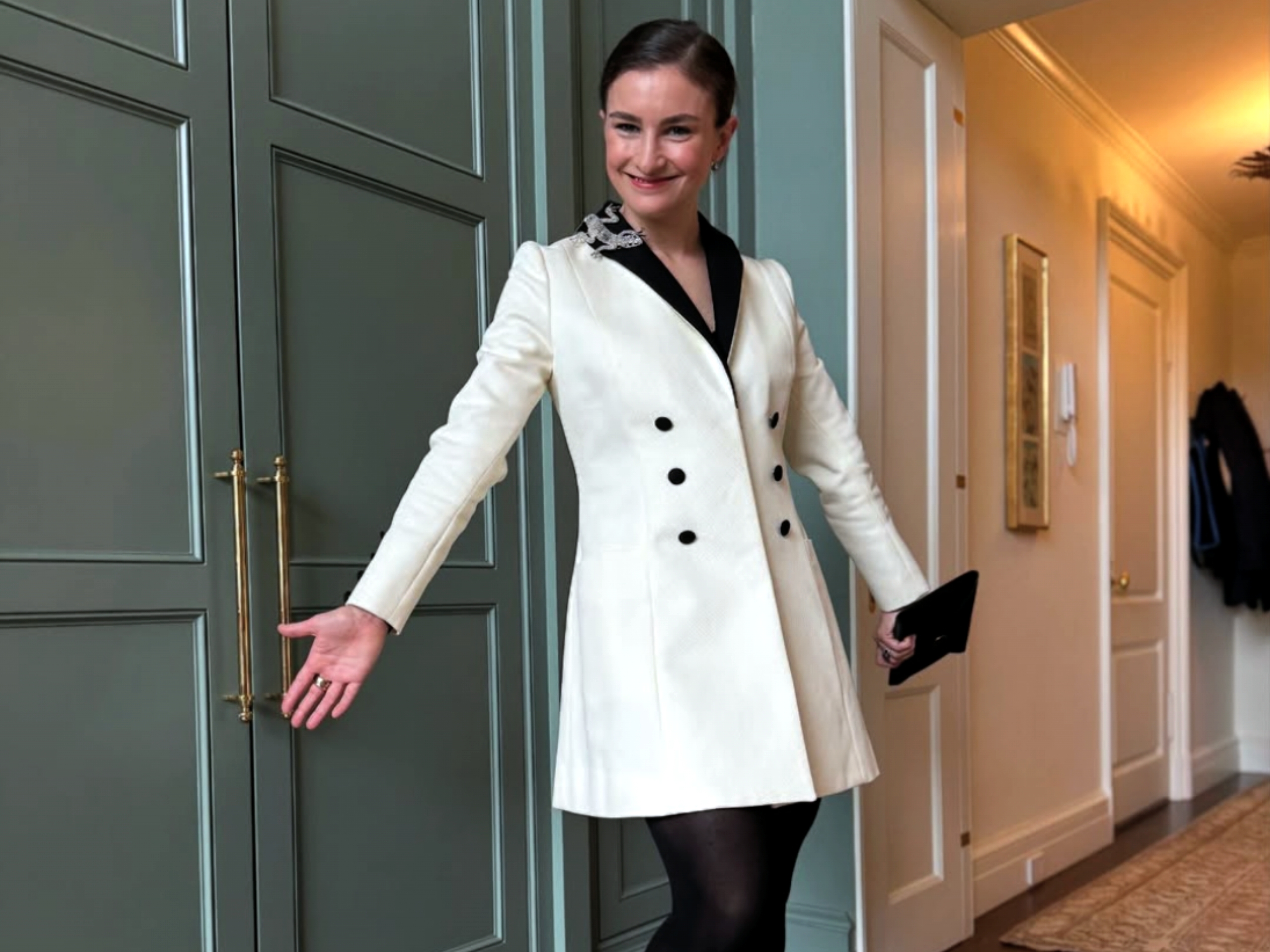
But she did not stay as the outsider who could ignore every trend that came tumbling down her way, claiming that she grew into a “fashion girl” through “osmosis”, a process that is undeniably slow. But finally adopting designer labels is not necessarily a sartorial conviction; it might simply be a uniform required by the job. The question that begs to be asked: Can a leader truly innovate and lead a “fashion bible” if their passion for the subject is an acquired taste, an “osmosis” rather than an innate drive?” If you look at her Instagram posts, Ms Malle still approaches fashion with trepidation. Her look is as vague as a politician’s promise, a tribute to undemanding, even for fashion’s Oscars, the Met Gala. Despite her best efforts, she pendulums between aunty-practical to promp-pretty, but is often stuck in stasis, showing no signs of moving forward. Her look, like her boss’s hair and shades, is in a state of contented permanence.
Fashion cred aside, there is also the question of her pedigree. Ms Malle has famous parents: her father is the late French film director Louis Malle and her mother is Murphy Brown herself, Candice Bergen. Her lineage has been a topic of discussion, with Netizens calling her a “nepo baby”, with some of the harsher critiques labeling her a “nepo hire”. Her long tenure and accomplishments at Vogue has become as crucial to her current appointment as her famous parents. The fashion industry at large, including Vogue, has long operated on networks of privilege and access. Vogue’s own colourful past is intertwined with the social elite. The magazine’s founder, Arthur Baldwin Turnure, in fact, created Vogue as a weekly high-society journal for New York City’s social elite. This tradition of catering to and recruiting from a privileged class has largely continued till today.

This question of pedigree is not new to Vogue, and it is particularly interesting when comparing Malle to her predecessor. Anna Wintour, too, came from a family with strong media background: Her father Charles Wintour, was the editor of the London Evening Standard and brother, Patrick, is also a prominent journalist. It was Wintour senior who helped her secure her first job as a shop girl at London’s legendary store, Biba, back in the Swinging Sixties. Most industry watchers thought that it was her connections in the journalism world that played a role in her early career, though her talent, ambition, and drive are widely recognised as the driving forces of her success. This stands in sharp contrast to Ms. Malle, a Brown University graduate who, by her own account, was hired for her writing talent and her understanding of the Vogue machine, not her fashion sensibilities. And unlike the new head of editorial content, Ms Wintour had forgone tertiary education, and her hiring in 1983 was based not just on her decisiveness and vision but, crucially, on her noticeable and distinctive style.
Before Chloe Malle was confirmed for the coveted job, media reports then suggested that Eva Chen, a prominent Chinese-American in the fashion and tech industries, was a strong candidate for the top leadership role at Vogue. Ms Chen was formerly with Teen Vogue and Elle, and was installed by Ms Wintour as the editor-in-chief of the now defunct Lucky magazine, making her the youngest editor-in-chief in Condé Nast’s history and the first Asian-American to hold such a title. She also held a prominent role as the director of fashion partnership at Instagram, making her an ideal representative of the digital, business savvy direction media is now embracing. Before Ms Chen came into the picture, it was Edward Enninful, the ex-editor-in-chief of British Vogue, who was widely praised for his transformative and inclusive vision. breaking down barriers by featuring diverse models and celebrities on his covers, with a focus on powerful social and political issues, all while maintaining the magazine’s fashion standards.

Both potential heirs’ chances went up in smoke when Ms Wintour decided to hire from within. Mr Enninful’s hope is at odds with American Vogue’s preference for female editors-in-chief, a tradition that began with Josephine Redding in 1892. Moreover, the narrative surrounding Enninful’s somewhat abrupt departure from British Vogue in March last year and his new role as a “global creative and cultural advisor” suggests a complex power dynamic. Reports and industry insiders indicate that Mr Enninful’s ambitions to eventually succeed Ms Wintour may have created a rift between them. Ms Chen probably did not hold her breath too, as she knew that Ms Wintour likely had in mind a white woman with an elite lineage for the top job. The decision to appoint Malle, a hire with a privileged background, over a candidate like Ms Chen or Mr Enninful is seen by some as a missed opportunity to truly modernize and diversify the highest ranks of the magazine.
Chloe Malle does not have the same built-in brand recognition as Anna Wintour in the fashion world, and he appointment reflects a choice for continuity and control rather than a dramatic shift. While some see her as a safe, insider pick—a nepo baby who fits the magazine’s traditional mold, others view her as a strategic choice with the digital acumen needed for the future, Ms Malle’s appointment is also viewed as a shrewd and strategic move on the part of her boss. By choosing someone from within her trusted circle who is not seen as an assertive rival for influence, especially on the style front, Ms Wintour ensures that her own power and legacy remain intact and ready for more. She has effectively created a system of “succession theater” where a new leader is installed to manage the day-to-day, but the real power and the final say still belong to the “Devil” who will remain in charge from her panoramic global perch.
Photos: chloemalle/Instagram
 Style on the Dot