The frying pan is judgy about the fire!
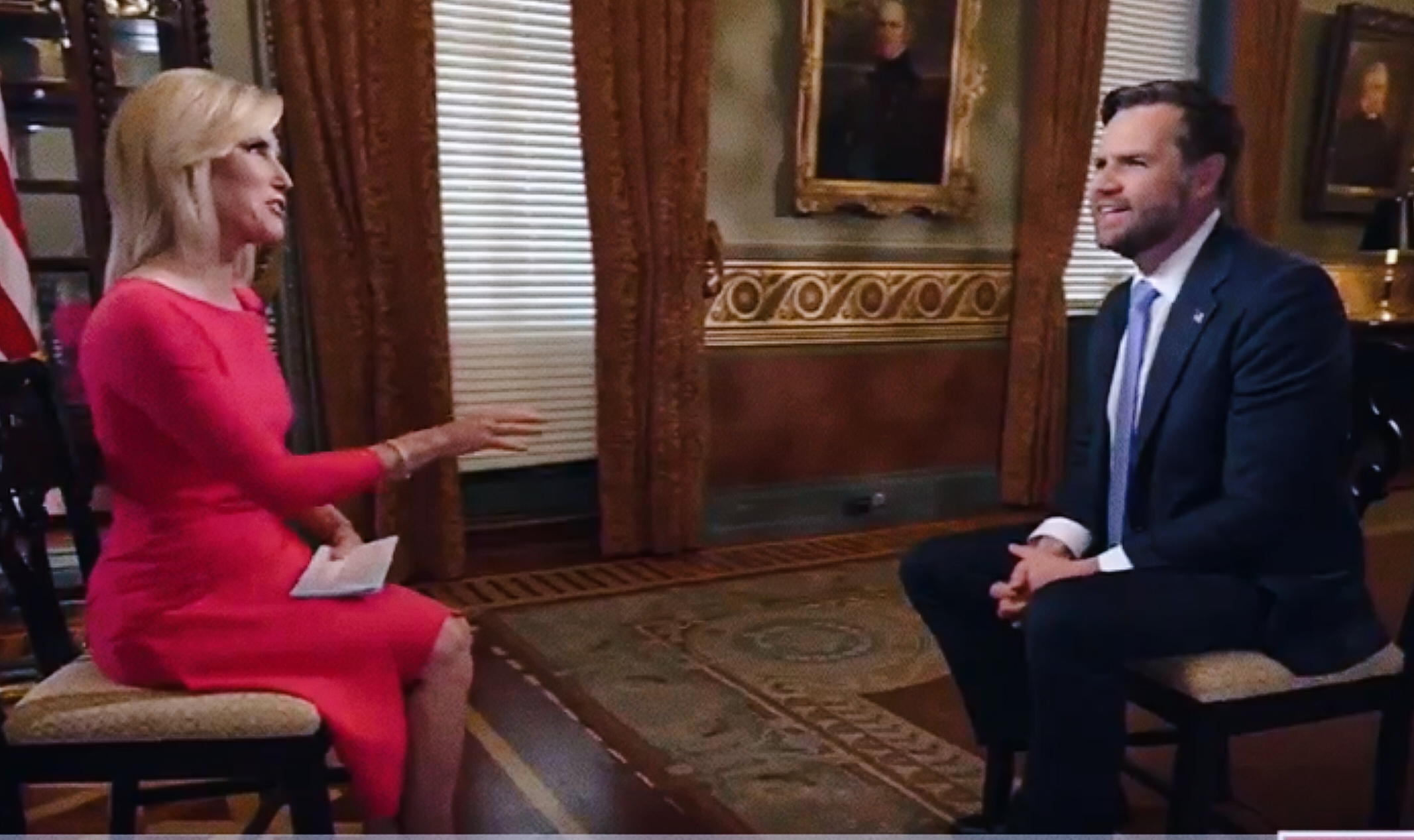
Laura Ingraham interviewing JD Vance. Screen shot: Fox News/YouTube
U.S. vice-president JD Vance has showed on television that when he wants someone else to change, it is because he is trying to avoid making changes himself. He would rather have the other person move out of their comfort zone so he does not have to. Mr Vance appeared on The Ingraham Angle two days ago, when host Laura Ingraham egged her guest on to describe the recent meeting at the White House between Donald Trump and Volodymyr Zelenskyy. “Take us to the room. I think we’re all dying to know that,” she encouraged. Mr Vance gleefully obliged. “So president Zelenskyy walked into the Oval Office and [I] chat[ed] with him, with the president, and some of the senior delegations (sic). I said, ‘Mr President, so long as you behave, I won’t say anything.” He is, as we saw, a firm believer in the ‘you first’ philosophy of discomfort.
Mr Vance subsequently framed the remark as a “good little icebreaker”. It is not clear how the skinny-pants-loving VP defines an icebreaker, but to us (and, seemingly, most viewers), it is a conversational device, especially in a social setting, employed to ease tension and foster rapport and to help the other party feel more at ease. Yet, Mr Vance’s remark, rooted in a history of public confrontation, did the exact opposite. It served as a reminder of the power imbalance and a threat to resume a past hostility. His memory of the Ukranian president “just chuck[ling] a little bit” was disdainful, minimising the Ukrainian leader’s reaction and painting it as a simple, good-natured response rather than a dialed-in diplomatic move. The entire anecdote, as he told it, was less about a genuine moment of human connection and more about a politician smugly congratulating himself on his own excess of cleverness.
Mr Vance’s remark, rooted in a history of public confrontation, served as a reminder of the power imbalance and a threat to resume the past hostility
From his account, which seemed to delight his interviewer, Mr Vance came across as an authority figure speaking to someone who is subordinate, like a parent-as-disciplinarian to a disobedient child. While Mr Zelenskyy apparently “chuckled”, this did not mean he saw what was said to him as a joke. But should the VP have made the “icebreaker” an unwarranted, cruel-sounding laughing matter to the president of a sovereign nation—a country currently at war? Assuming he wanted his remarks to provoke a chuckle, it was not taken that way after he bragged about it on television. No one forgot what he stirred up during Mr Zelenskyy’s first meeting in the White House last February. The context of that contentious meeting further amplified the perception of more hostility. By presenting himself as the arbiter of acceptable conduct, Mr Vance revealed a fundamental lack of respect for Ukraine’s struggle and its leader’s immense burden.
Mr Zelenskyy comported himself really well at that meeting. He was even lauded for his charm. He thanked Donald Trump and America; his gratitude matched by his performance: a bridge-building, diplomatic offensive. There is, therefore, the possibility that Mr Vance wanted to claim credit for the Ukrainian president’s not unremarkable achievement: All because I told him to behave. Ultimately, the comment on Fox News demonstrated Mr Vance’s profound lack of empathy and a shocking level of callousness. The seemingly proud retelling of a condescending remark showed stark disregard of the gravity of the situation. It reduced a complex geopolitical crisis to a simple matter of personal conduct, prioritising an air of cocky swagger over the principles of respect and partnership. Surprising no one, JD Vance basked in the lack of diplomatic finesse.
 Style on the Dot