At the White House, Donald Trump has moved from One Big Beautiful Bill to One Big Beautiful Ballroom
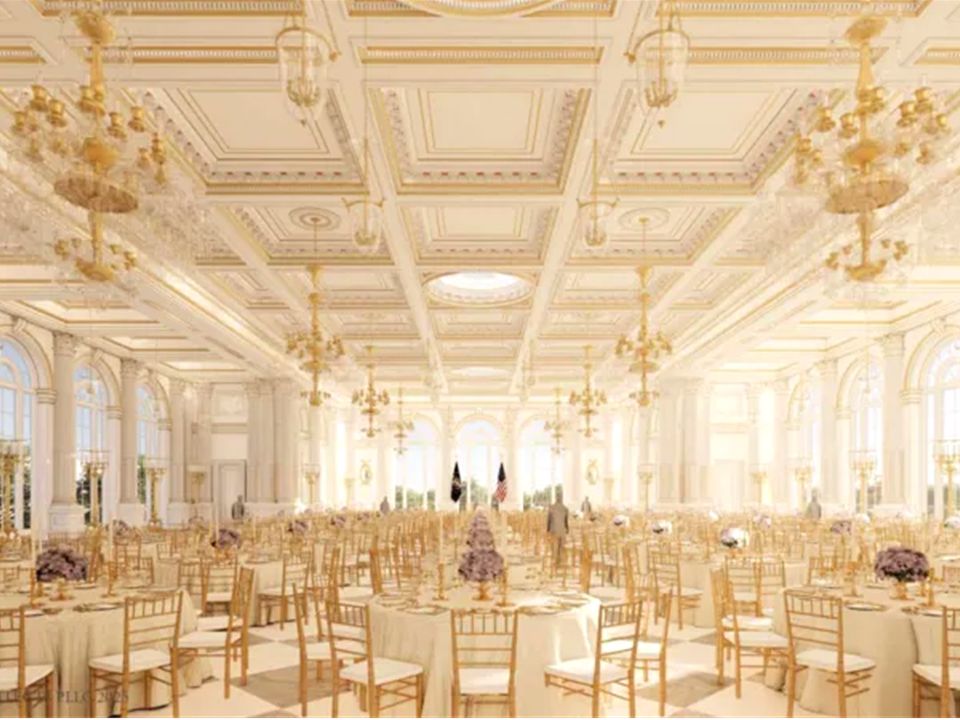
The proposed State Ballroom as seen in a rendering shared by the White House
Donald Trump is itching to build. And he finally gets to scratch the pruritus—at the White House, no less. Press secretary Karoline Leavitt has just gleefully announced that the president has initiated the erection of a US$200 million “White House State Ballroom” on the site of the current East Wing, and to be completed ahead of the end of Mr Trump’s term or, as Ms Leavitt said, “long before”. This is presumably for him to throw one last bombastic bash before he has to vacate the presidential quarters. And for FLOTUS, a final opportunity to twirl in her chosen couture within the grounds of the residence that she uses as frequently as common sense prevails in politics. While Mr Trump still owns the Trump Organization, and its properties being built bear his name, the last building where he had direct, day-to-day involvement in its development predated his first presidency (2017). Still, he has always identified himself as a real-estate developer. Even as president, he must not disappoint the branding.
Mr Trump has openly expressed his long-standing desire for a large, dedicated grand ballroom at the White House, even pre-dating his presidency. He has often voiced his dislike for the current practice of setting up temporary tents for major events, calling them “unsightly”, which could mean too grassroots. Tentage and chandeliers are as compatible as canvas and crystal. Not quite a dispassionate assessment of necessity. This is, no doubt, the grand project he was always meant to build. After a tumultuous first term spent in the trenches of policy—from infrastructure to healthcare, the grand schemes that never quite materialized, including the charmed handling of the COVID 19 pandemic—this time, the president has returned to his truest calling: construction. As any Lego fan would say, a builder must always build. But not any Trump Tower in any regular city centre. The apex of acreage is the White House Grounds.
After a tumultuous first term spent in the trenches of policy, the president has returned to his truest calling: construction
The desire for a grand ballroom primarily for entertaining, rather than simply an extension of a working or residential area, certainly has a monarchical flavor to it. Historically, many grand palaces and residences of kings and emperors were built with lavish ballrooms, state dining rooms, and reception halls. These spaces were not just for practical uses; they were designed to project power, wealth, and prestige, and possibly to wow guests into submission during elaborate diplomatic functions or social events. And that have to be massive enough to fit banquets and ballgowns. It’s a mise-en-scene for a very specific kind of performance. Very easily, the Hall of Mirrors at Versailles comes to mind. It’s absolutely no wonder that Mr Trump’s predilection for building, especially projects like the proposed White House ballroom, has drawn comparisons to “Sun King aesthetics”. Or, among the less historically-inclined, “dictator chic”.
Mr Trump’s taste in interior decoration is as distinctive and well-known as his taste for suits. It is often characterised by a specific passion that has been a consistent theme across his properties, from Trump Tower to Mar-a-Lago, and even influencing his changes within the White House: gold and gilding. CNN described the oval office vividly: “There is gold everywhere: new gold vermeil figurines on the mantle and medallions on the fireplace, gold eagles on the side tables, gilded Rococo mirrors on the doors, and, nestled in the pediments above the doorways, diminutive gold cherubs shipped in from Mar-a-Lago.” The New Yorker did not mince words, going with “tacky and trollish”. The first rendering shared by the White House showed that the president would not stray from the Midas touch theme for the ballroom: there will be gold-trimmed ceilings, gold chandeliers, and gold chairs. But this would not be Trump’s first ballroom bedizened in this style. When Mar-a-Lago was appraised in 2007, the report noted that the ballroom was: “in the style of Versailles, in a Louis XIV gold and crystal finish, with huge crystal chandeliers and floor-to-ceiling mirrors on one wall.” It still is.

A rendering of the East Wing (right), which will become the State ballroom
Critics, however, view the proposed ballroom as an extravagance, a personal vanity project, rather than legacy, as Mr Trump described it; a shift from the more common ideal of a president serving the people, towards a regal flaunt of power. That Mr Trump is said to be deeply involved in the design further emphasises the personal nature of this supposed “gift to the country”, which some could interpret as a desire to leave a lavish personal mark on the nation’s most symbolic and recognisable residence. But we see it as a need for architectural narcissism. Mr Trump has not sufficiently commented on his grand hall for the White House, except that “there’s never been a president that’s good at ballrooms”. But, neither has his administration offered how the facility will serve a functional need or the public good. What is puzzling many is that the US$200 million is funded by the president himself and unnamed “patriot donors”, as Ms Leavitt called them, leading to questions about transparency, conflicts of interest, undue influence, and the principle of public trust in government.
It’s quickly turned into a debate that touches on the practical needs of the presidency versus the symbolic grandeur and historical traditions associated with heads of state. The White House is being gifted a new ballroom not because it is a vital, functional necessity, but because it is a situation of paramount urgency to the current occupant to execute his grandest vision. It is the last, gilded panache on a legacy built on brass and bluster, a monument to the trumping of eagerness over taste. And while future presidents may indeed use this opulent new ballroom for their banquets, such as state dinners, it will forever stand as a testament to a tough choice: serve the people or the memory of one man’s ego. It would be hard to shake off the unique image that built one part of the People’s House, even after the dust has settled, and the gold has dulled.
Images: thewhitehouse/X
 Style on the Dot