The Kalhapuri pickle Prada strutted into shows once again how exotica is still steep with Western allure and is an easy sell
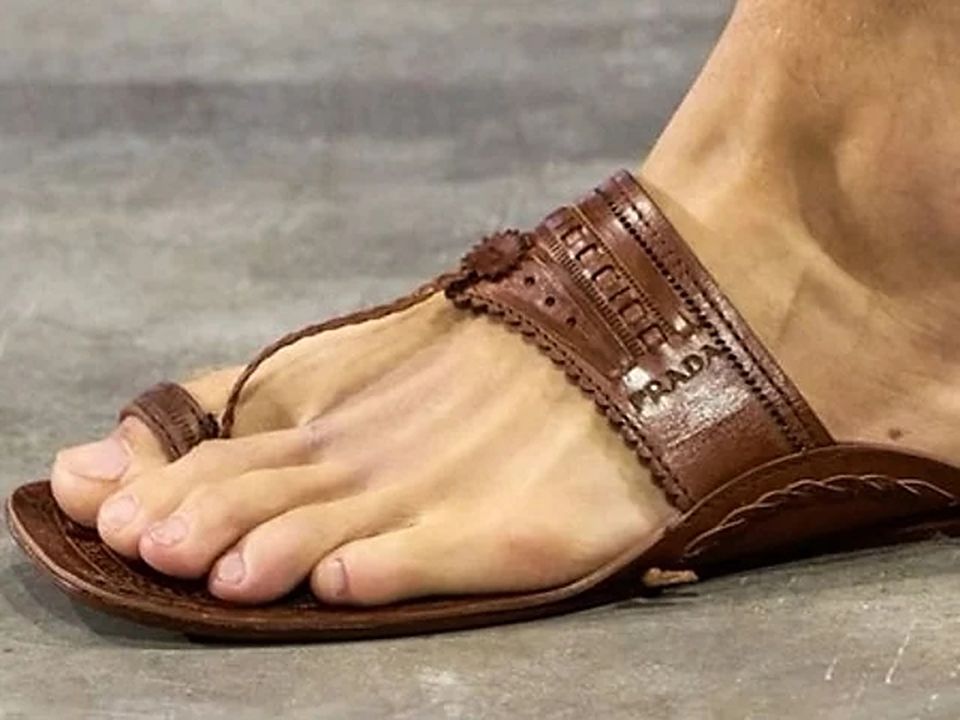
Prada’s Kolhapuri chappal shown during the men’s spring/summer show in Milan last month. Photo: Prada
You’d think that brands like Prada would know better, yet they do not. It is not certain if Prada’s Kolhapuri chappals, at the heart of one of the most attention-grabbing fashion controversies of recent times, is a result of ignorance or arrogance. It is unlikely Prada’s footwear design team is not aware of their inspiration. The chappal clearly did not germinate in Italian soil, yet it took the brand a while to address the issue and go to India to speak to the affected and angered artisans. Prada finally acknowledged the inspiration from traditional Indian handcrafted footwear through a statement issued by Lorenzo Bertelli, its group head of corporate social responsibility. While the reasons for a delayed response from a large corporation are often rooted in internal processes and strategic considerations, the negative impact on brand reputation and consumer loyalty from such a delay can be significant and far-reaching.
This is not Dolce And Gabbana turning the Trevi Fountain into a handbag (although the celebrating of their own national heritage has its own controversies too). This was one of Italy’s most revered brands taking a design with no connection to its own aesthetic tradition and turning it out on the runway and then, later, into the stores, without acknowledging the footwear’s design provenance. Mr Bertelli told Reuters that the chappals were “at an early stage of design”, even when they were already shown on the runway. Still, to the Indians, who first spotted the chappals and drew the world’s attention to the footwear and the lack of credit to the slippers’ origins and history, it was outright cultural appropriation. Immediately, they saw Prada’s action as exploitation, especially when it was reported that the chappals would be sold at a massive markup. India’s culture would generate profits for Prada, but the original creators do not profit.
To the Indians, who first spotted the chappals and drew the world’s attention to the footwear and the lack of credit to their origins and history, it was outright cultural appropriation. Immediately, they saw Prada’s action as exploitation
That the appropriation comes from Prada is glaringly ironic because the brand is known for their innovation and their quirky tweaks on the familiar. Prada’s chappal appeared to be a near-wholesale take, complete with the characteristic “toe ring”. The point of differentiation: just the brand’s name slapped to the side of the strap across the dorsum of the foot. There was no reimagining of the slippers. It could have come straight from a market in Kolhapur. Instead of their characteristically offbeat refinements or intellectual re-contextualisations, Prada’s treatment of the chappal (or lack of) makes it feel like an act of blatant adoption rather than creative re-invention. In a world where every designer’s work, however groundbreaking or not, is subjected to scrutiny, Prada’s lack of credit where credit is due is slack, aloof, and insensitive.
At the heart of this issue is a concept that has long underpinned the Western fashion industry: the economics of ‘exotica’. Western design has, in some ways, reached a point of creative saturation. They have to look at other cultures now to augment their own product offerings. For decades, the industry has relied on a limited set of silhouettes, materials, and historical periods (e.g., ’70s disco or ’80s sportswear). As these sources become increasingly recycled, brands are turning elsewhere, to the exotic, for newness. India, with its thousands of years of textile heritage, intricate craftsmanship, and diverse cultural practices, is a seemingly bottomless well of inspiration, a fact also recognised by Pharrell Williams at Louis Vuitton. This search for the ‘new’ often leads to the adoption of old traditions from non-Western cultures, re-branded as marvellously novel.
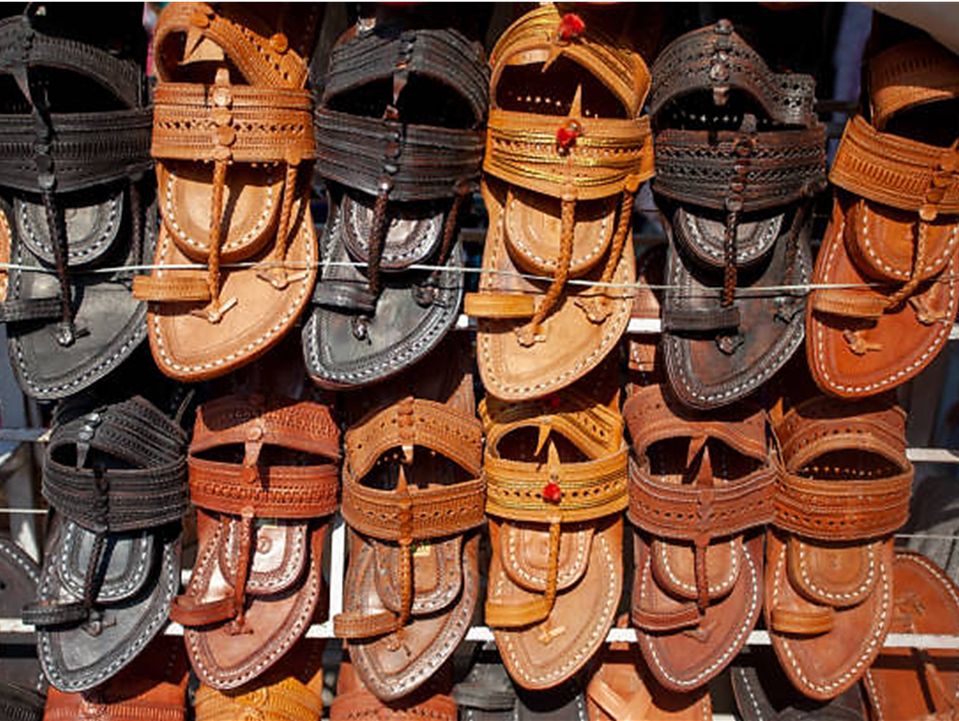
Traditional leather chappals, seen in an Indian market. Photo: iStock
The term ‘exoticism’ has a problematic history. It’s hard not to think of colonial-era attitudes where non-Western cultures were seen as mysterious, primitive, and a source of fascination for the civilized, advanced world. Chinoiserie comes to mind. In fashion, this often translates into taking elements from these cultures and using them not for their original meaning, but for their visual novelty. The item is stripped of its context—its history, the artisans who made it, its ritualistic traditions—and sold purely for its alluring look, or as counterpoint to Western modernity. This is not just a creative choice; it is a display of a profound power imbalance. India, one of the oldest civilizations in the world and a rich creative source, is less economically mighty than the West, who can therefore simply pick as they please, as if at a buffet.
But what is exotic in the west is not necessarily so in, say, the east. A pair of chappal in many parts of Asia, for example, are too ethnic to be adopted authentically into what is predominantly a western mode of dress. Within India, the chappal is seen as traditional. It’s a staple in many households, often worn for comfort or with traditional attire. Its low price point (often ranging from around $5 to $100 depending on quality) means it’s not typically considered high fashion. Over here, chappals, seen as Indian footwear, have become a rarity. In researching an earlier post about Prada’s chappal, we could not find a single pair in the whole of Serangoon Road, traditionally the go-to area for Indian fashions. While some online theorise that Prada’s chappals might be intended for India’s growing middle-class market, this notion is akin to Europeans selling noodles that are not pasta to the Chinese.
India, with its thousands of years of textile heritage, intricate craftsmanship, and diverse cultural practices, is a seemingly bottomless well of inspiration.
If the reverse were to happen, the Western outrage needs no deferential imagining. Think about it: A major Indian fashion brand, for instance, creating a line of American cowboy boots, slapping its logo on them, and selling pairs for a fraction of what an authentic, handcrafted pair would cost, without crediting or collaborating with the original artisans of the American West. What would that churn: ire or inferno? The outcry from the U.S. would be on the theft of heritage, the exploitation of a cultural icon, the lack of respect, and, in a Trump era, the slap of punitive “reciprocal” tariffs. But the irony extends further: for Prada, it remains uncertain if, when the footwear becomes available at the end of the year or early 2026, it will even bear the name chappals. As the BBC initially reported, the brand’s description was simply “leather footwear”.
Yet, a different playbook exists for global cultural exchange or sharing. In the ’80s, when the Japanese debuted in Paris, trailblazing designers, such as Rei Kawakubo of Comme des Garçons and Yohji Yamamoto, did not merely draw from Western sartorial ideals, they fiercely turned inward, drawing profound inspiration from their own rich cultural heritage and aesthetic traditions. They didn’t just reinterpret; they radically deconstructed the very fabric of Western dress and reworked the spatial relationship with the body. Their designs, often oversized, asymmetric, and deliberately unfinished, infused a distinctly Japanese sensibility. This was not an act of adoption, but a powerful, even subversive dialogue that compelled the Western fashion establishment to re-examine its own rules, ultimately shaping the future of global design with an authentic vision born from their own yard.

The styling for the show was so intrinsically Prada that the attention was initially not on the chappals. Photo: Reuters
When it comes to cultural exchange, the Japanese experience and what Prada has done are not just different: one is a tea ceremony, the other is a mosh pit. Increasingly, we are seeing among Western brands, a one-sided extraction which is becoming an egregious trend of treating the creative legacies of the Global South not as partners for dialogue, but as open-source material to be gleefully tapped. The Prada experience could serve as a reminder that “inspiration” in a globalized world comes with significant responsibilities. It’s possibly a call for the Western design world to move from a unilateral borrowing model to one that is rooted in genuine respect, collaboration, and equitable exchange. Even then, the call for proper attribution may not be heeded. If adopted, it may come as a slow burn, rather than a sudden blaze.
Following India’s outcry, Prada sent a high-level team to Kolhapur to assess traditional production methods and engage with local artisans. Reportedly, a second delegation is planned, set to include Prada’s global business and communications heads for high-level discussions with government officials and trade bodies. The Maharashtra Chamber of Commerce, Industry and Agriculture stated in media reports that Prada is keen to launch a limited-edition “Kolhapuri-inspired” collection in partnership with local chappal makers. This may be a significant step towards cultural recognition and ethical fashion. Crucially, however, this newfound engagement came only after a powerful brand was publicly called out. In India, some artisans are still skeptical. While they are glad for global exposure, they remain cautious about exploitation without proper attribution and, ultimately, benefit-sharing.
 Style on the Dot