Controversial Malaysian rapper-actor recently requested for a wefie with two Hong Kong star. It was a masterclass in not reading the room

The picture that proves some trios are better left in separate frames. From left, Eric Tsang, Namewee, Kenny Bee. Screen shot: namewee/Facebook
Another scandal has found its preferred photographic model. It seems that our favourite cross-border rap star Namewee (aka Wee Meng Chee, 黃明志 or Wang Mingzhi) just cannot resist a good photo op, even if it means pulling a spontaneous appearance between two beloved veteran Hong Kong stars. In an image initially shared on Mr Wee’s social media—and then deleted as rapidly as it appeared—the lyrical master of double entendres and sexual wordplay eagerly allowed himself to be snapped with Eric Tsang (曾志伟, Ceng Zhiwei) and Kenny Bee (钟镇涛, Zhong Zhentao), two pillars of HK entertainment whose professional lives and continued popularity are meticulously balanced on the tight rope of appropriate political alignment. The Hong Kong entertainers were in Malaysia for the Super Trio (獎門人) Wow! Super! Happy 30 Years concert at Resorts World Genting on 19 July. And true enough, the guest stars were officially wowed.
You’d think that after being blacklisted from an entire country, one might develop a keen sense of personal space, especially when the fellow still relies on (or desires to) that very market for his financial security or to continue to catch the ebbing wave of adoration. Mr Wee has been sanctioned in China since 2021, after he released the “satirical” single Fragile (玻璃心, bolixin). The track, performed with Australian singer Kimberly Chen (陈芳语, Chen Fangyu), was interpreted to be replete with lyrical stingers that were directed at Chinese President Xi Jinping (习近平) and China-related issues, including the political status of Taiwan and censorship in China. But, Mr Wee seemed unmoved. He appears to operate on a different plane of existence, where celebrities are just props, as if he is on an extended performance of his Tokok shows—easily read as watch me stir the pot.
You’d think that after being blacklisted from an entire country, one might develop a keen sense of personal space, especially when the fellow does still rely on that very market for his financial security
Unsurprisingly, Netizens, especially those in China, were not amused, given Mr Tsang and Mr Bee’s known pro-Beijing stance. The ensuing scramble was criticism against both men, perceived to have associated themselves with Namewee, which is seen as a betrayal or a lack of patriotism. It is not clear if the veteran stars knew Mr Wee personally. It was likely a chance encounter, and possible that the Negarakuku singer was looking to leverage the photo for his own publicity or another carefully orchestrated impromptu moment. Mr Wee has an expressed fondness for Taiwan, having pursued his tertiary education there and has aligned himself with Taiwanese stars, such as Wang Lee Hom (王力宏, Wang Lihong) and Jam Hsiao (萧敬腾, Xiao Jingteng). It is possible that he now wants to appear connected to Hong Kong performers, too.
Following the backlash, both Mr Tsang and Mr Bee swiftly distanced themselves from the rapper-as-fan. They issued separate statements on their Weibo accounts, clarifying that the photo was merely a courtesy interface in a public setting and that they were unaware of Namewee’s back story. Mr Bee did not refer to the Malaysian by name, not even that nice young man or that telented rapper. Instead as “个别人士 (gebie renshi)” or an individual—a generic instance of a human being. He added, “I didn’t know who this person was or what their background entailed.” Mr Tsang was similar in his attempt to stress that he knew not the controversy magnet, saying: “This incident was entirely unintentional and in no way represents my support for or endorsement of the singer’s views.”
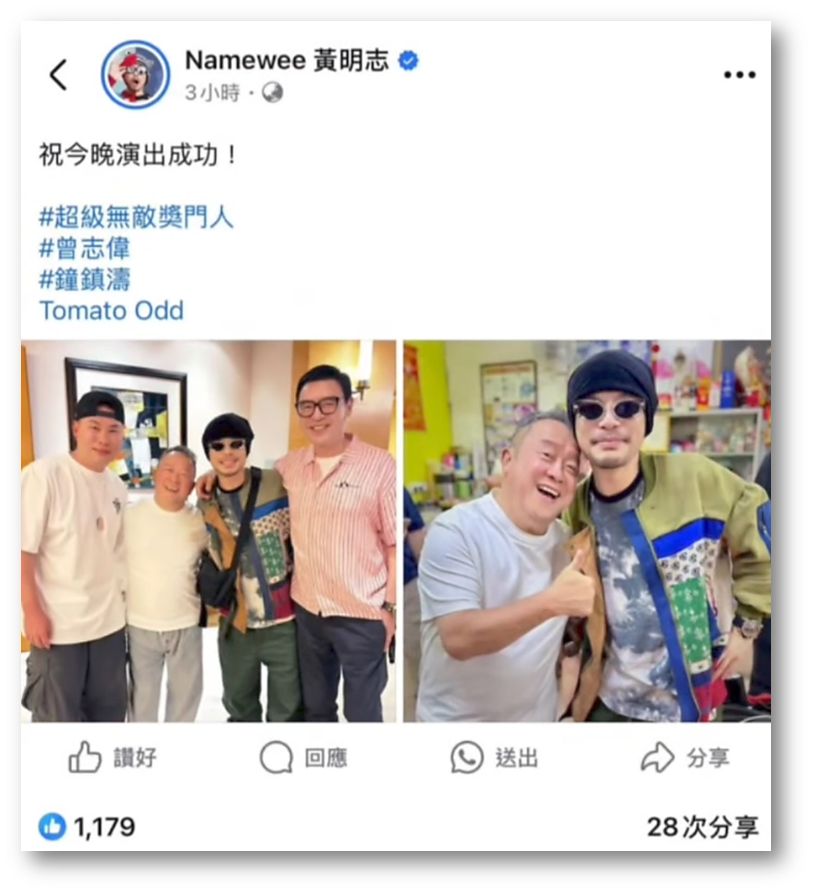
Screen shot of the now deleted Facebook post. In the photo on the left, Malaysian influencer and SteadyGang member, Tomato. was in the shot too
The subtext was crystal clear: we don’t know him, we never knew him, and for the love of all that is patriotic, please believe us when we say we wish we never saw him. Like fanboys, Mr Wee probably did not think of the outcome when he shared that innocent-looking, but profusely problematic photo on Facebook, which included the hashtags of Mr Tsang’s and Mr Bee’s full Chinese names. The singer, dressed in the photo in his signature beanie and a patchwork T-shirt that his fans would decry as 乞丐装 (qigaizhuang) or beggar style, but approve, was quick to act. In a now-deleted Facebook post after the also-discarded previous, he wrote in Chinese, just as beggarly: “In order not to affect the peace and stability of the ‘motherland’ as well as the safety of our comrades in Hong Kong in the Greater Bay Area, we have removed the previous post and photos.”
Namewee, attempting to play the feeble comedian, not only wiped the photo from his feed, he did it with a sarcastic turn, practically winking, as the Malaysian heroically and triumphantly protected the “peace and stability of the motherland”. He knew the dominoes would fall, but he could not resist giving them a little push, perhaps for the sheer thrill of watching the PR machinery churn, and splatter. Or to expose how easily triggered Netizens can be. There was no apology or expression of regret on his part, not even a hint. He knew how far he could go. He is shrewd and calculated in his actions. His controversial nature isn’t accidental; it’s a deliberate part of his brand and artistic strategy. After his tertiary education in Taiwan, Wee Meng Chee chose to reside, even if ideologically, on the unflavoured flank, where he continues to maintain creative ties. But, if you are declared persona non grata in a major market, perhaps it is best not to assume its stars are dying to be seen with you.
 Style on the Dot