One worn in, one out, but it is clear which came first
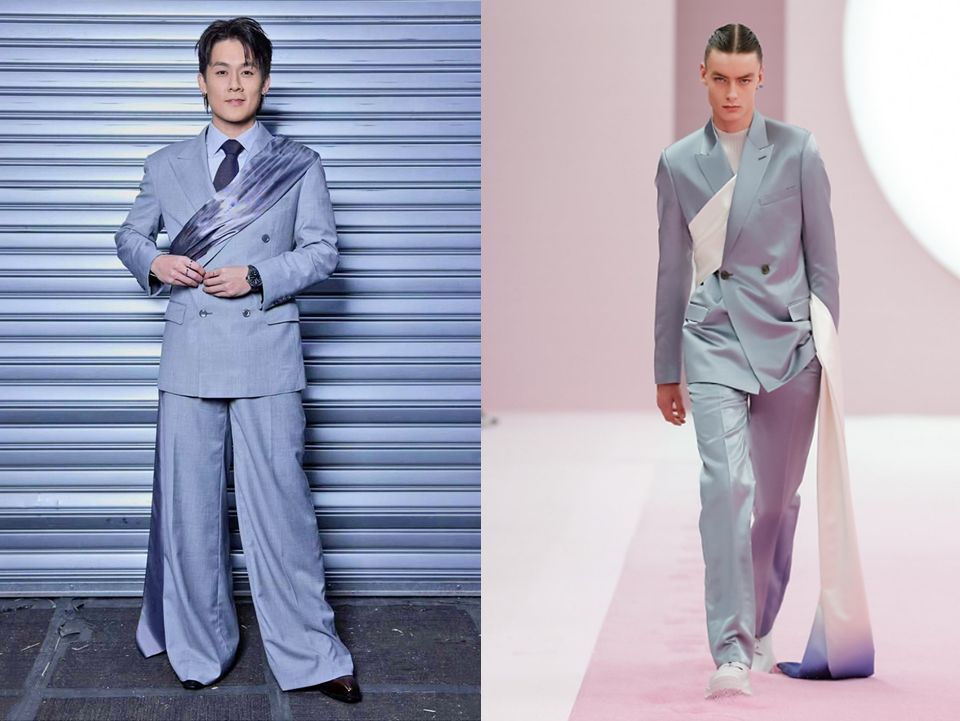
A question of drape. (Left) Ritchie Koh in Q Menswear and (right) Dior Men spring/summer 2020. Photos: ritchiekrq/Instagram and Showstudio repsectively
This year, on the Star Awards red carpet known as the Walk of Fame, the suit Richie Koh (许瑞奇, Xu Ruiqi) wore garnered considerable attention, apart from the ungainly jumpsuit Elvin Ng (黄俊雄, Huang Junxiong) donned. But it was not how superbly tailored it was. Rather, many in the audience and those watching at home were wondering what the heck was that “scarf” doing on Mr Koh when he was not participating in a beauty pageant. But that length of shiny fabric, staying put diagonally across the upper body, struck us to be similar to the selendang (scarf) of a Malay baju (garment). Or some kind of a soft harness employed to keep the errant left lapel in place. It was hard to tell, watching the dull proceeding from our equally bored smartphone.
But as Mr Koh took to the interview platform and was about to face innate questioning by one of the co-hosts, the trying and goofy, and towering Hermen Keh ((郭坤耀, Guo Kunyao), it dawned on us that we have seen the sash similarly styled somewhere else. To be precise, in the spring/summer 2020 Dior collection designed by the maison’s former creative director Kim Jones. That season Mr Jones’s use of sashes stood out. WWD, we recall, described it as “flamboyant”. We thought it looked rather swish. Unlike the sashes seen on beauty contestants, however, Mr Jones styled his on the left shoulder, beneath the jacket, rather than draped across the front.
Instead of mimicking those worn by beauty contestants, Mr Jones had the sash worn on the left shoulder, under the jacket, instead of across it in the front
The ultra-long Dior sash emerged through the opening between the moderate-width lapels, swept past the right side of the torso, was secured under the arm, and gracefully followed the contours of the rear of the trunk. The remaining length of fabric would emerge through the gap between the body and the wrist, when the hand was anchored into the side pocket of the pants. The trailing end was left to hang to the floor. It followed the wearer, like a truncated wedding train. There was something regal in the pairing of the sash and the suit. It did not look remotely like ethnic dress.
But we doubt the screaming girls standing in front of the red carpet and burning in the late afternoon sun of last Sunday could see the similarity of ideas. Nor, we are quite certain, Ritchie Koh himself. The star in all likelihood left it to his stylist, who then worked out with Q Menswear whatever both parties thought was going to look—quite literally—striking on Mr Koh. It is hard to determine who, between the two parties, came up with the idea of using the sash as a feature to help the wearer own the red carpet. Or the choice of the grey suit. In this part of the world, a sash across the upper body has ethnic references. Perhaps, rather than the selendang, Q Menswear was thinking of the 披红 (pihong), a red sash in Chinese tradition, usually draped as a sign of honour or on a groom at his wedding. But this, as anyone watching would surely concur, was hardly such an occasion.
 Style on the Dot