Three decades of the MediaCorp’s self-congratulatory event, it still yawns wide… In full view of Chow Yun Fat
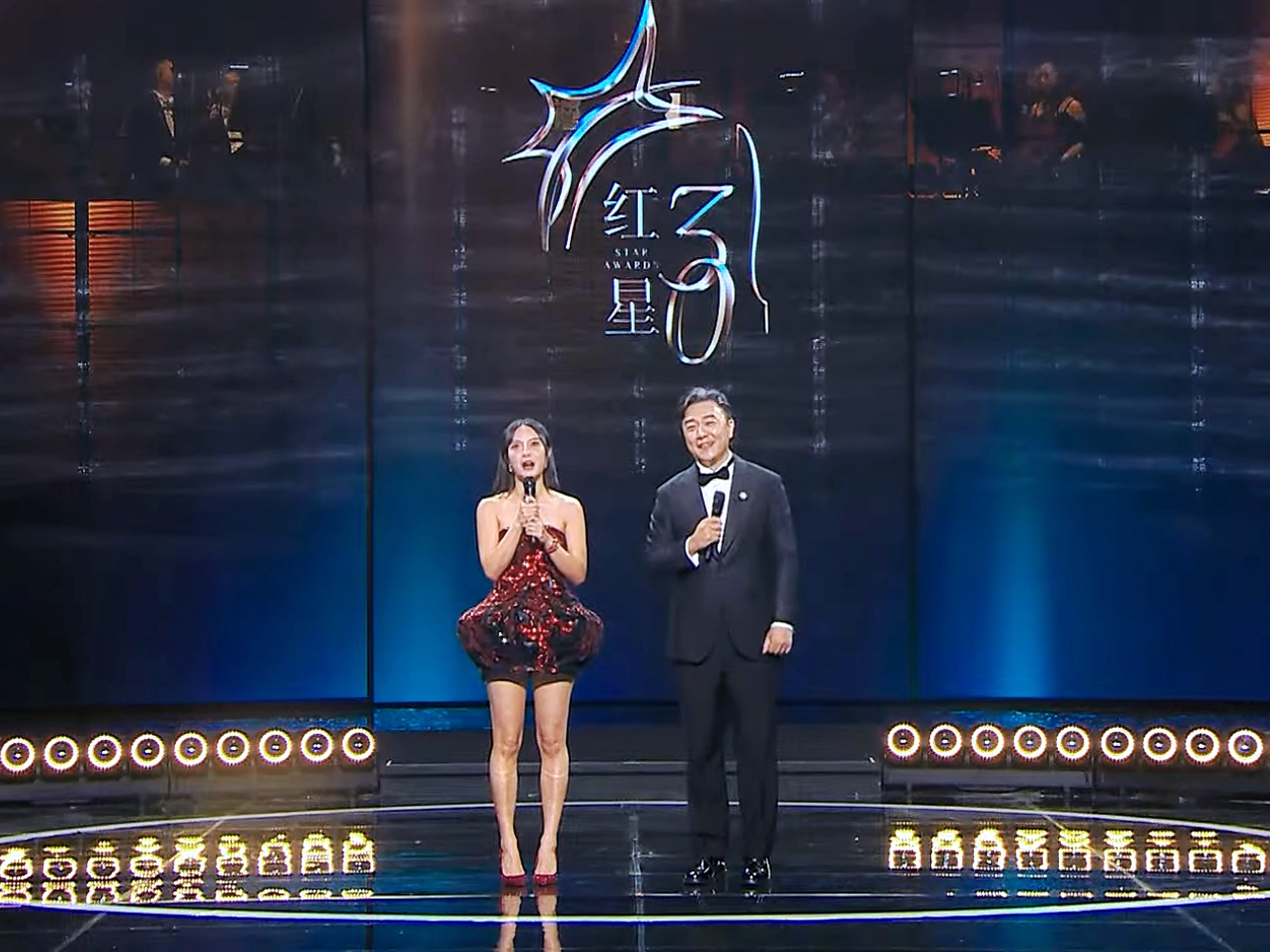
In the history of the Star Awards, there has never been co-hosts as strained as these two: Chantelle Ng and Guo Liang
This year’s Star Awards (红星大奖) proudly celebrated thirty years of honouring largely MediaCorp’s own stable of artistes under the vapid theme, Walking Through Time Together, which could be the title of a hummable National Day song. For a 30th anniversary, this was, frankly, a flat-out cliché. While it sounded acceptable on paper, it failed to translate into an enlivening affair on the stage or on the red carpet earlier that already struggled with being exceptional. The theme was not only hackneyed, it was vague and allowed broad almost anything-goes interpretation. As it was so generic, it did not inspire fresh ideas. It is regrettable that the show was marketed as the most important for Channel 8, yet the producers did not make it any grander than what was staged in the past. This was not an attempt, this was unthinking formality. There was more effort from host Guo Liang’s cue cards.
And like the NDP of the recent past, the show opened with a scripted video segment to literally walk through time and accentuate the togetherness such a show—“全家人的年度大事 (the annual major event of the whole family)”—fosters. This was less the featured woman’s attachment to the presentation than MediaCorp patting themselves on what would have been a very sore back. The narration was so cringe-y that it made us question all our life choices that led us to this. Then it was cut straight to the live show in the Theatre at MediaCorp. Immediately déjà vu set in. The lame stage and digital backdrop design could have been rehashed from an old edition of President Star Charity that we have now totally forgotten. There was, curiously, no opening act. Veteran host Guo Liang strolled in, accompanied by a live band that appeared to be and sounded like a relic from the Singapore Broadcasting Corporation (SBC) days, and very quickly introduced his co-host, who is younger than him by 26 years, setting the stage for an awkward dynamic. This was not Jamie Foxx and his daughter Corrine Fox co-hosting the music game show Beat Shazam.

This year’s Star Awards was also about Chantelle Ng, daughter of veteran actress Lin Meijiao. It was Ms Ng’s debut, hosting a show of this size. Barely an hour into the event, social media was rife with comments that her hosting skills were abysmal. Unlike co-host Guo Liang, who has 16 years worth of Star Awards hosting gigs behind him, Ms Ng performed like she just fell off the bangkwang (turnip) truck. And she did not attempt to hide. It was clear from the start that she intended to impress rather than express, to be her own star, rather than a co-host. Yet, she had inane lines during many portions of the event that did not endear her to many, except those for whom her star status meant she could do no wrong. Many viewers felt embarrassed for her. MediaCorp marketed this year’s Star Awards as the most important, and one deserving of a mega Hong Kong star Chow Yuen Fatt to give out the Top Ten Most Popular Artistes awards, yet they had a veritable Ah Lian rookie to co-host it, sending a girl out to do a woman’s job. Were they desperate?
Similarly, Ms Ng’s fashion pick for her hosting debut was nothing short of a spectacle of misjudgment. Rather than the generally graceful gowns that her predecessors wore, Ms Ng chose a Frederick Lee beaded and embroidered tube-dress with a short skirt in the shape of a 7th lunar month lantern. While likely intended to convey youthful exuberance, it instead rendered her foolish and utterly lost amid the other outfits of fellow stars, especially her co-winners of the award for the Most Popular Female Artistes. The skirt fortunately cast shadows on her thighs (they made her look like she was wearing bicycle shorts), providing a modicum of modesty as her mother was in the audience, but it cast her status not just as a novice host, but as a truly befuddled fashion adopter for such a grand event. To appear a serious host, she adopted a stiff posture and an curious half-an-arm’s-length gap from Mr Guo throughout the evening, amplifying the awkwardness, making it seem as if she was maintaining composure for her frock, rather than wearing it to look collected. The rigidity was, however, unbuckled, when she, responding to an awardee’s name being announced, scream into the mike, “my friend!”
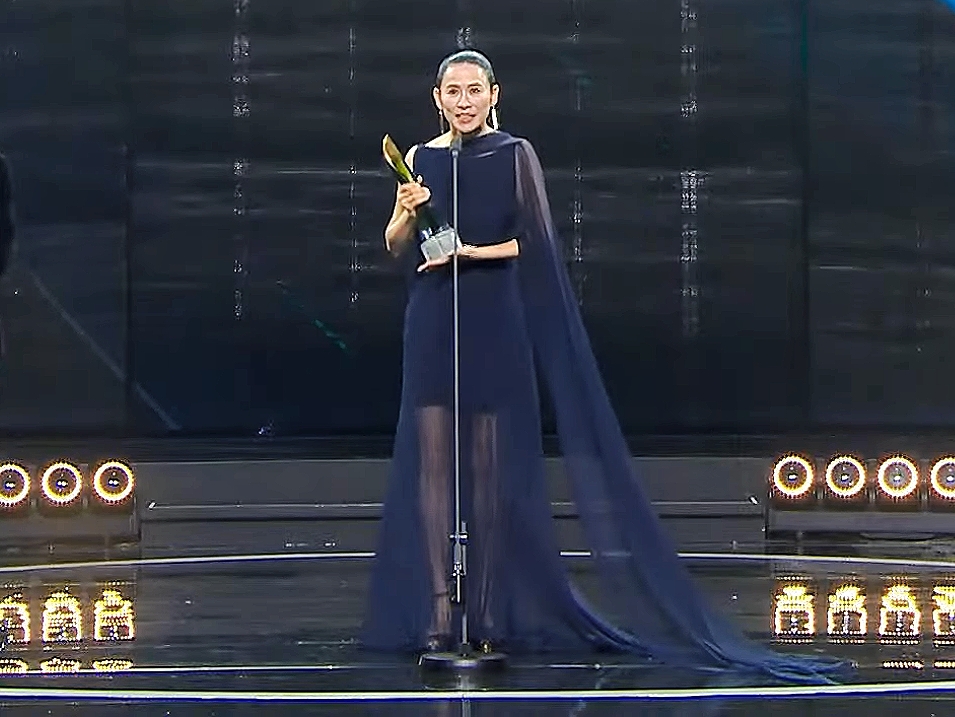
Despite the questionable choice of Chantelle Ng as a co-host, there was also the inclusion of Hong Kong actress and MediaCorp outsider Jessica Hsuan (宣萱, Xuan Xuan), who, in a diaphanous Ralph Lauren gown that could have easily been something she bought from Shein, went on to win the Best Actress award for her role as the revenge-bent mother in the crime series, 谁杀了她 (shui sha le ta or, in English, Kill Sera Sera). This was followed by Christopher Lee (李铭顺), a Malaysian, also clad in Ralph Lauren, scoring the Best Actor win for his role in the same drama. This was Mr Lee’s night (and Ralph Lauren’s!). He ensnared four awards, which could pave the way in the future for the Christopher Lee Award, the equivalent of the Cecil B. DeMille Award at the Golden Globes. Each time, he went on stage to receive the trophy, his acceptance speech would inevitably contain his kampung humour, followed by him laughing at his own jokes. 阿顺真的有主意. Ah Soon really had his own ideas.
Whether Ms Hsuan’s win was to inject regional star power to the show or Mr Lee’s to acknowledge the talents across the causeway and to encourage more to come over to join Mediacorp, it was hard to say with certainty. But for an award night that was thought to celebrate 30 years of Singaporean talent, it was very odd that the top acting awards (including the best supporting actor that another Malaysian, Chen Han Wei took) went to non-natives. Their collective victory cast a long shadow over the very premise of the 30th-anniversary celebrations. The optics certainly suggested a show less about nurturing the home team, and more about showcasing what could be perceived as Mediacorp’s transnational ambitions, leaving a bitter taste that even Ah Soon would not be able to mask for those hoping to see Singaporean stars truly shine on their biggest night. To be sure, there was nothing wrong with the awards going to those individuals if the presentation was now rebranded as one that salutes regional talents, but it was not. It is possible that the Star Awards, presently in established adulthood, was suffering from an identity crisis.
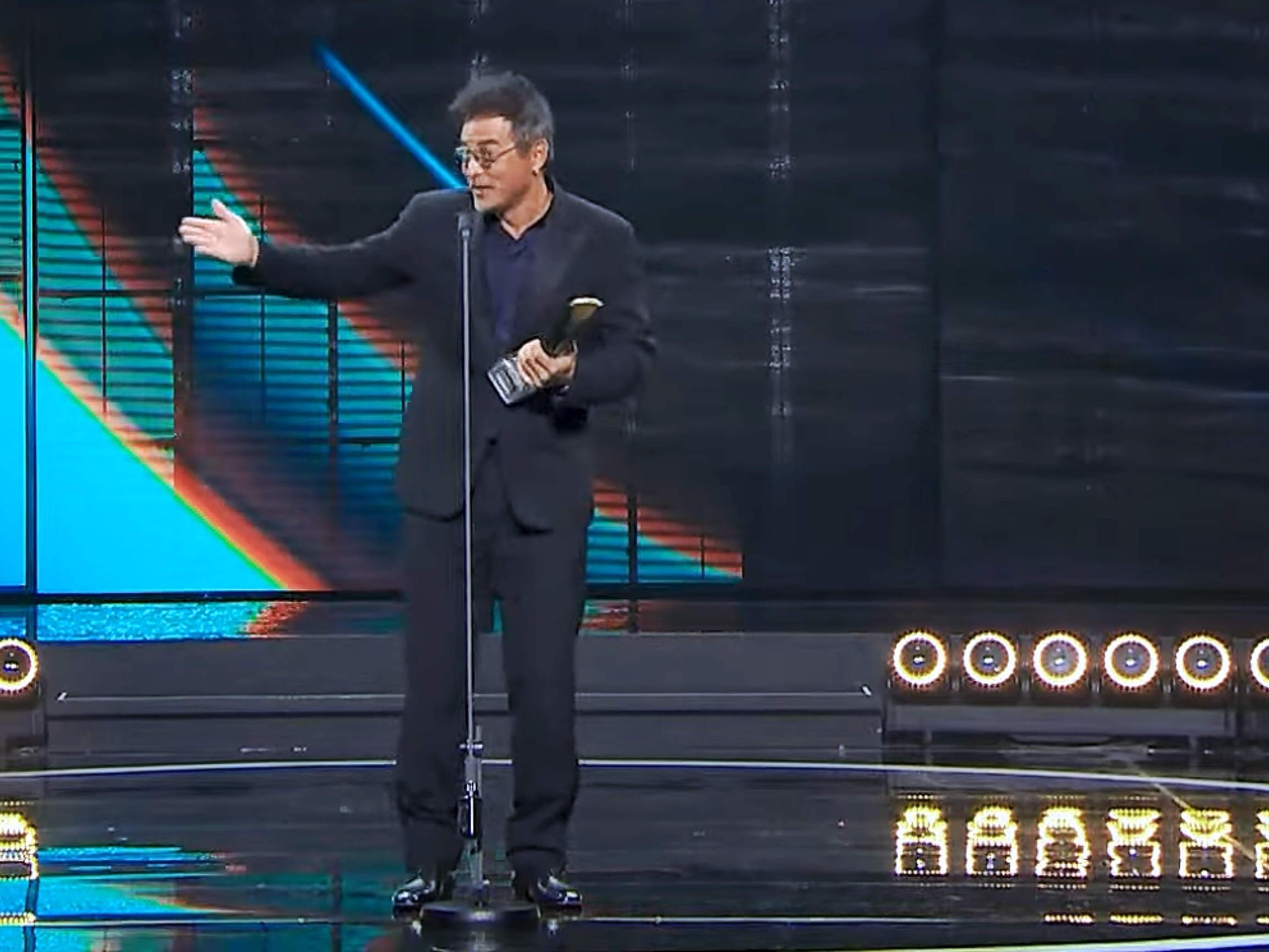
Christopher Lee, as avuncular as ever, especially in Ralph Lauren
Earlier, outside the MediaCorp complex, more than 200 stars, past and present, walked the obligatory red carpet in the fatuous segment known as 星光大道 (xing guang da dao) or ‘Walk of Fame’. Since the Star Awards called the Theatre at MediaCorp home in 2016, this event functions less like the red carpets of major international awards shows that we are familiar with. Unless you are an ardent consumer of manufactured stardom, it has been a dutiful promenade for contractually obliged talent than a star-making event. As the red carpet meandered through public walkways and climbed a staggering flight of steps, it was a display of what they could do with the open spaces of the MediaCorp compound than a simple, linear commute from getting off the car to getting into the theatre. At most major international award shows, a significant part of the spectacle is the genuine arrival of the stars, often in fancier automobiles, stepping out into a throng of paparazzi, fans, and media. There’s an element of raw excitement and unpredictability as the stars navigate the crowds and members of the media.
But on the ‘Walk of Fame’, some stars arrived by car, some emerged from different buildings of the MediaCorp complex, and all were directed to specific spots, pose for a predetermined number of photographers, and then to move along the designated paths to arrive at a main stage to be interviewed about their sartorial choices by clueless-about-fashion hosts. There was less of a sense of them commuting from a general entry point to the venue, and overcoming structural barriers impeded glamour and the natural flow of the clothes. As this year’s main sponsor was the Chinese car maker BYD, the brand’s latest models were strategically placed to allow the vehicles to serve as backdrop, much like it would be at a car show. Some of the attendees even forgot that they were supposed to pose in front of the chosen vehicle, and ran back to complete the task. It was clearly not about the grand entrance and more about ticking boxes for sponsors and media partners. It was all manufactured rather than organically exciting. It was about the broadcast, not the arrivals.
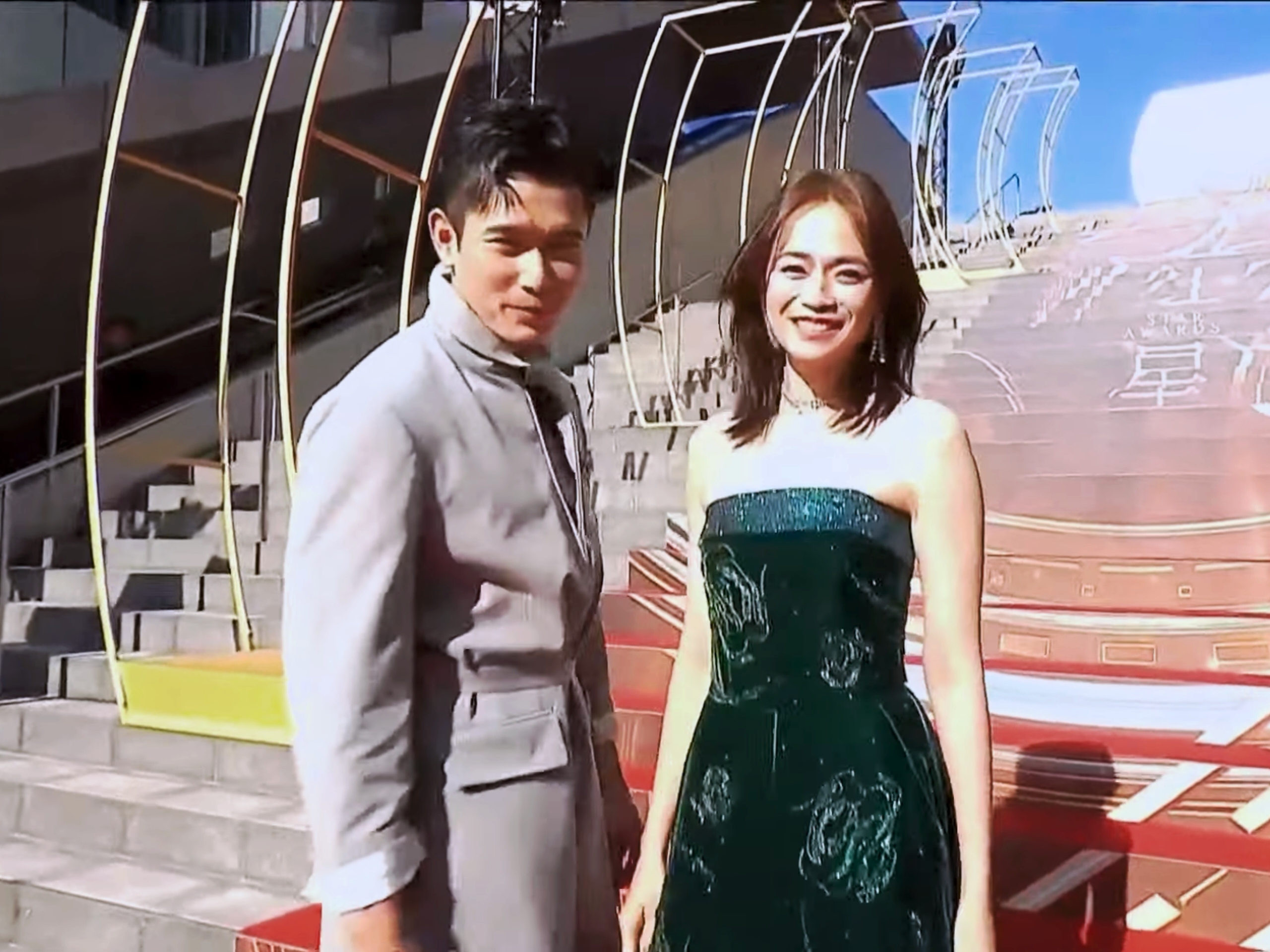
Elvin Ng and Felicia Chin at the foot of the red-carpet-on-a-stairway

Tyler Tan and his partner of the night, Ye Jiayun
MediaCorp stars have largely depended on their stylist to serve as the artistes’ eyes and taste, and this year was no exception. What was obvious was how terribly risk-averse the stylists, and by extension the artistes, were. They prioritised looking competent, avoiding misfires over making groundbreaking fashion statements, which accounted for the surfeit of trusty suits and conventional gowns. Only Elvin Ng (黄俊雄), togged in a jumpsuit (and unzipped nearly to the navel) by the Beijing-based Maison Sans Titre, who attempted the unconventional, but, unsurprisingly, it earned mockery than admiration. And there were those for whom our punishing heat mattered not. There was the puffball of ridiculousness on Tasha Low (刘怡伶) who wore a fur Chanel Metiers d’Art coat in 32°C (real feel, according to Accuweather, was 41°C) day-time temperature. It became a punchline, not a paragon. Not to be outdone was ajie (big sister) Zoe Tay (郑惠玉), also in Chanel Metiers d’Art. This time, the usually reliable she inexplicably opted for a heavy-looking tweed coat, with embroidered flowers on the lapels that, in sum, was borderline mumsy. Sure, it was not an unmitigated disaster, but neither was it one for the annals of Singaporean red carpet fashion.
If there was any hope that the new-gen artistes would show the way to impeccable style, that too was dashed. All of them were not senior enough in MediaCorp to deserve arrival by a BYD car, so they emerged from the side of a building as if walking out from a postern after just completing their hair and make-up, and stumbling into the blinding daylight. The big newbie winner of the night, Tyler Ten (邓伟德), with two awards, adopted a look that Desmond Tan (陈泂江) discarded since last year—a suit (Mr Ten’s dark chocolate two-piece was from Fendi) without a shirt inside and a serpent-shaped necklace from Bvlgari hanging conspicuously on the ‘heavage’. It was not just a bad look; it was a stale bad look. His date of the night, fellow newcomer Ye Jiayun (叶佳昀), was dressed in a flattering, slim-fitting Rick Owens gown with what appeared to be origami bust-cups that stayed up in place without a seam in the middle, exposing her narrow longkang (drain), but considerable pectorals. But, as his heavage and her cleavage showed, there was more surface than depth. Or, as one of the hosts, Hazelle Teo ( 张颖双), in an unintentionally honest moment, said of Mr Ng, “漏的那一快空 (loude na yikuai kong)” or leaking (sic) a piece of emptiness.
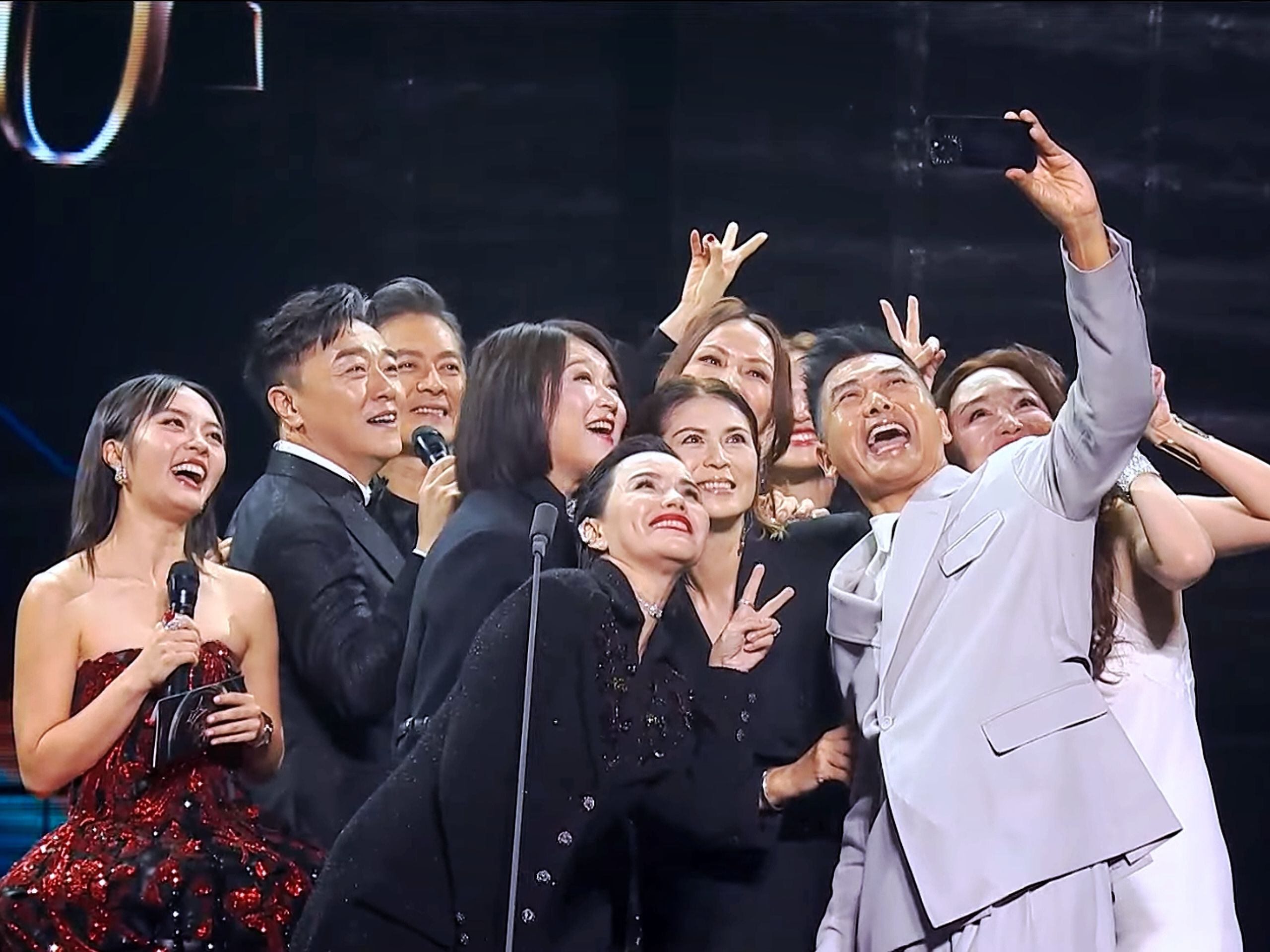
The by-now most-talked about segment of the evening, with Chow Yun Fat holding his smart phone. Chantelle Ng clearly did not belong
The stars’ arrivals in their finery are always fascinating to watch. It creates a sense of engagement and a shared experience, especially on social media. But the show producers would be better advised if they halt the hosts’ love of making insipid and ill-informed fashion commentary that added nothing to the conversation. The worst of them all was, again, Herman Keh (郭坤耀), who in 2022, shockingly could not tell the difference between 制服 (zhifu or uniforms) and 礼服 (lifu or formal attire). The Ah Beng host, in his typical goblock (idiotic) manner, offered the best and most informative line of yesterday evening: “美到令人难忘啊”, or “so beautiful that it is unforgettable”. Perhaps to add gravitas to the commentaries this year, two media professionals were invited to offer their views: Huang Yenling (黄艳玲), the editor of Nuyou (女友) magazine, which over-exuberant host Ms Teo strangely pronounced to sound like 女幼 (also nuyou) or young woman, and Zhang Yujie (张妤婕), fashion editor of Icon (风华) magazine. Both women, at best, offered perfunctory approvals.
In the end, what should have been a shiny pearl anniversary felt suspiciously like costume jewellery of a show. Even three decades of practice couldn’t polish away the fragmented ‘Walk of Fame’ that squashed any sense of unified grandeur and the pervasive on-stage dullness that could bore the unoccupied theatre chairs. To be certain, the usually stupefying monotony of the closing two-part Top Ten Most Popular Artistes awards was handled deftly and amusingly by a Dior-clad Chow Yun Fat (周润发), who began requesting a wefie with the original Top Ten winners from thirty years ago, when he was the awards’ first presenter. But that turned to be repeated wefie sessions, serving to extent the agony of the segment. Mr Chow’s eager photo-taking clearly delighted the stars, but he was not the first to whip out his smartphone to put the camera to good use. During the 2014 Oscar telecast, Ellen DeGeneres famously wielded her phone to shoot several wefies. Regrettably, the Star Awards 2025 in its thirtieth year, was, again, unable to be a glittering stage of inspiration, let alone originality.
Screen shots: mediacorpentertainment/YouTube
 Style on the Dot