Naomi Campbell appears in Miley Cyrus’s newest music video, but at least it’s a speaking part—a few words, on repeat

Naomi Campbell has tried very hard to be a pop icon. She has not given up in her attempts. Despite being a fashion star, she has consistently made efforts to establish herself beyond the runway, in music culture. Her latest venture, a blink-and-you-miss-it soft-talking head in Miley Cyrus’s recent Every Girl You’ve Ever Loved music video, serves less as a testament to her enduring appeal and more as a stark reminder that a big-enough fashion star can still chase a pop dream, with all the subtlety of a disco ball in a blackout. Bathed in self-defeating backlighting that renders her almost a silhouette, Ms Campbell’s few, uninspired repeated words do little, but underscore the uncomfortable truth: A model of her stature simply exists in frames not long enough to mask the hollowness of a cameo that’s all “pose” and no poetry.
But even “pose” is stretching it. As for poetry, let’s not go there (but we shall, in a minute). If Ms Campbell was hired to be a model in the MV, akin to her iconic turn alongside the other “supers” of her generation in George Michael’s Freedom! ’90, then she has fooled us. She barely catwalked; she barely posed, even when her own voice reiterates that very word! She stood as she does, largely letting the camera do all the work, as if to say, “it’s enough that I am Naomi”! Early reviews might have suggested the intended effect was a subtle presence over overt action, but does subtle truly compute with the explosive, phone-throwing persona of Naomi Campbell? Her emotion-less presence did eventually morph into some semblance of poses, but it is doubtful any sitting editor today, not enamoured by her stardom, would be sold.
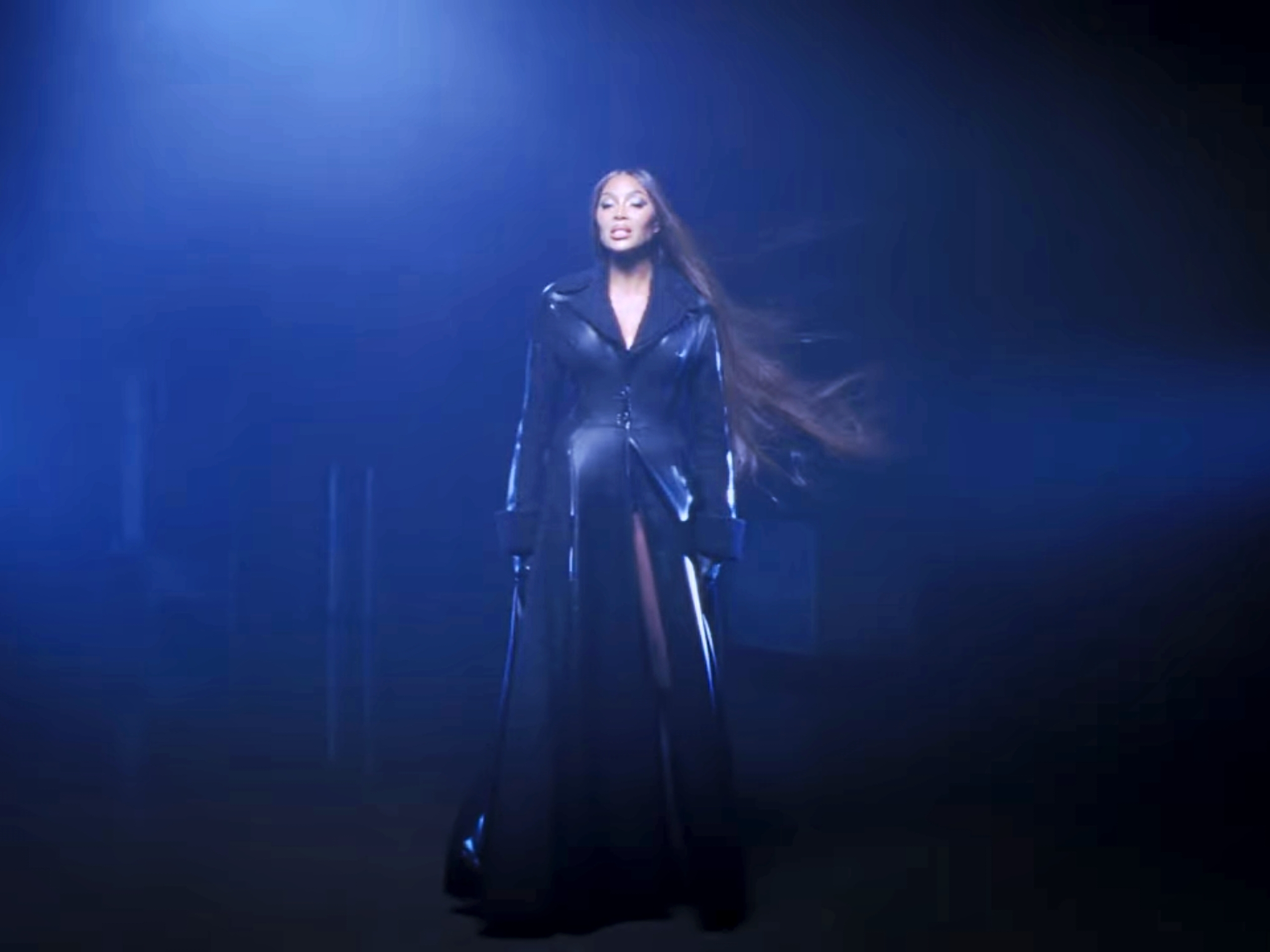
We also read somewhere that her role is more “akin to a goddess-like figure or a muse, delivering spoken-word poetry.” That she spoke rather than sang is widely known to be a necessity, given that she cannot even hum a tune, a fact painfully evident even when she recorded her one and only studio album, “Babywoman,” in 1994. The poetry she uttered: “Pose. She has the perfect scent. Pose. She speaks the perfect French.” Later in the song, she said, “She never wears a watch. Still, she’s never late. She’s got that kind of grace. Did Botticelli paint her face? She has the perfect scent. She speaks the perfect French. She can dance the night away. And still, she’ll never break a sweat.” She repeated “pose” again, and again. The lyrical device, naturally, brougfht to mind Madonna’s Vogue from 1990. While Madonna’s was a call to action, Ms Campbell’s was summoning the dead.
Speaking is not necessarily poetic. Less so in Ms Campell’s case—she sounded self-conscious, unconvincing, conceited. The minute we heard her, it was hard for us not to draw a distinction between Ms Campbell’s spoken word and the established artistry of fellow Brit, Ann Clark, a spoken-word pioneer, particularly in the electronic music space of the early ’80s. And it is no exaggeration to call Ms Clark a poet. Her lyrics often delve into critical observations of everyday life, and politics, and the imperfection of humanity, frequently creating a gloomy or melancholic atmosphere, against a catchy electronic soundscape. She even recorded a piece in 1987, Poem without Words, and it was exactly that. Lyrically, her work is known for its depth and intellectual engagement, delivered in a highly intentional, if not always traditionally melodic, serving to convey the mood and meaning of her often profound lyrics. In 1984’s Our Darkness, she spoke, “There has to be passion/A passion for living, surviving/And that means detachment.” No, not pose.

By contrast, Ms Campbell spoke in the third person, but with her clearly as the subject. “Did Botticelli paint her face”, she wondered without real curiosity, as if she already had the answer since she was the subject. Mentioning Botticelli does not art make. A model is not a creation of art. Simply name-dropping a renowned artist like Botticelli, who is synonymous with classical beauty, came across as a superficial attempt at injecting art into phrasing that barely had poetical depth to begin with. A reference that alludes to art without actually being artistic in its own right, especially if the surrounding words and delivery do not carry any corresponding weight or insight. It is, at best, a pose and yet, not quite.
Every Girl You’ve Ever Loved is part of Miley Cyrus’s latest album, Something Beautiful, which was accompanied by a “musical film” of the same name, described as a “one-of-a-kind pop opera fueled by fantasy” that blends music, fashion, and emotion into a visual experience. The single within the film showed Ms Cyrus and Ms Campbell performing in an empty warehouse with dim, blue lights, as if a prelude to a slasher film that moves the plot with horrible deaths. The two performers’ parts were mostly separate takes until the last minute of the video, possibly to ensure that Ms Cyrus, all senewy and limbs, would not outdo the supermodel. But it was Ms Cyrus who was impassioned as the Every Girl You’ve Ever Loved, and, ironically, the one who could truly strike a pose.

The video is part of the musical film that had been explicitly touted as blending music, fashion, and emotion. Online chatter prior to the release of the MV yesterday suggested that both stars would be “adorned with archival couture”. Ms Campbell is known to be a collector of fashion, who called the late Azzedine Alaia “papa”, so she would not be disadvantaged in that area. But, the vaunted fashion that was meant to be a cornerstone of this cinematic experience was, however, largely swallowed by the pervasive gloom of the video. Both of the stars were frequently reduced to mere silhouettes. This yingxi (影戏) or Chinese shadow play is regrettably assumption that the idea of archival couture, worn by icons, is enough—that the viewer will infer glamour without actually seeing it. The aura of high fashion rather than the clothes in the murky tableau offered dancing ghosts than memorable gowns.
The film, reportedly co-directed by Miley Cyrus herself, was, in sum, less a musical performance and more a carefully orchestrated brand appearance for Naomi Campbell. Indeed, this is just the latest in a long line of music video appearances for the supermodel, who has starred in close to ten others, including Madonna’s Erotica. There is no doubt that she is a serial MV Cameo. Yet, for Miley Cyrus, her model-star was a near-static prop, too grand to move, too self-assured to genuinely perform. It is a stark reflection not only of Ms Campbell’s unyielding, if often misguided, ambition, but also of a music industry increasingly willing to accept hollow spectacle over compelling substance. Is this the future of celebrity cameos—a “pose” in the dark, heard but barely seen?
Screen shots: mileycyrus/YouTube
 Style on the Dot