When has the line between the look of an editor and his subject been this blurred?
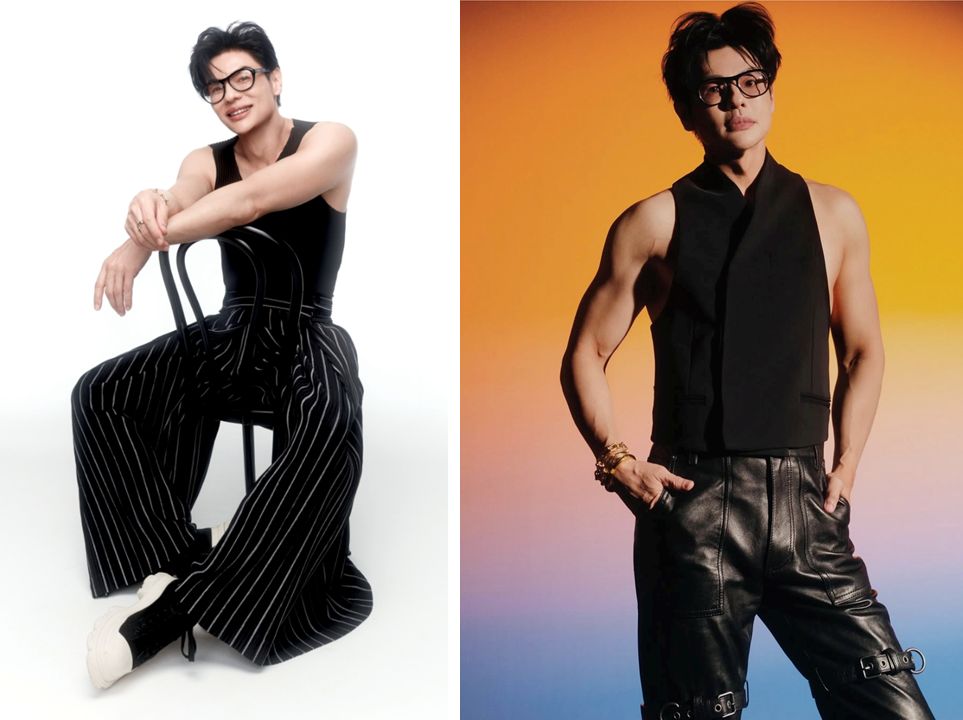
Thai actor Phuwin Tangsakyuen (left) and editor-in-chief of Harper’s Bazaar SG Kenneth Goh (right). Photos: Harper’s Bazaar SG and kennieboy/Instagram respectively
A casual flip of the latest issue of Harper’s Bazaar Singapore brought us to an image that was quite startling. It was a photo of the Thai cover star, the actor Phuwin Tangsakyuen. He was styled, oddly enough, to bear more than a passing resemblance to the magazine’s editor-in-chief Kenneth Goh. Did Mr Goh discover his long-lost twin? The image required no side-by-side comparison to evoke the style of the veteran editor, who goes by Kennie Boy on Instagram. On IG, he often shares images of himself in various atas (high-end) social settings, immaculately groomed, all togged to impress his 53,400 followers with expensive clothes and barbell-shaped arms. Sure, editors these days are expected to maintain an active social media page, and Mr Goh’s is as vivid, aspirational, and self-absorbed as any influencer at the top of their game. He is a veritable star.
As that image—with the subject in geeky eyewear and togged in a tank top and roomy pants that are no different from what the source of inspiration wears—resembles posts from Mr Goh’s IG page, it is tempting to ask: Is this photo of the-star-as-editor serving the magazine, the reader, or just the editor’s ego? Mr Tangsakyuen is an actor and songwriter under GMMTV as well as parent company, the Thai entertainment conglomerate, GMM. He debuted as an actor at age eleven and quickly gained popularity, and is particularly adored within the BL (Boys’ Love) genre. His fame is no doubt still growing, but his reach is attested by the various brand ambassadorships he has earned, such as Tommy Hilfiger in 2024 and then Loewe in the same year. On his official IG page, he has 4.1 million followers. There is no doubt who the bigger star is. Yet, Harper’s Bazaar SG saw him rather differently.
As that image resembles posts from Mr Goh’s IG page, it is tempting to ask: Is this photo of the-star-as-editor serving the magazine, the reader, or just the editor’s ego?
This is where the anomaly of the Harper’s Bazaar SG cover truly comes into focus. It is rare that an editor-in-chief would agree to a star to be styled like him or her for the magazine. The only time that we can think of is Marc Jacobs requesting to look like Anna Wintour when he was asked to guest-edit the November 2024 issue of American Vogue. But even then, it was his and Ms Wintour’s back that was photographed to show Mr Jacobs mimicking the EIC’s globular bob. It was tongue-in-cheek rather than imitative. For decades, the most revered names in fashion publishing cultivated an aura of remote, almost mythical, authority. At Harper’s Bazaar, there was Carmel Snow, who famously named Christian Dior’s debut collection the “New Look” and launched the careers of notable figures, such as Diana Vreeland, Richard Avedon, and the author Truman Capote. Neither of them were fashioned to resemble her. And there was also the late Liz Tilberis, who significantly pushed the magazine’s standing to such a reach that it could stand shoulder to shoulder with Vogue. No one was ever styled like her during her tenure.
And it was the inimitable Diana Vreeland, the editor-in-chief of Vogue (1962 to 1971), who really championed individuality. As she wrote in her autobiography DV, “Style—all who have it share one thing: originality.” Among the many legendary editors of the golden age of the fashion magazines, Ms Vreeland was the most unique, not only in dress, but also in voice, offering memorable aphorisms, such as “a new dress doesn’t get you anywhere. It’s the life you’re living in the dress.” And while she wore dresses that were the most au courant at the time (Chanel and Balenciaga couture), she was never the primary subject of her own editorials, let alone mimicked by the very stars she featured. But these days, a magazine’s cover star, who meant to embody aspiration and often a unique personal brand, is styled to mimic its editor. Clearly, the curated content has shifted to the curator himself.
 Style on the Dot