The debut collection by new creative director Jonathan Anderson is normcore redux, and the Bar jacket for men
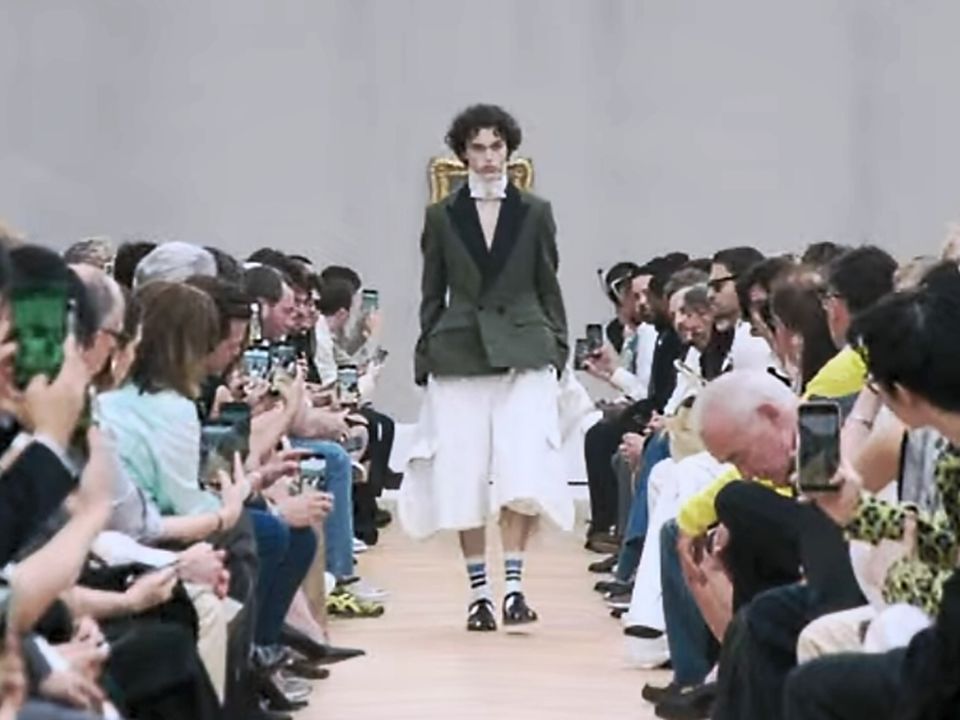
If a fashion presentation can be judged by its finale, Jonathan Anderson’s Dior debut was as exceptional as it was expected to be. Shown earlier this evening, it was a parade of many looks, each stronger than the last. But, crucially, the applause that accompanied the final line-up lasted its entire duration. When Mr Anderson emerged to take the customary bow, he received a rousing standing ovation. He smiled widely, more than he ever had on the Loewe runway. Triumphant he clearly felt. And just as thrilled was Donatella Versace , who dashed towards him, but Mr Anderson was too agog with elation to notice. The show was the high of the Paris season so many had expected.
The live-streamed event was watched by more than 5K viewers on YouTube. The start was more than 80 minutes after the publicized time or 2pm (Paris time or 8pm, our time): shout out to J’adore Dior face Rihanna, who arrived late, but hardly fashionably, with A$AP Rocky in tow, carrying her Dior handbag. Prior to that we were treated to an introductory video, followed by the guests arriving at the Musée de l‘Armée in which the show staged was under the famed Dome les Invalides, as well as celebrity guests, such as Robert Pattinson and Chinese actor Yu Shi (于适), getting ready in their hotel rooms and then in their arranged vehicles traveling to the show site. All the guests were clearly togged by Dior. Many of them were in fairly ordinary clothes: tees, shirts, pullovers and sweaters, all with the Dior logotype visibly present. During those moments, it was tempting to think: Uniqlo aesthetic got a high-fashion upgrade.
But on the runway, those same garments shed their potential normcore bent. Much of the collection were, in fact, what one would consider regular items from a male wardrobe, as listed above, but on the runway, they looked different, offbeat even. Their inclusion quickly prompted fans to call Mr Anderson’s work “genius”—the knack of taking seemingly ordinary pieces and presenting them in a way that shifts their perception or obscure their ordinariness. Even dress shirts, evocative of those Mr Anderson showed in his earliest collections for Loewe, were allowed their ‘undressed’ moment: they were untucked like a work shirt, and worn under vests or Mackintoshes. All the other shirts had a preppie quality about them, but their collegiate leanings were tempered with some of the most alluring shorts and pants of the Paris season so far.
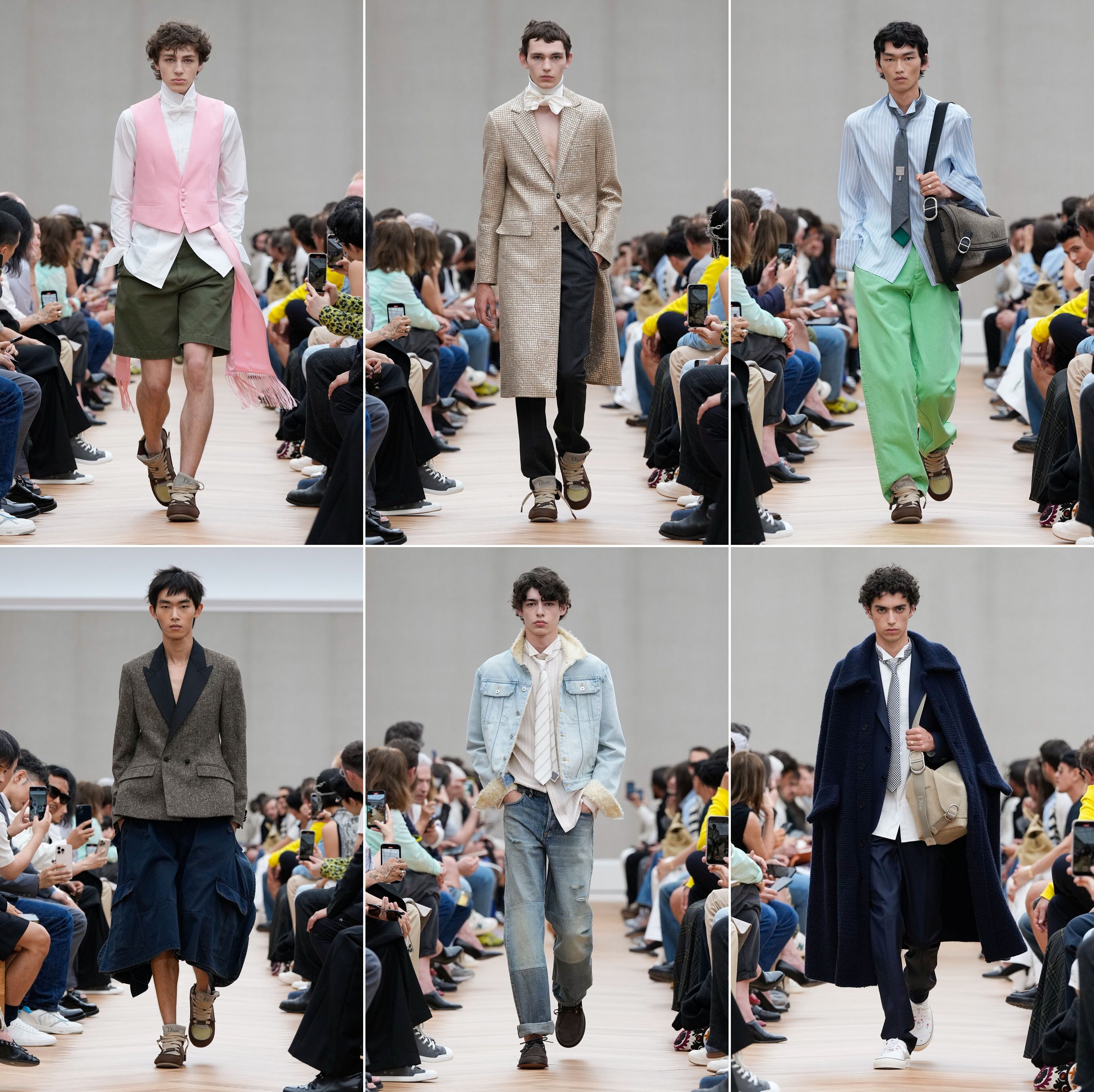
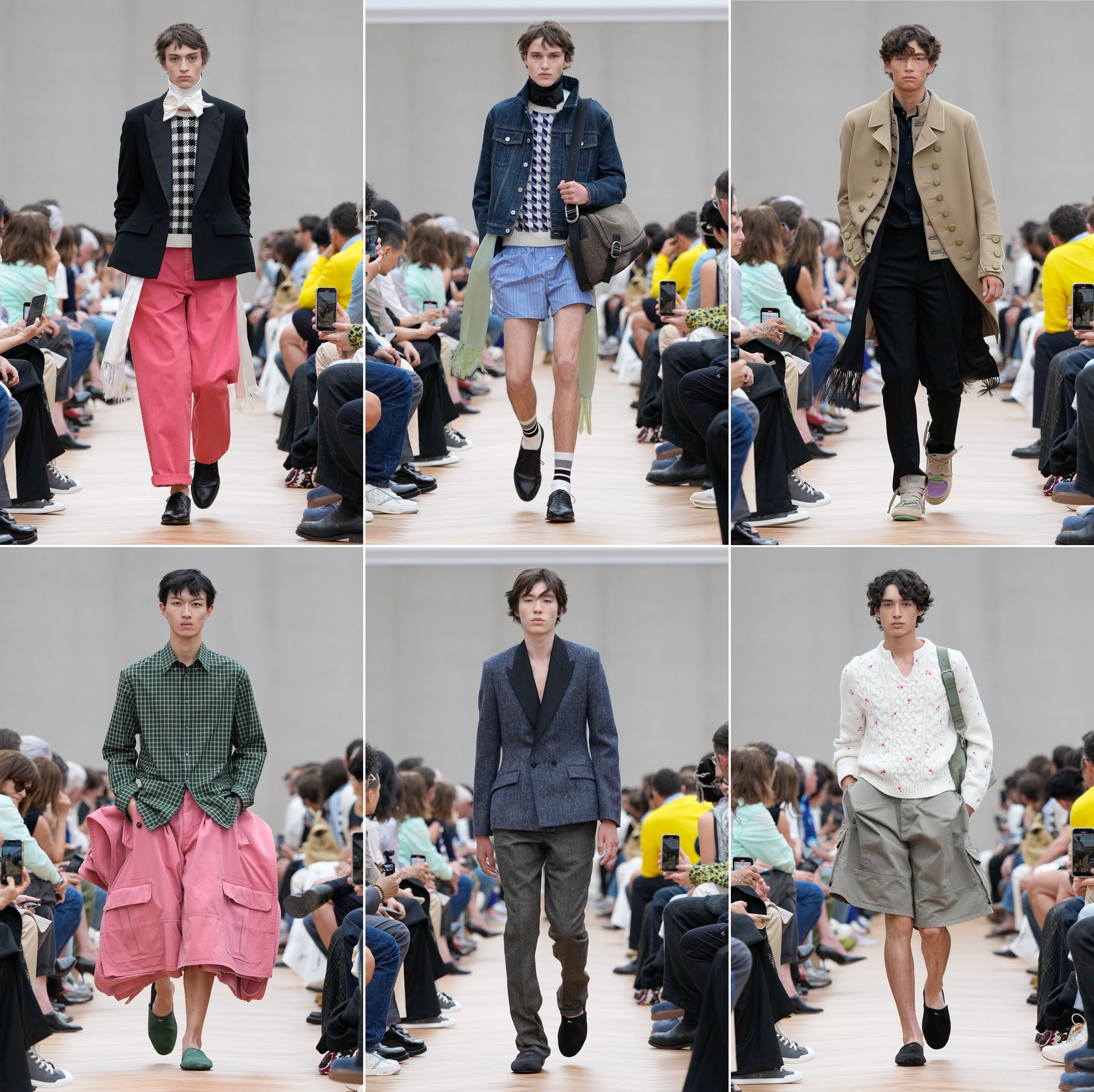
Mention must go to those voluminous shorts with the strange deconstructed and layered backs that looked like prehistoric gills drawn to the rear. Some, from the front, looked like conjoined anterior of jackets. The trousers, too, must not escape admiration: roomy khakis with deep pleats on the left and a curved drape on the right, a study in asymmetry that was not unthinking ridiculousness. Both bottom styles perfectly encapsulated Mr Anderson’s approach to blending classical tailoring with his signature oddball touches, and construction-driven aesthetic. The sum, as is usually the case, was composition to shift the silhouettes off-tangent, but not too much.
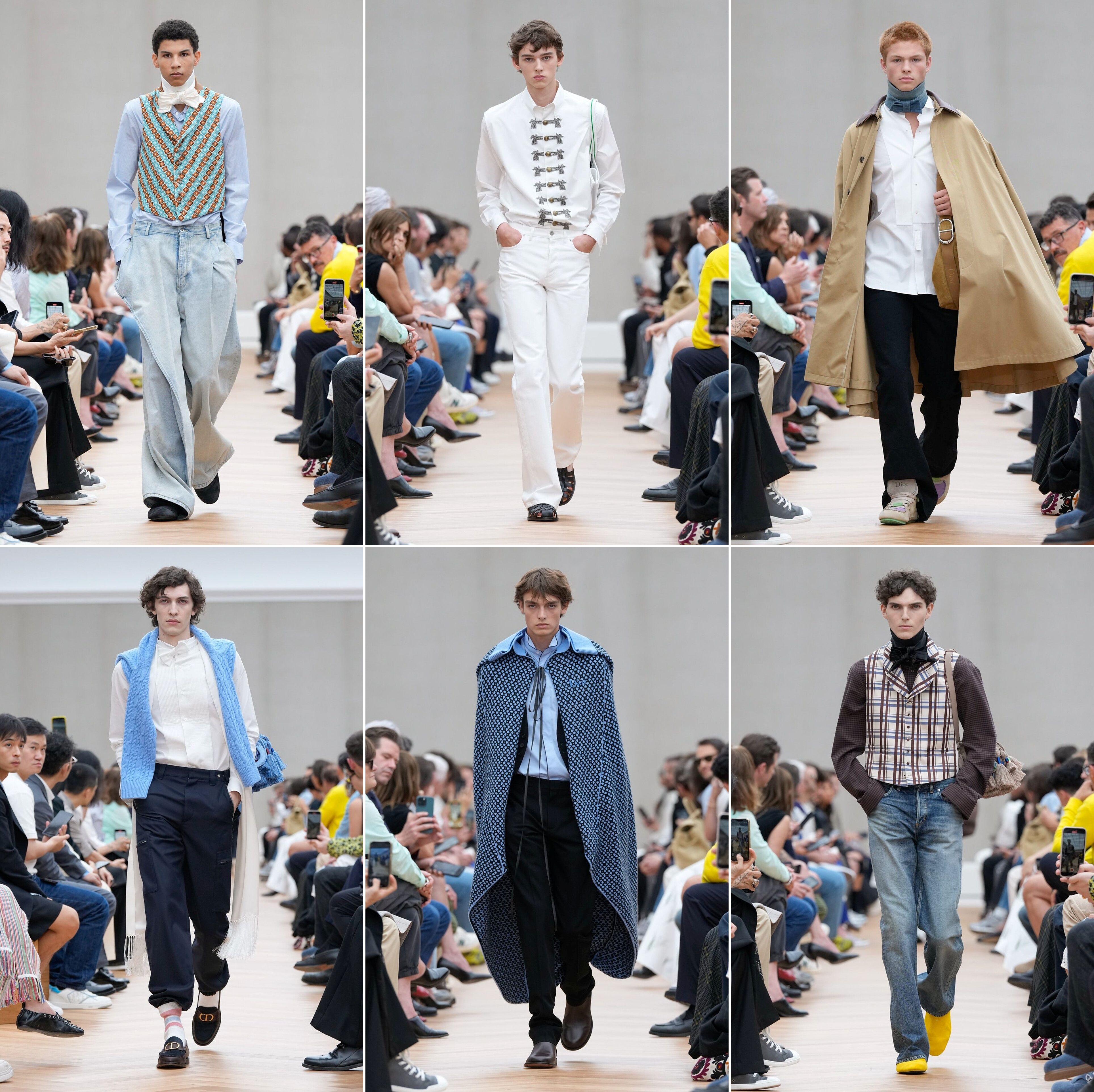
But, the true star of the show was the Bar Jacket, a cornerstone of Christian Dior’s original New Look for women, now given a distinctly masculine twist. This wasn’t just a simple resizing; it was a re-conceptualization for the male silhouette. In tweed, they could have come from a Dickenson novel, only now the front was softly shaped to give the waisted-and hip-defining signatures of the Bar, but in the rear, a masculine blazer’s back, with a single vent. The tailoring throughout was relaxed, with a swagger that recalled the Kris van Assche’s years than Kim Jones’s couture stuffiness. For the most part, these are traditional menswear pieces, even the capes that present-day Sherlock Holmes would appreciate, but Mr Anderson extended their length, creating a more elongated and almost painterly silhouette that felt deliberately out of sync with typical modern proportions.
A curious accessory was the standalone and tad oversized bow ties. Traditionally, a bow tie is an integral part of a formal shirt, tightly secured around the neck, Mr Anderson’s version, while Dorian Gray would not have said no to, was removable and worked almost like a choker. It detached the accessory from its usual function, turning it into an almost sculptural, decorative element, highlighting the craft of what would otherwise be a largely overlooked part of menswear. Although the frequency of its appearance felt less a novel neck wear and more like neck brace after a while, it did shift Dior away from the more streetwear-infused aesthetic of the past towards the sartorial, refined, even aristocratic. Early this week, Delphine Arnault told the Financial Times: “Quality is key.” If she meant it as a renewed and intensified focus, she was on point. It took some time, but Dior is back.
Screen shot: dior/YouTube. Photos: Dior
 Style on the Dot