Donald Trump looked no more imposing then usual, as he sat through a dull, stroll-through spectacle
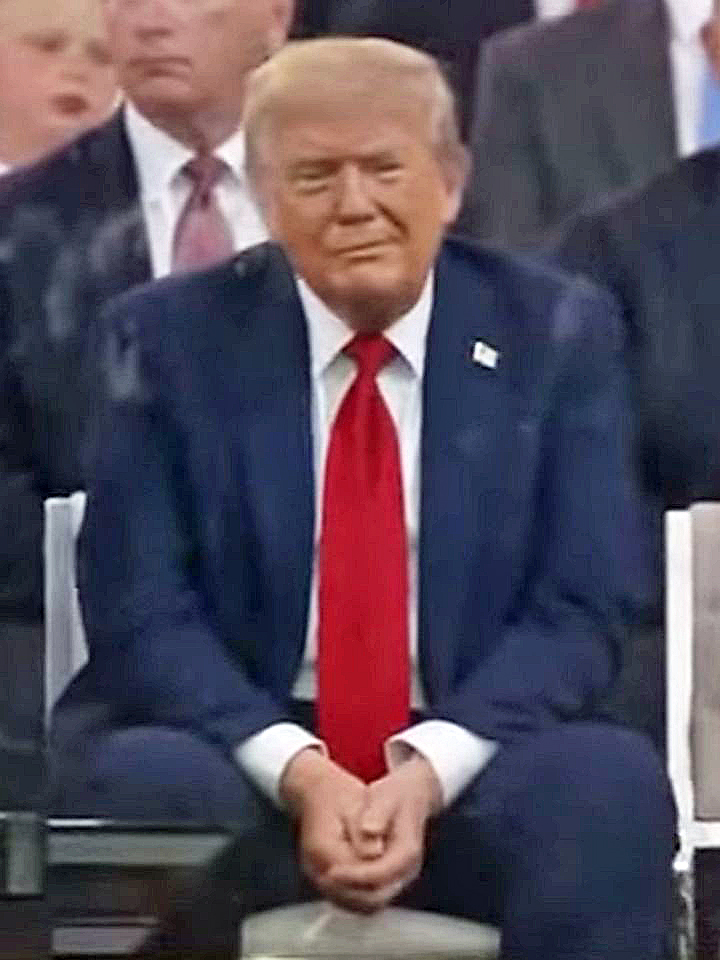
Donald Trump got his parade. He was clearly pleased, often clapping approvingly at what he saw was military might. For this special occasion, ostensibly to mark the U.S. army’s 250th anniversary, but was really a processional celebration of Mr Trump’s 79th birthday (or the high school show and tell he was not good at), he did not appear different than usual. He walked out onto the grandstand on Constitution Avenue, beaming, and holding his wife’s hand. He wore his usual lumpy navy suit. Underneath, a white shirt with a classic spread collar and square French cuffs was fastened with cufflinks punctuated in the middle with a black dot. As expected, hanging down the centre of his neck was a red tie, as rigid as a15-minute old McDonald’s French fry.
He sat down quickly, eager to take in what was going to march or roll past or fly above him. When the camera—and the world—zoomed in on him as he hunched forward, he looked no different from the many times he has appeared behind the Resolute Desk in the Oval Office, signing executive orders, or the numerous occasions he was photographed in court at the defendant’s table, listening to witnesses. Whether his choice is black or navy, he has reduced what he wears at work and in public to just that handful of suits. They are not sleek—lumps and puckering are sported in places, for the wearer has abandoned looking commanding or even good, as if his attire were an afterthought, unlike his truculent tariffs. Or, as Esquire put it more vividly, “the President of the United States gets dressed in the damn dark.”
Whether his choice is black or navy, he has reduced what he wears at work and in public to just that handful of suits. They are not sleek—lumps and puckering are sported in places, for the wearer has abandoned looking commanding or even good, as if his attire were an afterthought, unlike his truculent tariffs
Might he look better in a military uniform, as many strongmen he admires do, attending showy parades in their honour? In many constitutional monarchies, the monarch is the ceremonial head of the armed forces. They may not have practical command authority, but they do hold honorary military ranks and wear elaborate dress uniforms on ceremonial occasions. It is not farfetched that Mr Trump has such aspirations (which explain the concurrent ‘No King’ protest nationwide), but in the United States, the unchanged tradition is civilian control of the military. As the commander-in-chief of the armed forces, Mr Trump, like all before him, accepted a civilian role, not a military rank. He is not, therefore, a commissioned officer among service members; he is not issued uniforms by the quartermaster, even during parades or when interacting with the armed forces. Mr Trump, who loves to speak to a uniformed crowd, always appears in a suit—the one we have seen to death.
Looking at the troops in the parade, a tax-payer-funded birthday present, Mr Trump seemed impressed and appeased. But the display of soldiers and weaponry, while impressive in its raw components, was weakened by a somewhat sluggish procession. The men in uniform appeared to be strolling rather than marching. Some contingents looked as if they had just returned from the battlefront, defeated. This was a show of combat prowess, yet there was strangely nothing formidable about the participants. The lackadaisical march dented Mr Trump’s attempt to show the world how powerful the U.S. army is. While the media broadcasted interviews with those who were extremely proud to be in the parade, they did not speak to those who dreaded being coerced into it or who did not agree to their president politicising the army. Given the raging conflicts in the Middle East, the military fatigues worn did not obscure the weariness to war as tactically as Donald Trump’s shabby suits.
Screen shot: cnbc/YouTube
 Style on the Dot