Japanese brand Uniqlo joins wearable local food craze with a graphic of the kaya toast breakfast on their UTme! T-shirts. Problem is, another brand, Musoka Club, had the first bite
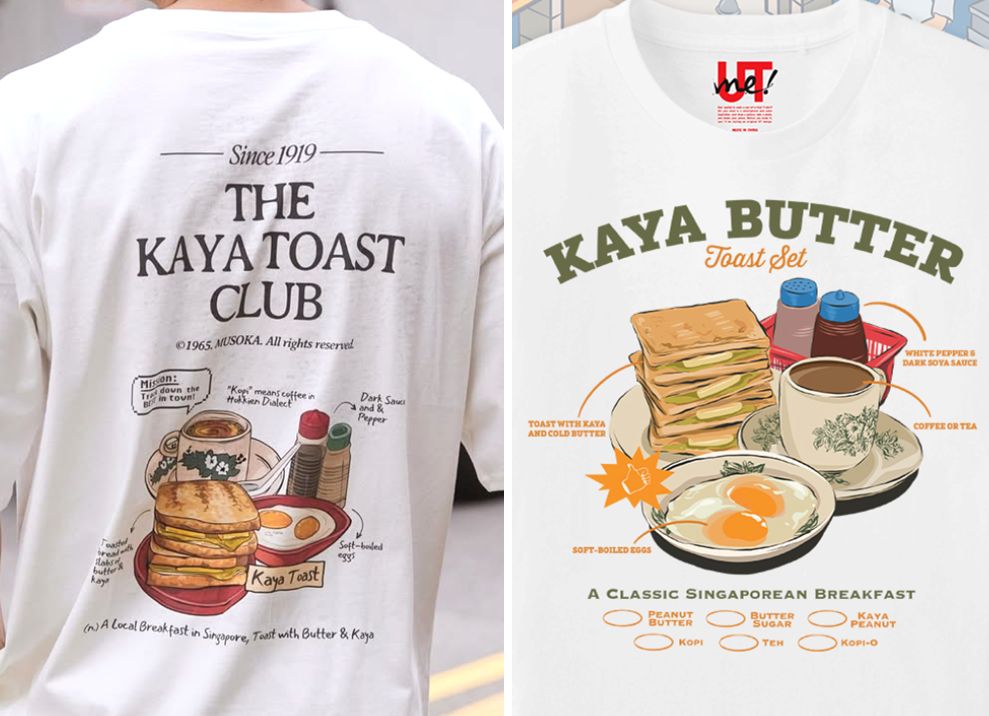
The kaya toast war: Musoka Club’s ‘The Kaya Toast Club versus Uniqlo’s Kaya Butter Toast Set. Photos: musokaclub/Instagram and uniqlosg/Instagram respectively
We admit we are late to the debate. Like many, we were disconcerted by the reporting that emerged two weeks ago, but chose to think about this before we join the fray. And also to wait for Uniqlo SG to issue a persuasive response to the allegations levelled against them. To recap, Uniqlo SG launched a new UTme! collection with tees featuring local Singaporean dishes, including kaya toast, as part of their ‘Thank You Festival’ that began on 23 May, 2025. However, this launch drew significant criticism due to the graphics’ striking similarities with the ‘Dress Code: Kopitiam Edition’, first released in July 2023 by local brand Musoka Club. The controversy became so loud that Musoka Club took to Instagram to clarify “some confusion a lot of you have due to the slight similarities of a certain brand with ours”, without identifying Uniqlo, adding that “ALL designs from MUSOKA Collections are Original & Exclusive to us.”
In an IG post from last month, Uniqlo lauded that the T-shirts “celebrates Singapore’s rich food heritage, featuring designs inspired by iconic local dishes” when they blurbed the launch on their Instagram page. Responding to queries by The Straits Times, Uniqlo said that their latest UTme! collection “was created in celebration of Singapore’s vibrant food culture, together with home-grown artists (their Kopitiam edition was reportedly conceived by illustrator-duo Tiffany Lovage and Kenneth Seow) and beloved local food brands” and that “food has long been part of our cultural storytelling”. While that is true, the response did not address the allegation of conceptual similarity with the output of Musoka Club. To make matters worse, it was revealed by Netizens that Mr Seow follows Musoka Club on Instagram, further fueling speculation.
The controversy became so loud that Musoka Club took to Instagram to clarify “some confusion a lot of you have due to the slight similarities of a certain brand with ours”, without identifying Uniqlo
Uniqlo, however, did not only crave for kaya toast; they were hungry for cai fan (菜饭, or mixed rice) too. The brand was called out for another case of conceptual similarity. One more local brand, PointyRice, also raised concerns about Uniqlo SG’s recent issue: a cai fan keychain, which bore an “uncanny likeness”—in customisability—to their own popular sticker set. On an IG post titled “did Uniqlo steal PointyRice’s concept?” by the brand’s founder, Caitanya Tan, the poser was tempered with the possibility that “big brands and small creators can sometimes arrive at similar ideas.” She also said that PointyRice had previously explored a potential collaboration with Uniqlo, which did not materialise. “Yes, it was a surprise,” she continued, “to see a similar concept brought to life so soon after.” A Uniqlo spokesperson claimed that the brand “did not receive any collaboration proposals from local artists or illustrators related to the cai fan customisation,” ST reported.
This second strike of alleged thematic similarity, following the Musoka Club kaya toast (and the like) T-shirt issue, has intensified the discussion about intellectual property, the challenges faced by local creators, and the responsibility of global brands in celebrating local culture authentically. While Uniqlo maintains their commitment to local culture and talent in their carefully scripted responses, the recurring online dismay highlights the delicate balance big brands must strike to avoid appearing to appropriate the ideas of smaller, independent creators. Still, two incidences in a row move the issue beyond unfortunate coincidences to suggest a systemic issue or a lack of robust internal checks within Uniqlo Singapore’s creative process. It highlights a critical need for global brands to move beyond mere local themes and adopt a more genuinely collaborative, respectful, and ethically transparent approach when engaging with our culture and talent. They need to play down the perception of the imbalance of power, when a big brand leverages its scale, resources, and market reach to benefit from ideas generated by smaller businesses without equitable recognition and—just as bad—compensation.

Mixed rice, mixed feelings: PointyRice’s customisable stickers of cai fan-on-a-plate versus Uniqlo’s also-customisable cai fan-on-a-plate of a keyring. Screen shots: pointyrice/Instagram and kerrynleemx/Instagram respectively
The Uniqlo controversy regarding food items like kaya toast and the like intersects with the existing, often heated ‘origin wars’ between us and our northern neighbour. This often plays out on social media and the local press on both sides. Uniqlo’s actions take this debate into the realm of mass-market retail and consumer goods. When a global brand commodifies these items under a Singaporean branding, it could give the Singaporean claim a much larger, more visible platform. This could be contentious to Malaysians who feel their historical or cultural claim to these foods is stronger, since it may suggest that a major brand is taking sides in the debate. Additionally, if Singaporean brands are copying each other, and an international brand is copying a Singaporean brand, it creates a tangled web that undermines any claim to original or unique culinary/cultural heritage being represented. It is not just about who invented the food, but who authentically represents it.
There is another layer of complexity to the dispute: It does not help that in our fashion industry, originality is not exactly a paramount virtue or an admirable professional trait. We are increasingly seeing the normalisation of ‘inspiration’, easy euphemism for taking ideas from others, even if the end result is not merely homage. For our fashion scene to truly flourish and gain even a vestige of recognition for our unique voice, it needs to cultivate and celebrate genuine originality. If the perception is that local designers primarily rehash or combine existing ideas, it becomes challenging for Singapore to establish itself as a source of truly distinct—forget cutting-edge—fashion and design. The Uniqlo incidents tragically undermine even this basic aspiration, making it harder to show that local creativity goes beyond thematic replication. Ultimately, this controversy is a stark reminder that the best way to elevate local flavors is to truly savor their unique essence, not just re-plate them.
 Style on the Dot