…for the Pink Fest, but was the second Fashion for All a compelling exploration of fashion on our island, besides being a commitment to move beyond traditional, often narrow, definitions of fashion and beauty to embrace a wider spectrum of the people around us?

The motley group of runway participants at Fashion for All 2025
DORS (the preferred name of Design Orchard Retail Space now) opened last week after nearly two months of what CEO Zhang Ting Ting (张婷婷) called “renovation” to fortify its positioning as a “community-rooted” store. The first event that marked the refreshed space was not a grand opening (that, reportedly, will be held next month), but the second installation of Fashion for All, one of this year’s “Signature Events” of Pink Fest, the community-led LGBTQ+ platform. The show last night was unexpectedly ticketed. For non-invitees, the $80 charge came with “two drink coupons and a $30 DORS voucher”, the counter staff at the entrance helpfully informed and showed us. DORS shared on Instagram that tickets were sold out. It was not immediately clear if most of the attendees—the usual mix of theatre folks and fashion types—paid to partake in the celebratory blowout-with-a-show.
Fashion for All 2025, after a rather riotous outdoor debut last year, was a sleeker affair held in DORS itself. So thrilled the bedecked festival director of Pink Fest, Harris Zaidi, was to be able to stage the show in the store that he told the audience in his opening speech that now, “we got a space; we are not in the fringes”. Indeed, they weren’t. There was perceptible levelling up at this year’s Fashion for All. It was more in line with a runaway presentation than a carnival parade, as seen at last year’s roof-top affair. Apart from the perceptible comfort of the guests (and the models, although a couple were visibly soaked), there was a greater emphasis on the visual impact, the styling, and the overall look of the show, which we noted was a creative endeavor in itself.
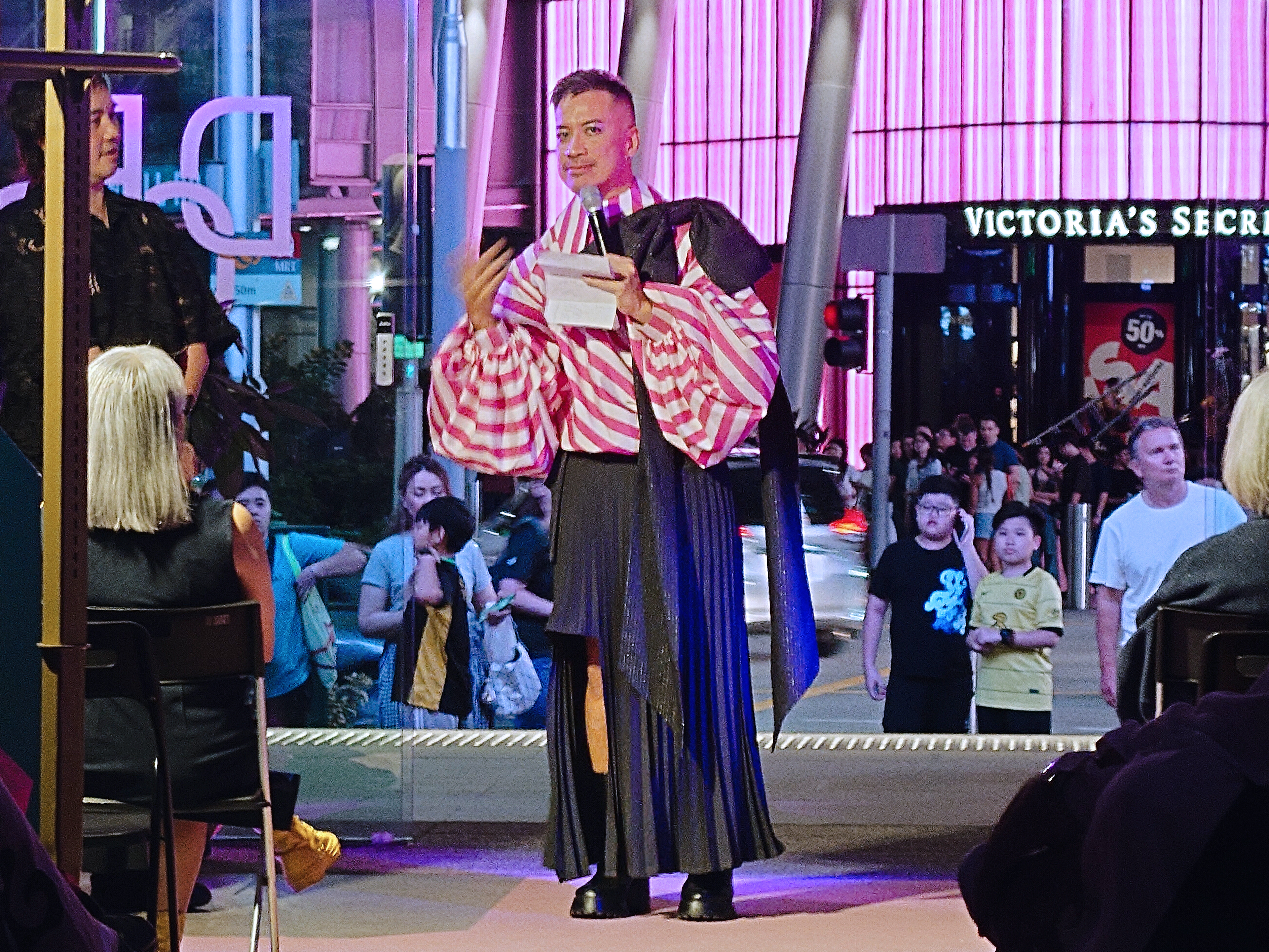
Host of the evening, festival director of Pink Fest, Harris Zaidi, in a costume by Nasri Isaac
A good idea was to have the models walking in from the entrance and the guests facing out. Doing away with static screens and sets, the Orchard Road traffic, including public buses roaring past and curious pedestrians and tourists peering in, as a dynamic and living backdrop was clever. It helped, too, that there was the on-theme pink façade of the Victoria’s Secret store across the street. In sum, it created a contrast between the choreographed movement of the models and the organic flow of city life. It afforded the commentary on how ‘fashion for all’ integrated with the urban fabric of our city. Even the roar of the vehicular crunch on Friday evening coming through on the finale music of Olivia Newton John’s Xanadu was a curiously charming juxtaposition. Instead of trying to block out the city noise, which would be nearly impossible on Orchard Road, the show embraced it.
A fashion show is, ultimately, about the clothes. And the clothes yesterday evening could be clearly seen, without the distraction of the punishing heat, as experienced last year on the ‘bleachers’ of DORS’s roof top. Some people told us that we should support the cause, not scrutinise the clothes. Admittedly, the cause was the reason for the show. However, if the cause was the what, the clothes were clearly the how. They were the tangible medium through which the message of Fashion for All was communicated. For the event to be truly impactful and to further the conversation around fashion beyond just representation, the clothes themselves—especially since the merchandise at the venue were by compatriots (or neighbours) of the people we were there to support—needed to engage. As with many shows at DORS and its past iteration, the styling saved the day.
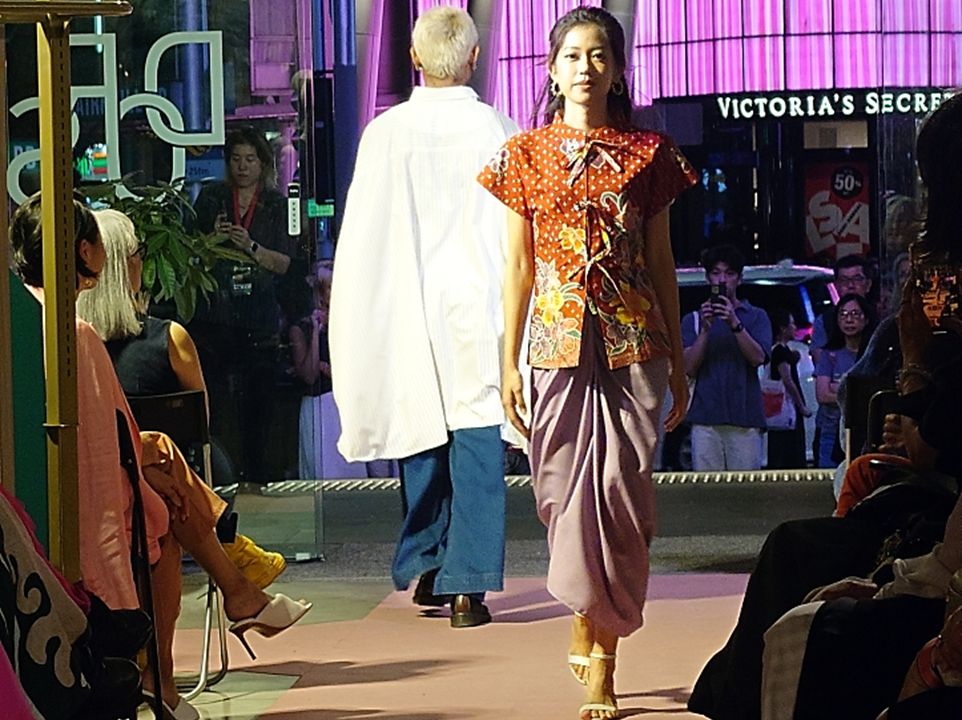
A talent in Studio Gypsied
It is admittedly challenging to keep to the “fashion” aspect of the event and the “all” component, and risk achieving neither. But the curated looks this time attempted to say something through the lens of fashion. The audience at a “fashion” event, even one attempting to be inclusive, expects to see designs: creative vision, new ideas, aesthetic appeal, and pieces that inspire. While DORS has yet to speak with the authoritative voice that we have been hoping they could, the show was ardent in saying something about the possibilities when one applies a deft hand in styling the clothes not necessarily conceived for an all-encompassing audience. Many of the runway pieces are existing collections from designers who have not exclusively focused on inclusive design from the ground up. But the way each look came together had something going for them: fashion interest. Fashion for All this year moved beyond merely fulfilling a quota of obviously diverse models.
However, while we understood that there was a need to pay homage to Little Nyonya (considered MediaCorp’s most successful TV series. The original broke viewership records in 2008, leading to this year’s spinoff, Emerald Hill—The Little Nyonya Story), we rather there was not. It is typically tough for ethnic-flavoured clothes to cater to the “fashion” part, even if they do the “all”. Lest we are mistaken, they could be beautiful in their traditional context, but incorporating them into a show that aimed to speak to the modern fashion consumer can be difficult. Frequently, they do not lend themselves easily to the experimental layering, deconstruction, exaggerated silhouettes, or reinterpretation, evident on this year’s Fashion for All runaway, which one senses was a more serious and polished approach, aiming to be taken as a legitimate fashion event, not just a community gathering.

Former and, now, comeback model Colin Chee in Duxton
A profound point about the concept of all in Fashion for All is also the who. While the offerings of DORS are “community-rooted”, as Ms Zhang said, they should not be just about addressing the margins, as it could be construed. Apart from the ‘fringe’ and ‘special needs’; they should also serve the vast, diverse middle ground. Fashion for All must push beyond annual tokenism and into a more robust, challenging, and ultimately, more meaningful sphere. It’s about encouraging a fashion ecosystem where as many as possible can find their style, whether designers or consumers, and feel good in what they sell and wear, and not only at uproarious fashion events.
The most notable of the show was the capsule by the show’s choreographer, the “godfather of Singapore fashion” himself, Daniel Boey. His debut line Furry Tales, expected to launch next month at DORS, is an extension of his love of dogs, and a possibile merchandise spinoff of his two books, We Adopted and We Adopted Too. The unisex pieces of T-shirts and hoodies, in proportions that stayed away from the muscle tee (more inclusive fit?), sported fetching collaged graphics of anthropomorphic canines, put together by long-time collaborator Sam Lo, also the illustrator behind Mr Boey’s two books about dog adoption. An ardent supporter of inclusivity, Mr Boey’s Furry Tales was a welcome contribution to the dialogue of striking a balance between “all” and artistry.

Debuting at Fashion for All was Furry Tales, the new T-shirt/hoodie line from the show’s choreographer Daniel Boey
However feel-good in effect Fashion for All was, it wasn’t immediately clear what the messaging was for DORS, still in the process of a rebranding exercise. Old perceptions of its former self, Design Orchard (noted as a tourist gift shop or a place with inconsistent design value), still linger. There is, regrettably, limitations to what a single, annual event, no matter what good vibes it generates, can do to fundamentally shift a long-held perception of brand ambiguity. And oddly, this time, staged ahead of the grand opening of the renamed store, risking a missed opportunity for synergy, especially when the operator of DORS, Singapore Fashion Council (SFC), has floated the market tagline Every Body Matters, which includes a design competition in partnership with Shein.
Under its previous guise, Design Orchard struggled to deliver convincingly on the ‘design’ promise of its moniker—the quality of design and the innovation of design. Or challenge the perception that it wasn’t consistently hitting the mark, if at all. DORS’s support of the Pink Fest is appreciable, but with Fashion for All, the immediate thought might be about universal accessibility and representation, which, while commendable for promoting social cohesion and tolerance within Singapore, doesn’t automatically equate to designs that can communicate the breadth and depth to move beyond local social good and achieve global design recognition, which SFC hopes to gain when it opened the competition to “emerging fashion designers and industry professionals from around the world”. Fashion for All can make its mark, if it can prove that a wider embrace doesn’t mean a narrower vision for design.
Photos: Zhao Xiangji
 Style on the Dot