Amazon may have backed down now, but other e-commerce sites operating in the U.S. are not afraid to reflect the tariffs charged in the pricing
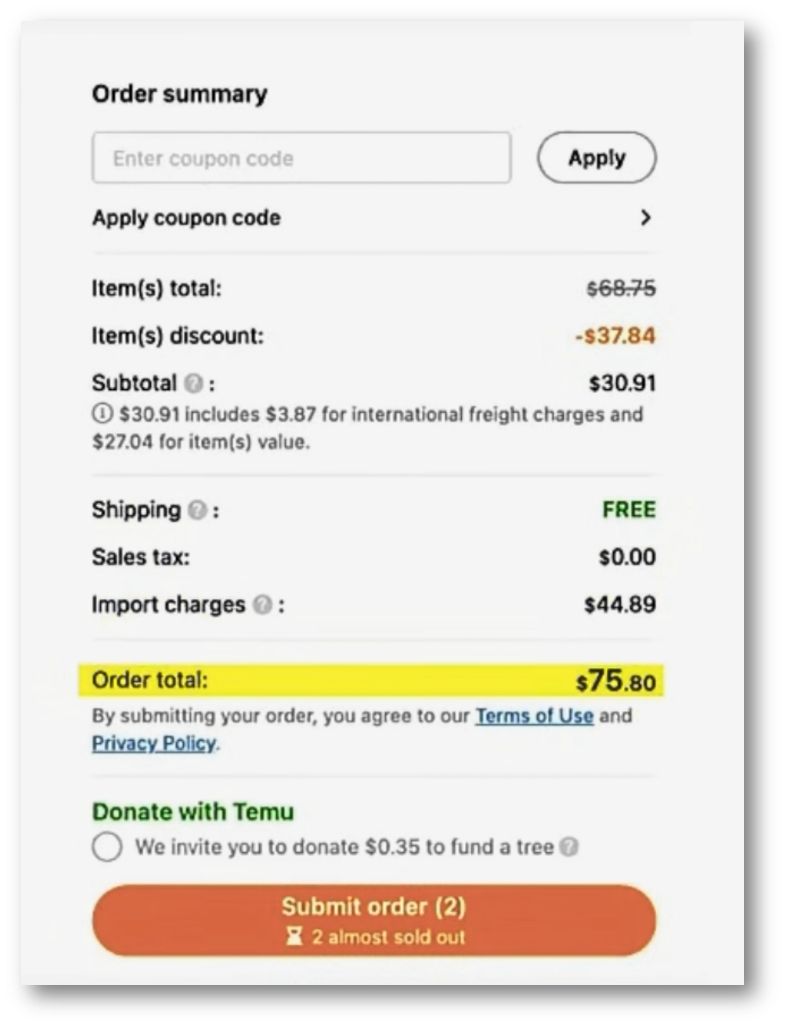
A Temu bill showing the tariff one customer had to pay. Screen shot: CNBC
In the wake of what some have called Amazon “cowering” to Donald Trump, the question many American retailers are now asking: Should the added cost of tariffs be explicitly displayed to consumers at the point of purchase? Two days ago, Amazon made the news when, during a White House press briefing, the press secretary Karoline Leavitt was asked if Amazon’s then purported plan to show the tariff figure om their website was “a perfect demonstration that it’s the American consumer who is paying for these policies?” She hit back without answering the valid question: “This is a hostile and political act by Amazon.” It is so because for a very long time Ms Leavitt has been peddling the alternative fact that those slapped with tariffs pay the tax, as if it were a fine.
The e-tailer was quick to act. They released a statement to say that it was a consideration for their “ultra-low cost Amazon Haul store” and that it “was never approved and it is never going to happened.” But that was not the end of it. According to CNN, the president was “pissed”—quoting a source—and called Jeff Bezos to “complain” about what Amazon was not considering doing, yet. Mr Trump, who described it to the media as a “good call”, said that Mr Bezos “solved the problem very quickly”. What the problem was, Mr Trump, delighted that it was no more, did not say. But it was not hard to make out that the Trump administration did not want the American public to see the added cost that tariffs brought to products since they have been saying the exporting countries pay.

A product page on Temu. Screen shots: Temu. Collage: Just So
But while Amazon was willing to let a president influence an essentially commerical consideration, other e-tailers were ready to go ahead to clearly spell out what shoppers would have to pay in terms of Mr Trump’s tariff orgy. One of them is Temu. CNBC reported two days ago that the Chinese e-commerce platform included the tariff amount in their check out page, using the less-alarming term “import charges”. A receipt (top) shared in the report showed a total price for two items purchased—a kid’s swimming costume and an adult sundress—US$31.91, not including the staggering $44.89 in tariff charges. Showing the tariff breakdown is offering pricing transparency to customers. If Amazon already lists the sales tax separately in the final billing, showing the tariff paid is no different.
What Amazon initially considered, therefore, might have built trust and positioned them as being upfront about price increases driven by external factors. Oddly, in their explanation of what they were toying with, they came out drawing attention to their Amazon Haul store, where cheap products can be bought. U.S. Treasury Secretary, Scott Bassett, it would be interesting to note, had earlier said that “access to cheap goods is not the essence of the American dream.” While this might merely be an economic observation that the American dream should not be built cheaply since America is so wealthy, the broader theme could be the easy availability of affordable goods that are often facilitated by now in-the-spotlight large retailers and global supply chains. One can’t help but feel that, like so much under the current American administration, it carries underlying implications for U.S.-China trade relations.
 Style on the Dot