On the U.S. tariff front, no good news yet, just flip-flopping. Who’s surprised?

“Have some patience and you will see,” White House press secretary Karoline Leavitt said two days ago when asked if the tariffs will work because China has not budged. The problem is, many business owners are losing any store of patience they may have. Not a day have we woken up in the morning without news of the Trump administration flip-flopping on tariffs. One SOTD reader texted us earlier: “See, lah. Crazy” when he learned of the backtracking, and then the re-imposition of those maddening “reciprocal” tariffs. The question that keeps popping up: Can capriciousness really bring about any good to the business environment anywhere? Is it possible that over there, they don’t know what they’re doing? Maybe there really is no plan, just whims?
And then the CEOs of Walmart and Target—two of America’s largest retailers, including garments, warned in a private meeting with Donald Trump that his tariffs could lead to zero stock levels soon, U.S. media reported. The men did not specify what was exchanged in the “productive” meeting—according to them, but apparently the tariff tsar was told that the sweeping tariffs he has imposed on America’s every partner-nation in trade (including the islands of Heard and McDonald in the Antarctic populated by penguins) could “disrupt supply chains and lead to empty shelves in the coming weeks”, according to CBS News. That probably included empty racks too. It is not reported if the dire message fell on deaf ears.
Is it possible that over there, they don’t know what they’re doing? Maybe there really is no plan, just whims?
Last week, the tariff on most goods made in China was 145 percent. Two days ago, Donald Trump said the U.S. would drop tariffs “substantially, but not zero”. The unrelenting shifts and changes are hard to keep up with, let alone comprehend. It is unclear how the flip-flopping provides him negotiating leverage as his tariffs were supposed to offer. After all, Mr Trump thinks that trade deficits, especially in goods, means that trading partners have treated Americans unfairly, downright horribly. They have to come begging and willing to “kiss ass” for any change. But could uncertainty too be used for leveraging a better deal for the poor, battered US of A? And to hastened America’s already damaged relationships and loss of credibility?
According to a CNN report two days ago, in 2024, apparel constituted “5% of (U.S.) imports but 26% of tariffs collected”, citing data from the American Apparel and Footwear Association. This year, the tariffs paid to the Trump government are expected to rise, inevitably leading to higher prices for retailers in the States. Yet, it is not clear if anything is really confirmed with America’s trading nations that might halt the price hikes. According to PBS News, 50 countries have reached out to the White House”, but the outcomes unknown. Treasury Secretary Scott Bessent mentioned on CNBC that there were “up to 70 countries” lined up for negotiations. Again, no outcome. And then Ms Leavitt, the combative White House press secretary, said two days ago, “there have now been 18 proposals and more than 100 countries around the world who are wanting to make a deal with the United States of America.” Proposals. No ratifications.
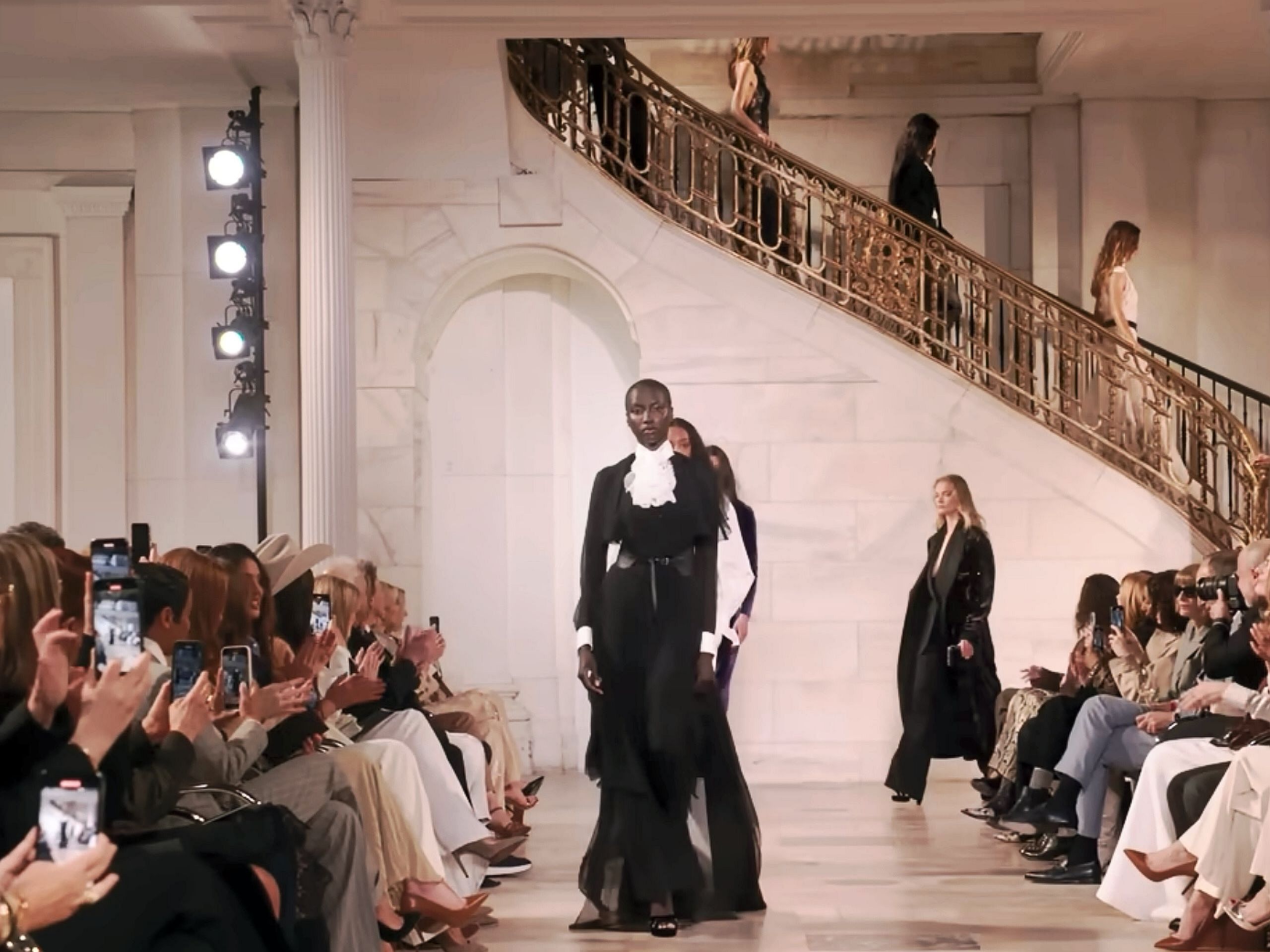
Ralph Lauren pre-fall 20205 show in Manhatten, New York. Screen shot: ralphlauren/YouTube
Whatever the real situation is, businesses have to go on or stop. One of them that has definitely soldiered ahead with the appearance of scant tariff impact is Ralph Lauren. Last week, the brand staged a fashion show for its pre-fall 2025 collection in a former bank hall with Corinthian columns and ornate wrought iron stair-railings. In her review of the show, Vanessa Friedman of The New York Times wrote, “president Trump is not the only one with the last Gilded Age on his mind.” As usual, Mr Lauren evokes in his clothes an American era that exists only in his imagination. One of the most recurrent detail in the close-to-frumpy collection is the lace jabot. It is not known who among the few American garment manufacturers still make these neck hangings associated with the 17th century that Mr Lauren thinks women will love to wear. He may have knocked on China’s door.
Legacy brands may be able to put a brave front to suggest that they are able to weather the tariff storm, but small, independent brands have been candid about their struggles. On a recent broadcast of Amanpour & Co, the late-night global-affairs show on PBS, Sarah LaFleur, founder and CEO of the New York-based clothing line M.M. LaFleur, told journalist Michelle Martin: “our May collection is 90% evaporated overnight because we can’t afford to bring in goods from China.” She also clarified that those who pay the import tax are importers, like herself (not, as Karoline Leavitt said, “a tax hike on foreign countries”). “If you think about the duty… that we have to pay to the government, we pay the moment our goods hit the United States border. That’s an outlay… without the certainty that the customers are actually willing to take on the price increases.”

A coat and a turtleneck top from M.M. LaFleur’s currrent collection. Photo: M.M. LaFleur
Although we mentioned two American brands, Trump’s tariffs affect the broader fashion industry. And, the now-in-the-spotlight global supply chain. As we have stated before, articles of fashion are made across the world, rather than in the country where the brands are founded. A recent visit to a Calvin Klein store, for example, revealed that nothing—absolutely nothing—is produced in the U.S. (on their website, CK does not even say where their garments are made). Very few American brands are produced in a single nation. This is by no means exhaustive, but we have uncovered the following countries that manufacture for CK: Bangladesh (tees and sweats, and jeans), Cambodia (tops and knitwear) China (technical outers and jeans), India (tees), Indonesia (woven shirts), Kenya (tees), Sri Lanka (denim shirts and pants), Pakistan (denim wear), and Vietnam (tees, blazers, and blousons).
Given CK’s wide merchandise mix, they would not source their production from a single country. In fact, most American brands do not. Extensive international sourcing means cost efficiency, specialised skills and expertise, and access to wider selection of fabrics and trims, among a host of compelling reasons. Present-day brand management strives to achieve the desired balance of cost, quality, specialization, and risk mitigation. In order to do so, brands usually engage with multiple suppliers and manufacturers across the globe. Needless to say, there is the cost advantage, which contributes to higher profit margins. When we asked a twentysomething if she has ever looked at the label when buying CK to see where the garment is made, she said no. Does it matter where the items are manufactured? The answer was, again, in the negative. Was she aware that Calvin Klein garments are made in at least half a dozen countries? “Really, meh?” Did she think that the clothes would be more expensive with Trump’s punishing tariffs? “What is that?”
A recent visit to a Calvin Klein store, for example, revealed that nothing—absolutely nothing—is produced in the U.S.
The complexity of global sourcing is now, more than ever, amplified by Trump’s tariff policies, and how the taxes fluctuate. Mr Trump often talks about having a plan when there are, in actuality, none. At best, a sketchy one that no strategist would consider to be a scheme of things. Trump’s tenure has redefined ‘truth’; now ‘plan’ too. One sourcing agent told us, “that brands are shifting production to countries that are not affected by high tariffs, such as China”. He was personally told by clients that they would be cancelling unnecessary orders and delay non-urgent shipments. In addition, he was told to strike a deal with vendors to “bear a part of the tariffs”. He also said, “Being an exporter to the U.S. today is very lousy. They will not make much money, especially those operating on low margins.”
Despite the efforts of the CEOs of Walmart and Target, it is not clear if Mr Trump understands the global trade situation now, not just the supposedly damaging deficit bearing its weight on America the Great. He demands that manufacturing returns to the U.S., but even if that can be realised (unlikely is the common response), it won’t be before the tariffs are lifted or before his presidential term ends. Donald Trump has never worked for anyone except himself. This indicates a possible lack of understanding of corporate parameters and discipline. It is not even clear if he comprehends how a company actually works. He likely approaches his business, many of which have failed, with a flagrant disregard of business conventions and restraint, even fiscal propriety. This is how he runs America Inc today. As Sarah Lafleur, the clothier, said about her business situation, which could be about U.S. trade policies: “It has been total chaos”.
Illustration: Just So
 Style on the Dot