Love, Bonito had a massive sale at Singapore Expo. The response was astonishing. So was the amount of stocks
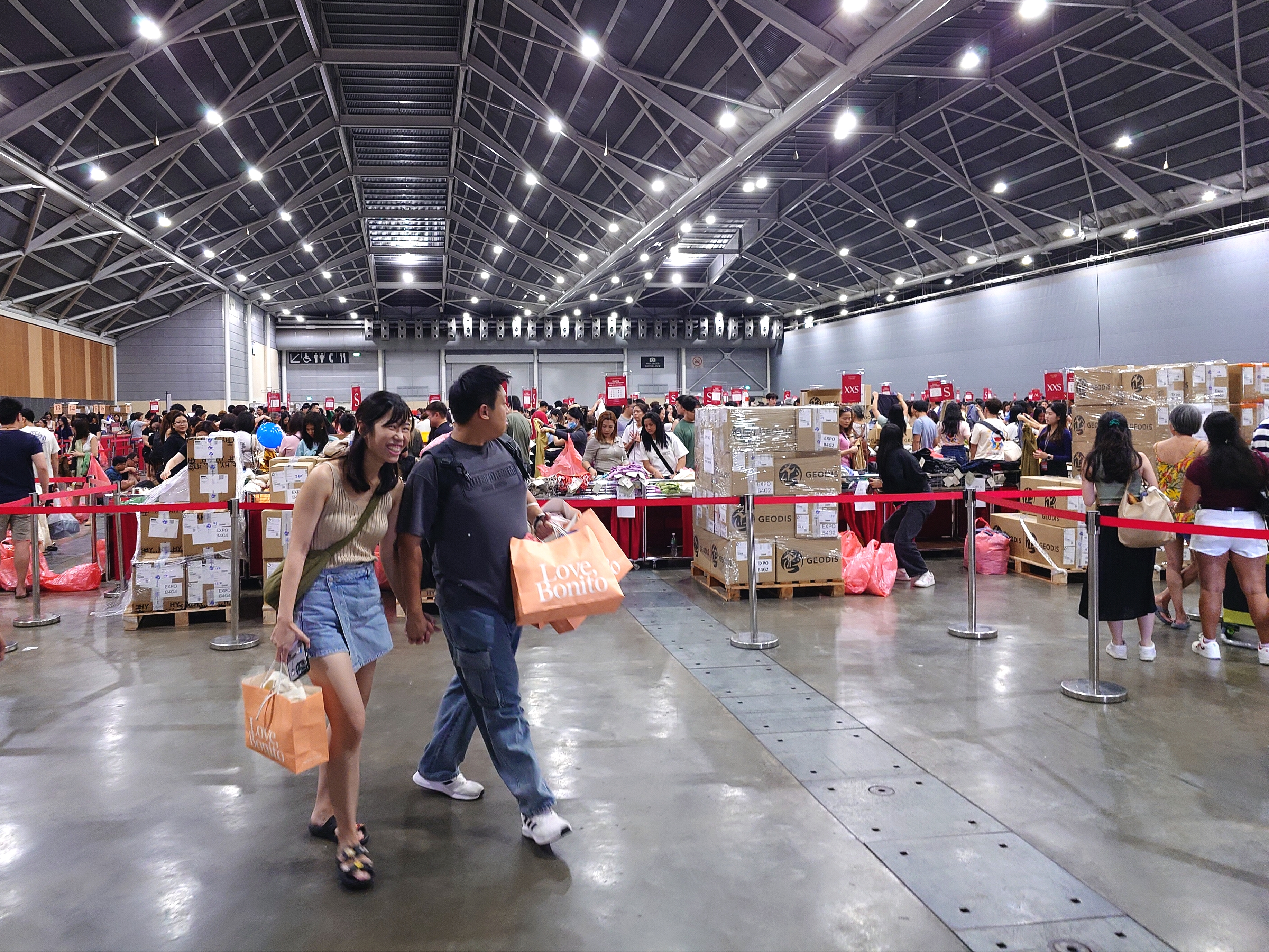
Love, Bonito’s first warehouse sale at Singapore Expo
By Mao Shang Wang
It was their “first ever (sic)” warehouse sale at Singapore Expo and they happily touted it. Love, Bonito sales are popular, but the massive turnout of their latest over the weekend, I did not expect. My colleagues who took leave on Friday to go had texted me to say they had to join a long line to get into the main event. Was it that good and was it worth the queue, I texted back. “Yah, very cheap and so many things to buy,” they replied rapidly. Still, that was no attraction to me. But I was kaypoh (curious): Did Love, Bonito have so much stock to clear that they needed to conduct a warehouse sale, not at their own stock-keeping facility, but at Singapore Expo, our city’s largest MICE venue?
The space that Love, Bonito took was 10,000-sqm huge, large enough to hold about eight Olympic-sized swimming pools. That was a crazy lot of merchandise to fill. I was burning with curiosity. How was it that one of our beloved brands had that much to get rid? According to the brand’s pre-event posters that circulated online, shoppers could “expect over 80k items” to dig into. And prices start “from just S$5”. That is less than a bowl of mee pok tar at the coffee shop nearest to my flat. Or, for the more atas among you, more than the price of a tall, iced latte at Starbucks. I had to go, I thought, not to buy, but to see to believe. However, I was not willing to queue. So I decided to go on the last day of the sale (yesterday).
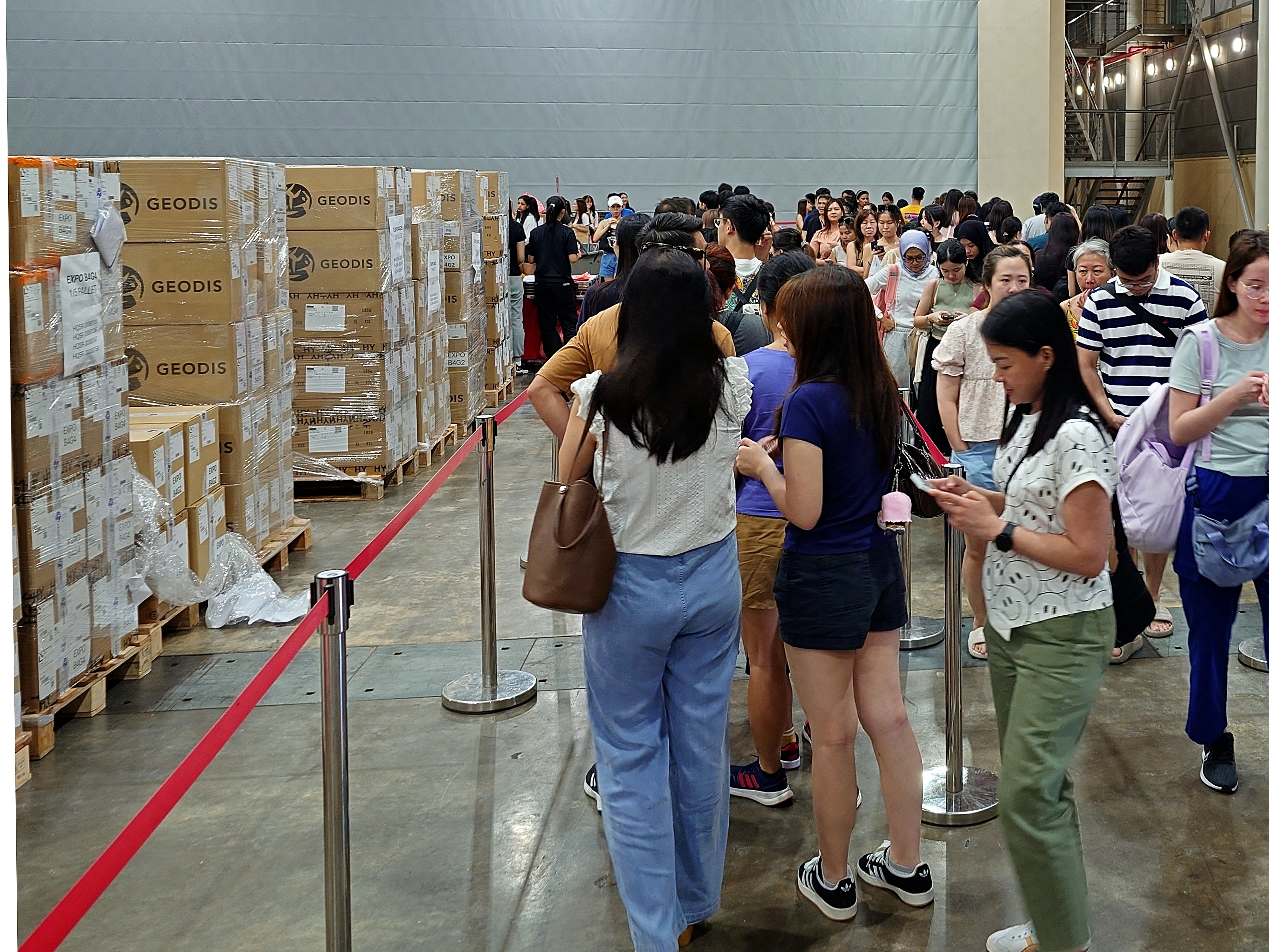
The long line to join before one could enter the main shopping area
Their communication materials told me that “last entry 5.30pm (although the event was to close at 7pm)”. I arrived two hours before the cut-off time for the final admission. Still, I was unable to avoid the daunting queue. Teenaged crowd control attendants pointed me to a line made orderly by belt stanchions. Frankly, I was not willing to join the line. But, like I said, I was curious. In front of me, I asked two girls who were watching Little Nonya on one of their smartphones if they were excited to be shopping the warehouse sale. They replied, “yah, lah. Cheap, mah. What do you think?” And they giggled, as if I asked the stupidest question they have ever heard in their entire markdown-hunting lives.
From the queue, I could see that the designated space for the merchandise stretched backwards for as far as the eye could see. Directly in front of me were wooden pallets on which up to five cardboard cartons of presumably garments were stacked. These created a division between shoppers and those waiting to be. It did not look overcrowded on the other side, yet the queue was moving rather slowly while it was growing longer. At the entrance, more belt stanchions were ready to accommodate those willing to queue when the holding area inside were too full. To my left, I could see a long cashier counter set up. There was no queue to pay. That must be relief to those who thought they would have much to purchase.

It was flip and toss at many of the gondolas
Thirty minutes later, when I was finally released from the line, like a refugee allowed into a relief supply depot, I was immediately met by people crowding the sale bins. About three-quarters of the hall was filled with gondolas, none of which contained neat arrangements of merchandise. This was a warehouse sale, I reminded myself. Aggressive shoppers were the winners. The products were arranged by size, beginning with XXS at the start and the largest sizes in the rear, which was where some semblance of stress-less shopping could be found. Most women did not realise that they had to shop by size, so they just plunged into whatever pile caught their fancy. And discard whatever they did not want wherever they wanted. Red plastic shopping bags like those you would be given when buying fish at the market were issued to hold your hauls. I saw that many shoppers had more than one bag to fill.
At the size-M zone, I asked one of the young staffers why there appeared to be so much stocks to clear. She replied coldly, “don’t know.” Perhaps sensing that that was no answer, she added: “Have to make space in the warehouse for new stuff.” Her reluctance to be friendly meant that I could not determine how old the merchandise in front of me really was. Or if the stocks included the unsold from their stores in Cambodia, Hong Kong, Indonesia, Malaysia, and the Philippines. It was the final day of their clearance sale and yet it appeared to me that there were still much garments that had to be returned to the warehouse as I could see at least 300 hundred (probably more) boxes unopened, still secured in their tight plastic wraps. It was quite a staggering sight. Even at S$5 a piece (and an additional 50 percent off for ten items), many pieces just looked too sad to entice.

Shoppers bought by the bags-full
According media reports, Love, Bonito has been performing well, despite seemingly aggressive expansion and, converse to that, the trimming of its global workforce by 6.9 percent in October last year. CEO Dione Lee, in a LinkedIn post, stated that the brand’s performance has been encouraging: In “2023 we achieved S$88M / US$65.8M in 2023 revenue (+37% YoY)”. And in the current year, they “are on track to cross S$100M / US$75M and hit profitability.” Love, Bonito has ventured into the American market with a pop-up in New York’s Soho district in 2023. But, as I was told, the store is no longer there for about a year, which means they have escaped the Trump administration’s harsh tariffs by a thread’s breadth. But the brand still targets the American market through its website and offers delivery stateside.
I am not sure if the upbeat projection that Ms Lee offered on LinkedIn took into consideration the new global trading reality, following the Trump administration’s wicked tariff policies. But Love, Bonito’s webpage presently also stated that “due to the ongoing changes of US tariff policies, shipments to the US with a customs value greater than $800 will be temporarily suspended”. It added that the “restriction is being implemented to help manage the complexities of customs clearance and avoid potential disputes related to duties and taxes under the new US tariffs”. Only total purchases of below US$750 will be entertained. It is unclear if their e-commerce platform has attracted good enough business from the U.S. Or if Americans, used to Shein and Temu, would buy up to US$750 worth of hauls from Love, Bonito. I looked at the amount of products yet to be cleared in hall 4B of Singapore Expo, and I cannot see positive signs of the brand’s dream of opportunities in Trumpland.
Photos: Zhao Xiangji
 Style on the Dot