With TikTok videos viewed by scores of Americans worried that their purchases from China will escalate in price, the Chinese e-commerce site DHgate’s app is enjoying “suddenly explosive” downloads stateside
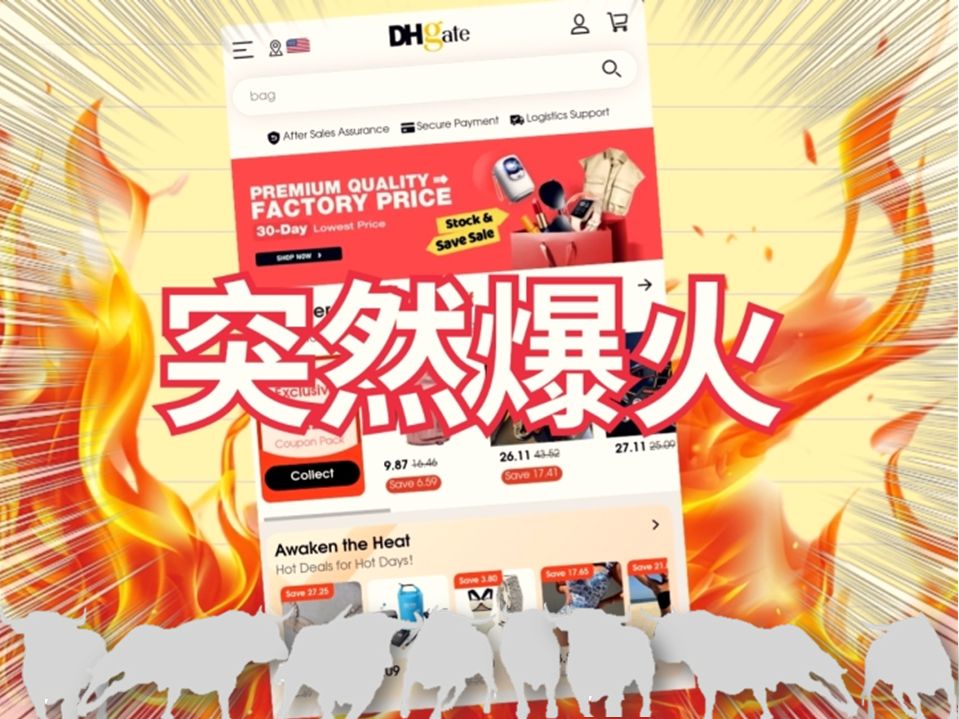
In America, consumers are in a state of despair. Despite the certainty of higher prices of nearly everything they will buy, they are not willing to cut down on their shopping. They want to continue to have access to cheap goods, particularly cheap Chinese goods. Desperation is in the air. Case in point: the “突然爆火 (turan baohuo or sudden explosive spread)”, as the Chinese media describes it, in the interest of Chinese B2B e-commerce platform DHgate that led to the dramatic increase in the download of their app. The sudden interest in DHgate is reminiscent of the uptake of 小红书 (Xiaohongshu) when TikTok was said to meet its demise. This is, no doubt, fuelled by the many viral videos circulating on TikTok lauding China’s manufacturing might. According to Sina Finance, the download rate jumped 800 percent in the past few days. Publicly available data showed that the DHgate app is second only to ChatGPT in terms of downloads on U.S. app stores
Known as 敦煌网 (dunhuangwang or dunhuang.com) in China, DHgate was founded in 2004 by Diane Wang Shutong (王树彤), who, according to a profile on the World Economic Forum website, is “responsible for the overall strategy and operation” of the platform. A former lecturer at Tsinghua University (清华大学), Ms Wang has been much accoladed, including Outstanding Woman of China and Outstanding Woman of Beijing recognitions. She has also held considerable appointments at various international organisations, including Asia-Pacific Economic Cooperation (APEC) as a representative for China. It would be hard to describe Ms Wang and her team as “peasants”—JD Vance’s preferred characterisation of the people of China and the profound Chinese diaspora.

Some of the bag listings on DHgate
Although essentially a for-business, cross-border platform, DHgate houses suppliers who might accommodate individual shoppers without imposing a minimum on orders that are typical of B2B transactions. This is appealing to bargain hunters buying for themselves rather than a business. The lure of DHgate is understandable. Just a glance at their bag category alone is enough to see that there are no styles that Chinese manufacturers cannot assemble. Designer lookalike bags can be had for less than US$50 a piece (about S$65). Apart from finished products, DHgate offers bag parts that brands sourcing for their own products, whether they are to be made in China or outside, can pick. And best of all, the site is available to Americans (and those whose first language is not Mandarin) in English.
Those TikTok videos that are attracting millions of views encourage Americans consumers to essentially bypass the usual retailers and buy directly from Chinese manufacturers through sites such as DHgate to enjoy a staggeringly wide range of products and attractive low prices. The proposal is tempting in view of the tariffs that the current U.S. administration has imposed, which the Chinese government is not waving the white flag at. America’s tariff shocker fortuitously shed light on the complex manufacturing behemoth that is China, including its production and technological innovation and the logistical powerhouses that are platforms such as DHgate. In slightly over a week, Chinese manufacturing insiders and American consumers contradict the simplistic and ignorant notion that China’s is a “peasant” economy.
Illustration and collage: Just So
 Style on the Dot