Their first in the U.S. welcomed American shoppers last February in New York’s Soho district before Donald Trump’s latest round of tariff attack on China. Given the president’s relentless bluster, even if they seem to be empty menaces, are Chinese businesses welcome stateside?

The two-month-old Urban Revivo store in Soho, New York
Urban Revivo (UR) has been dubbed by the American media as Asia’s Zara (rather than China’s, possibly to mention less of the continent’s largest country in a tariff-saturated American era). Given the Spanish label’s popularity in the U.S., that could be a compliment to UR. Americans had the opportunity to uncover the accuracy of the comparison for themselves last February when the Chinese label unveiled its first store in the States, in New York’s Soho neighbourhood. On the day it opened, one of the guests invited for the ribbon-cutting ceremony was Coco Rocha. The Canadian model arrived in a Tesla Cyber Truck, painted with information of UR’s opening and the announcement that inside was a “UR Superstar”. After she cut the ribbon, she toured the 30,000-square-foot (or about 2,787-square-metres) space of largely made-in-China merchandise, from clothes to bags to shoes.
Would Urban Revivo be able to stage such a grand opening anywhere in the U.S. today, after the staggering tariffs Donald Trump has whacked on China? And would Ms Rocha feel as welcome if she were now invited to the store’s opening, even when Donald Trump already signed executive orders imposing near-universal tariffs on Canada as early as 1 February despite the many parallel economic interests between the States and their northern neighbour? UR had serious ambitions for America. It was planning to “scale its presence with at least one more U.S., store to open this year” and “to grow to over 200 overseas stores within five years”, according to a report by Forbes. But just two and half months after the Soho store rang its first sale, things in America have changed dramatically, unexpectedly, mercilessly.
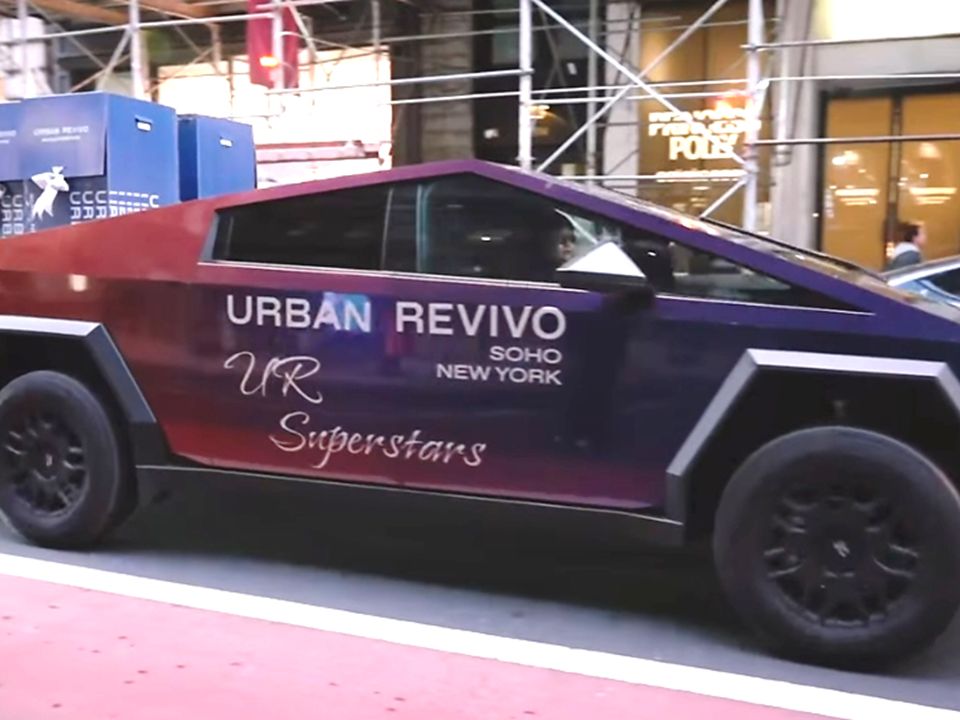
Urban Revivo ferried their guests to the opening of the Soho store in custom-painted Tesla Cyber Trucks. Screen shot: henrylunyc/Instagram
Trump’s trade war with China goes back to 2018, during his first term as POTUS. His unwavering belief that many nations, allies too, have been taking advantage of his country goes back even further, some thirty years earlier—to 1988, when he appeared in an episode of the Oprah Winfrey Show and griped that the U.S. was being “ripped off” by those who traded with them, and that only tariffs will work to undo whatever damages he perceived was exacted on America. But the current round of tariffs and then the dramatic “90-day pause”, and even more taxes—now a staggering 145% on China “effectively immediately”—are not only confounding, but detrimental to business and consumption in the States. China, unsurprising, hit back with their own three-figure tariffs. It is hard to imagine how Urban Revivo, who has positioned itself as a global business, straddles both sides.
Dubbed a “superstore”, the two-level Urban Revivo New York occupies the first storey and basement of what is presently an apartment block on Soho’s Broadway. The six-floor building, erected in 1880, was once the site of the legendary St Nicholas Hotel. Former occupant of the street-fronting space was H&M. Inside UR, it is all sleek, beige/clay brown modernity that makes H&M look positively tu (土 or ‘of the earth’, but, when used in the context of fashion, means unsophisticated). UR described the space as an “urban art centre” to tie with the brand’s “urban revitalisation” positioning, a seductive call for a flagship of a brand associated with fast fashion. Shoppers visiting the store for the first time were inevitably taken in by its spaciousness. The length of the lease and the rent of the huge unit were not revealed. Given the present business climate in the U.S., it is hard to predict if UR’s investment would be highly remunerative.

Snap of Urban Revivo’s massive inventory for their New York store
The current tariff environment in the US is surely not conducive to Chinese fashion brands (in fact, all merchandise made in China, including Gen-Z favourite Shein). As of now, only China does not benefit from Donald Trump’s puzzling “pause” on his far-reaching tariff policy. The 145% import tax—and it is really that—would create a substantial obstacle for UR to overcome as they seek growth in America, even if the brand’s CEO Leo Li was rather upbeat when he told Forbes back in February: “Tariff’s have a very limited impact on consumer retail, but UR continues to monitor the situation. To address potential tariff increases, we plan to optimize our cost structure and global sourcing strategies and of course negotiate effectively to mitigate the impact of any tariffs.”
Mr Li probably did not expect the tariffs to hit such stratospheric levels for China, alone. Sino-American trading relationship has, for a long time, been a complex play of protracted trade imbalance, fated interdependence, and “reciprocal” tariff clash. The current deadlock between the world’s two largest economies would inevitably lead to prohibitive cost for UR and the like, which, inevitably, could mean passing on the tariffs levied to consumers since the high percentage makes it tough for importers to absorb. Some estimates suggest that retail prices can jump up to 2.5 times. A dress at UR with the average price of US$59.90 (about S$80), for example, could possibly be adjusted to cost U$146.90 (about S$194) in the store. It is still early to see if American shoppers would willingly bite.

Accessories, too, at Urban Revivo New York, possibly meeting a price hike soon
What has been coursing through Donald Trump’s mind? His trade policies do not reveal a deep understanding of global trading systems or—considering how simplistic his reasonings are—reflect his knowledge of the current state of global supply chains or how advanced Chinese factories are. It is not unreasonable to assume that Mr Trump has never been to a Chinese garment factory before. He probably thinks they are still the sweatshops of long ago, based on unskilled workers and obsolete technology, and producing goods of low quality (sufficiently rock-bottom to sell to the U.S.?). He has probably not heard of China’s (notorious?) 黑灯工厂 (heideng gongchang) or black light factories, so technologically advanced that they run with minimal human intervention, hence requiring no illumination. This is, of course, unsurprising since he has been in real estate all his life and not garment retail, even if he has sold Trump-branded clothing to questionable degree of success in the past. The existence of the now-defunct Donald J Trump Collection is no indication that the man has intimate knowledge of the manufacturing behind it.
In one fairly recent interview with Fortune magazine, Tim Cook shared his observation of the Chinese factory (although he was referring to those producing items of advanced technology, such as iPhones, he could well be talking about garment factories too): “The popular conception of China is that companies come to China because of low labour cost. I am not sure what part of China they go to, but the truth is China stopped being the low labour cost country many years ago. The reason is because of the skill and the quantity of skill in one location. The vocational expertise is very deep—very, very deep here.” Mr Trump has never praised China’s vocational talent, at least not publicly, assuming he is aware of it at all, but his VP, JD Vance, did call them on Fox News “Chinese peasants”.
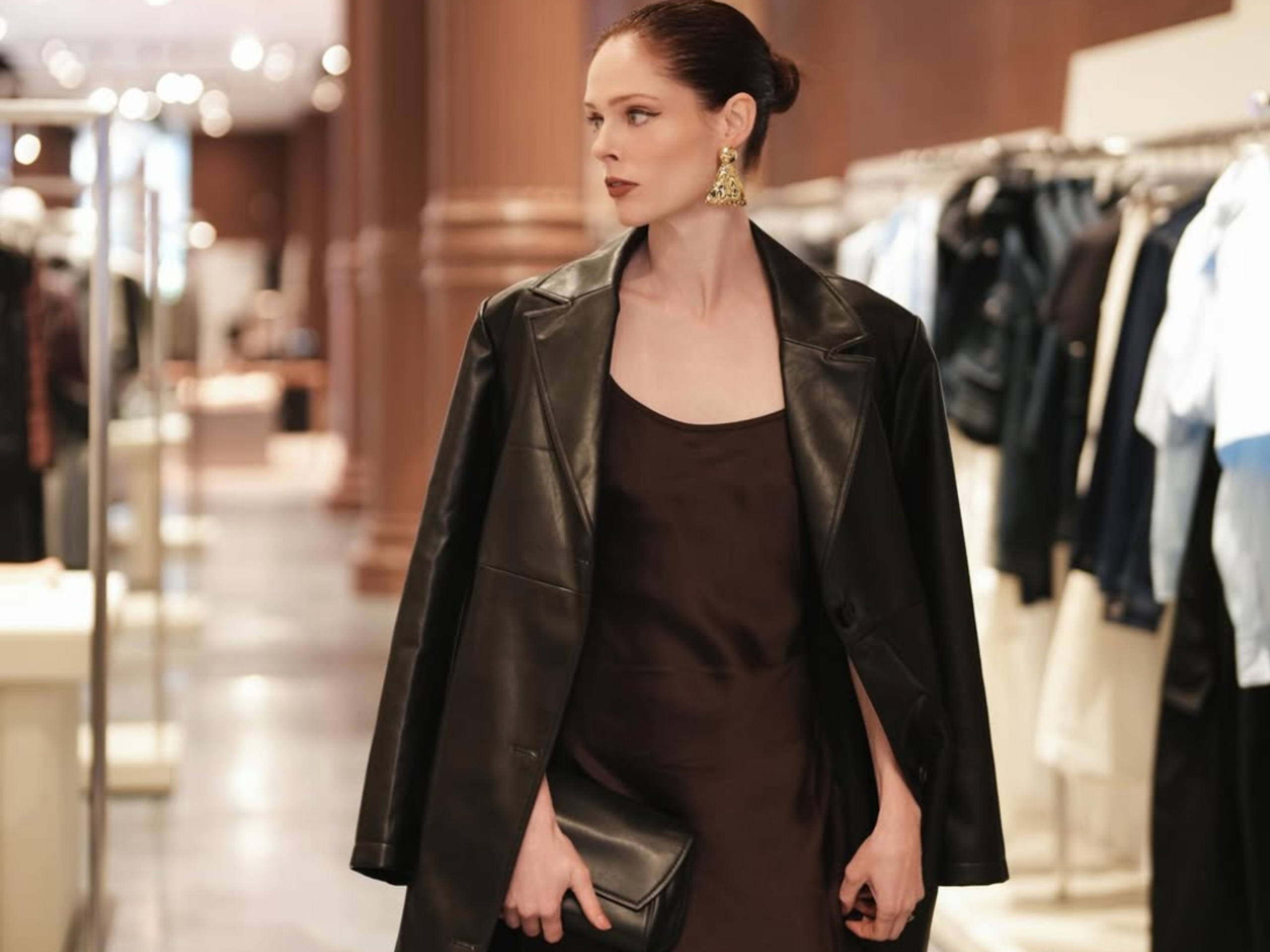
Coco Rocha admiring the merchandise during the official opening of the store in Soho last February
The president has a strangely binary view of world trade: surplus and deficit, bilateral and multilateral, tariffs and no tariffs, start and pause, winners and losers. His supporters laud him for his approach as it fulfils campaign promises than aligns with prevailing economic thought. And with his us-versus-them positioning, it is hard to resist the suspicion that there could be a touch of racism in his rhetoric, as well as how he wishes to trade with China (and, indeed, Asia). Few of us can forget his use of “Chinese virus” and “Kung Flu” to describe the contagion that triggered the COVID 19 pandemic. The language, even if off-the-cuff, triggered Anti-Asian sentiments and hate crimes across the States. And the latest tariffs—at first hitting Vietnam and Cambodia harder than non-Asian US trading partners—now walloping China mercilessly.
Urban Revivo is one of a handful of Chinese fashion brands that can raise the profile of mainland labels positively in the West. In 2016, UR opened here at Raffles City (it is still there) as the brand’s “first international flagship”. SOTD contributor Pearl Goh told us: “I still remember my visit, just before Christmas of that year. I was so surprised by the designs. I asked the salesgirl where the brand was from, and I remember she phrased it rather carefully—‘a Chinese brand, but the designs are from London’.” Omitting ‘China’ was possibly to play down the perceived lack of quality then still associated with products coming out of the land of the Great Wall. It isn’t so now. Urban Revivo’s CEO Leo Li told the U.S. media: “Our goal is to achieve long-term and stable development in the vibrant and dynamic U.S. market, while winning fans in New York and across the country.” Presently, it appears to be a tough trek ahead.
Photos: Urban Revivo
 Style on the Dot