Student loan startup founder Charlie Javice claimed her technology was revolutionary, but, in the end, was charged and found guilty of defrauding a bank. She was inevitably compared to now-jailed Theranos founder Elizabeth Holmes
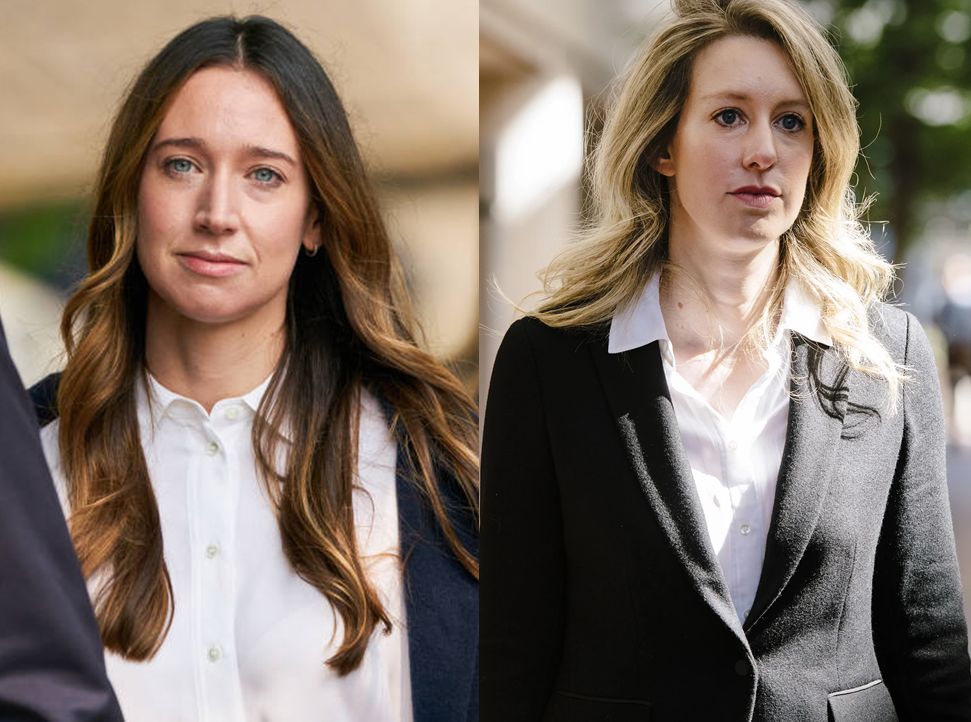
Criminal minds: (left) Charlie Javice and (right) Elizabeth Holmes. Photos: Getty Images
She called the company she founded Frank, but there was little that was straightforward or sincere about the data she provided to financial institutions interested in acquiring her startup. Charlie Javice was to fintech what Elizabeth Holmes was to healthcare. But, like Ms Holmes, the former’s brightly-burning star blacked out quickly when she was charged of fraudulent claims that led to the huge (and presumably well-shielded) JPMorgan Chase buying her college financial aid venture for US$175 million (or about S$234.5 million). A jury in a Manhattan federal court found the Forbes ‘30 Under 30’ honoree and a co-defendant, Olivier Amar, guilty on all four counts they faced: securities fraud, wire fraud, bank fraud, and conspiracy.
Both Ms Javice and Ms Holmes, who is now serving her 135-month jail sentence, cultivated similar images of visionary and ambitious, long-haired young female entrepreneurs punching above their weight in the competitive tech space that has been mostly dominated by men. They used their poise and persuasiveness, and perspicacity to build their photogenic public-facing profiles, eventually attract investor interest. In the U.S. technology sector, where female entrepreneurs are not many, both women fit—as with the proverbial glove—the image of those breaking barriers, never mind with specious ideas or arguments. Yet, the combination of the potentially profitable with the socially beneficial they persuasively offered was very attractive to those waiting for the next big thing.
Both Ms Javice and Ms Holmes cultivated similar images of visionary and ambitious young female entrepreneurs in the competitive tech space that has been mostly dominated by men
Both women used styles that they thought would make them appear to be serious techpreneurs; they emulated what their male counterparts were inclined to adopt sartorially. As young women proving their professional credibility, their presentation would have been considered rather important. But, there was virtually no fashion other than a calculated presentation of a certain image: serious and bordering on uniform dressing. We are already familiar with Ms Holmes’s turtleneck pullovers, an article of clothing very much associated with Steve Jobs. And when she wore suits, she almost always had a shirt underneath. Similarly, Ms Javice, while not as singularly defined as Ms Holmes, projected the image of one-of-the-guys competence and confidence with sensible business wear and sometimes nonchalant atheleisure combos. Both used clothes to craft a deceptive persona and a sense of authority that cleverly obscured the falsehoods they were peddling to would-be investors.
The guilty verdict of Charlie Javice after a five-week trial marks a stunning fall for the now 33-year-old, once feted as a rising star in fintech. Frank was launched in 2016 with the aim of making the application of college financial aid—specifically filling up the form—simple. It received considerable industry and media attention. Hoping to score investment with a monetary windfall, Ms Javice fabricated the number of users of her service to JPMorgan Chase (that thought there were four million customers when there were only 300,000), just as Ms Holmes misrepresented the capabilities of her company Theranos’s blood-testing technology. If the two women’s practices were deemed deceptive, so were their fashion choices. Appearing like one of the tech boys, however, was no guarantee that their false pretenses would not be exposed as scams or lead to their legal downfalls.
Update (30 September 2025): Charlie Javice was sentenced earlier today to seven years in prison for defrauding JP Morgan in 2021 for US$175 million. Crying, while she delivered an emotional statement to the court, Ms Javice asked JP Morgan, her employees, and investors to forgive her calling her misdeeds “errors”
 Style on the Dot