Do we consider books so unfavourably that we are only aware our city’s biggest bookstore sells just stationery? Or, unable to remember on which floor of the mall it sits, having been there for 11 years?

The entrance of Kinokuniya facing the main atrium of Ngee Ann City Shopping Centre, now boarded up
In an op-ed published in today’s The Straits Times and reprised in The New Paper, editorial contributor Debby Yong described her day last week “wandering through Ngee Ann City (Shopping Centre)” when she “momentarily forgot” on which floor Kinokuniya was situated. She said she spoke to someone working in the mall to jolt her memory. Apparently, the woman helpfully replied: “Oh, the stationery shop? That’s one floor up.” Ms Yong—“clutch[ing] my metaphorical pearls”—was aghast, likening the describing of Kinokuniya as a “stationery shop” to “calling the Louvre a frame store”. Mistaking the latter is, of course, absurd since the Louvre is a landmark museum, Kinokuniya is not. Even in Tokyo, it isn’t a must-visit unlike, say, Tsutaya, whose Daikanyama T-Site store is a veritable tourist attraction.
Ms Yong’s shock—more like disdain—is, perhaps, understandable. We know of young working people who have never been to a bookstore, let alone Kino, as it is affectionately called by the store’s regulars. Ms Yong could have encountered one among the many disconcertingly high number of Singaporean adults who, in a recent study by the Organisation for Economic Co-operation and Development (OECD), suffer from literacy proficiency that has regrettably dipped below the average for this group. That it was mistaken as a stationary store is, perhaps, unsurprising, and indication that its small stationary section is indeed a remarkable performer, often packed with shoppers in numbers larger than even at its fiction section. Keeping it could have been a retail strategy. In fact, the stationery store in the bookstore is operated by NBC Stationery and Gifts, a subsidiary of Kinokuniya. NBC’s first overseas store was, interestingly, in Singapore, when it opened inside Kino’s first flagship in the now defunct Liang Court Shopping Centre in 1983. NBC currently operates two popular standalone stores, one in Bugis Junction and the other in Raffles City.
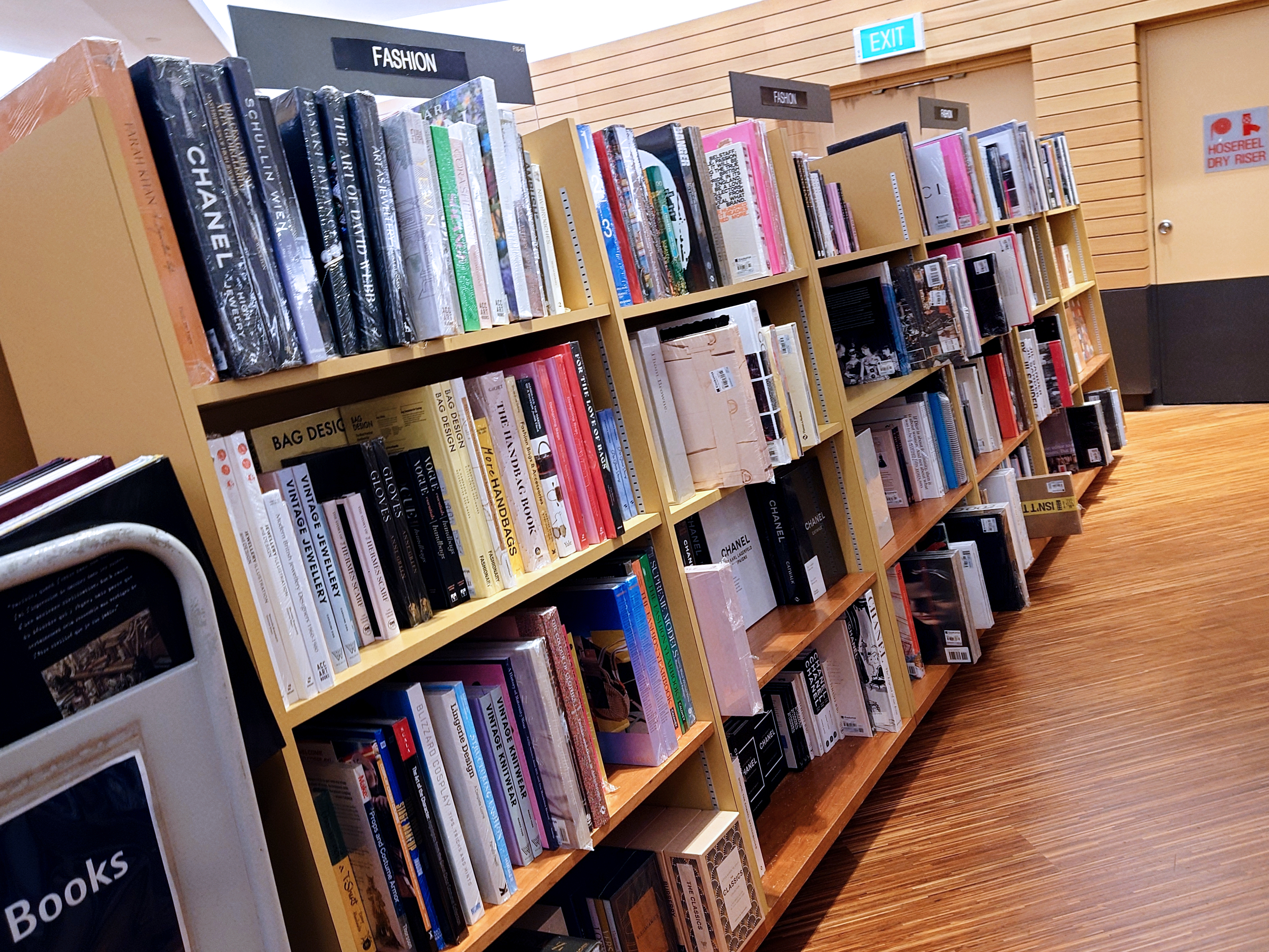
The re-orginised fashion section at Kinokuniya
We are not saying that mistaking Kinokuniya for a stationery shop is something that augurs well for the fate of the book seller here. But the sale of pens (especially the very popular Pentel Energel), stickers, washi tape, notebooks (especially the well-loved Traveler’s and Midori brands) and such is still a business thriving enough that many shops, including other players, such as the equally-impressive Think at Funan Shopping Centre, continue to survive and not downsize. Stationery sections as part of bookstores are not unique to Kino; they go as far back as the pre-war era, when Chinese book stores, clustered around North Bridge Road and Victoria Street, supplemented their printed materials with not only pens and erasers, but also brushes for Chinese calligraphy and attended ink stones. One of them is Popular Bookshop (大众书局, opened in 1936) on North Bridge Road. Popular is, of course, not a typical case: In the past ten years, it has become more stationery than book store, so had the once-mighty Times before they closed their last store in September last year.
Kinokuniya’s much-in-the-news downsizing of their flagship in Singapore is upsetting for many book lovers, just as the sale of the our city’s oldest supermarket chain Cold Storage to Malaysia’s Macrovalue retail group worry grocery shoppers: that quality will somehow be sacrificed. Kino, as Ms Tong noted, is known for the relatively wide breadth of titles it carries. Even their fashion section has been somewhat respectable, although, to our disappointment, they have yet to stock the exhibition catalogue of Iris Van Herpen: Sculpting the Senses, now on at the ArtScience Museum. But, it is unclear if the store, after the downsizing, would retain its merchandise mix that regulars have come to appreciate, even if only because there really is nowhere else to browse and uncover new titles one might wish to buy and read. It is worrying when, during a visit last week (we did not bump into Ms Yong), we saw past issues of fashion magazines plonked on a table to be sold at mark down.
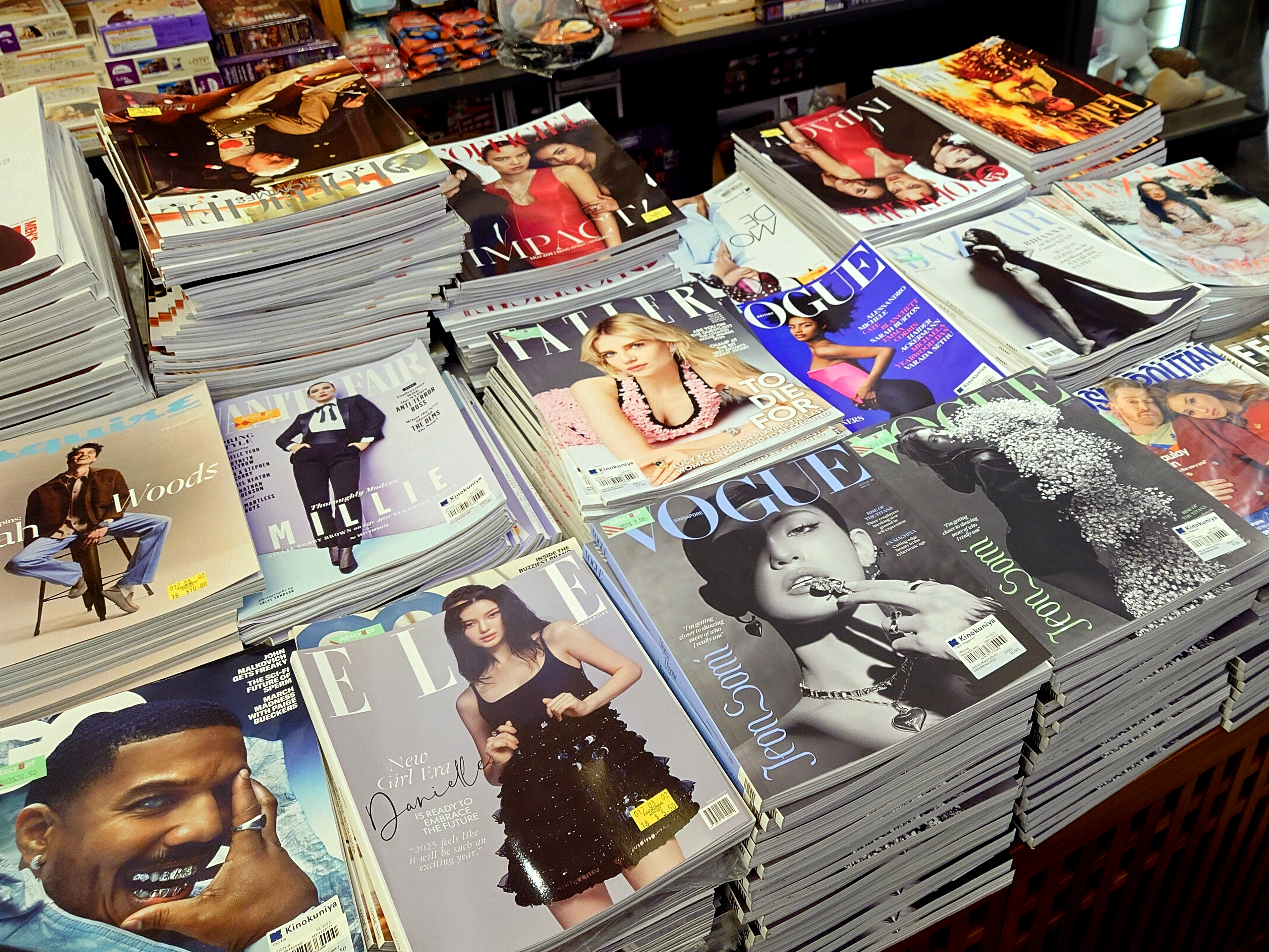
Past magazines plonked on a table, in piles
The place was tight enough. It did not need a table stacked messily with titles they wanted to get rid of. We were not sure whether it was us imagining it or if it was Kinokuniya’s doing, but the overall space now—from the 38,000 sq ft of the original to the yet-to-be-announced size—seemed to be tighter in the arrangements of their racks. The said fashion section, which did not appear to be smaller in total shelves, has its six shelving units now arranged in a single row, back to back, in seeming linear indifference. This could be the store deep in what has been reported as “refinement of its book collection”. But even Malaysia’s retailer of discount titles, BookXcess, has far more attractive stores, such as their first and truly striking outpost here and the outlet in the old Rex Cinema (now REXKL, in Kuala Lumpur’s Chinatown), where its design is so winning, the store is actually a tourist 打卡点 (dakadian or punch-card attraction) for social media habitues.
Talking about bookstores in Kuala Lumpur, the city itself has no less than three major international names operating in the Klang Valley. Other than Kinokuniya, which has been in the city since their first in Isetan at Lot 10 in 1990 (before moving, in 2001, to KLCC, where it is a duplex store), there is now Tsutaya Books, with two outlets in KL and one impressively appointed in Johor Bahru (how is it that JB gets such a beautiful store, but not us?) and Eslite (诚品) Spectrum from Taiwan in KL’s shopping heart of Bukit Bintang. All these stores have one thing in common: well-thought-out settings and well-stocked shelves to encourage—even forster—a cultured urban life, whether through books or related products. Regrettably, some shoppers, insensitive to store orderliness or the condition of the books that, after browsing, are still deemed sellable, do hamper the aim.
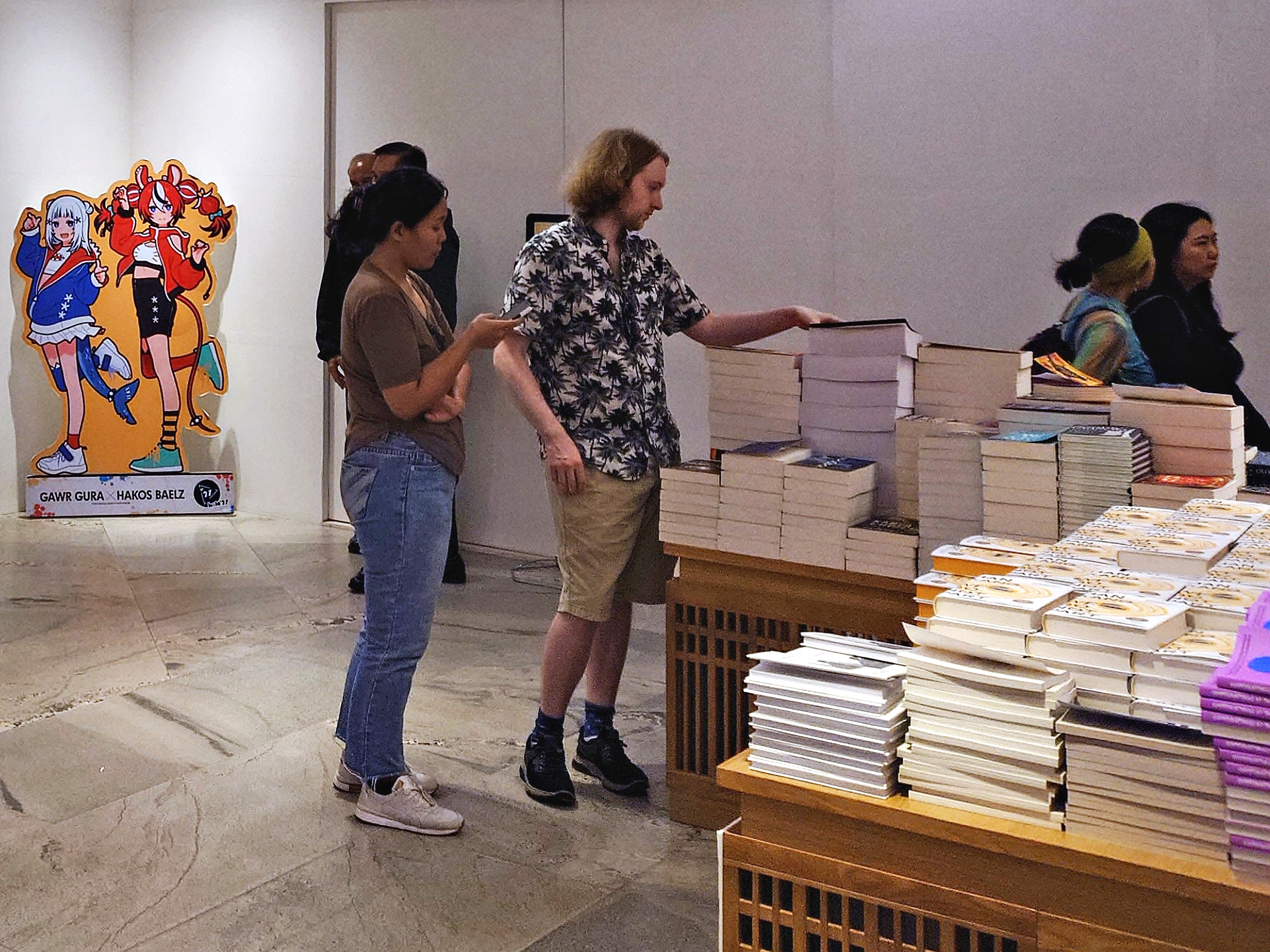
Behind the hoarding of what is a surprising uninviting foreground lies a yet-to-be-announced café
While we agree that bookstores here have to evolve, we, too, believe they must not lose their first role as a book seller, ideally with the desire to strengthen the intellectual and cultural life of this island’s people through reading. Debby Yong, who is also a brand strategist, suggested that for bookstores to survive, they have to be a “modern-day kampung for book lovers.” There is a jom-baca-sama-sama (let’s read together) ring to that. She later described an ideal bookstore to be a “community-centric space”, where “a test kitchen for cookbook demos or an interactive family zone can blur the boundary between browsing and belonging”. Curious it is that for a bookstore to keep afloat, she is encouraging “browsing” than buying and that she thinks those who have never belonged to a reading minority could suddenly feel they do after watching how, say, chee cheong fun (猪肠粉) is made. She even suggested that bookstores “consider a rotating slate of home-grown chefs serving up literary-themed treats, like Alice in Wonderland afternoon teas or Crazy Rich Asian kuehs to keep things fresh and fun”.
Is catering to the book lover, then, the main aim of her colourful suggestions? Those who still read voraciously can do without, in a bookstore, the potentially noisy distractions that “interactive family zones”, for example, could be, as seen in already family-centred Popular Bookshop. It appears to us that Ms Yong, in calling bookstores to offer what our regional libraries have been dishing up, such as the test kitchen she so enthusiastically proposed, have not visited one. She mentioned our “excellent public library network”, but has she spent time in a library recently? May we suggest the Tampines Regional Library at Our Tampines Hub, which includes, yes, a fully-equipped kitchen, as well as, workshop space for crafts, such as laser cutting. And, family zones that Ms Yong will be thrilled to see and use. Catering to book lovers (who prefer a bookstore to look, to feel, and be quiet like one) is not really the issue. How to encourage more to buy books and read is, perhaps, imperative. It is unclear how frequently—or infrequently—Debby Yong visits Kinokuniya. How does one forget on which floor a store is if one is a regular? Or, a frequent book buyer there?
Photos: Chin Boh Kay
 Style on the Dot