Reclusive actor Takeshi Kaneshiro unexpectedly appears in new ads for the Japanese retailer of minimalist merchandise
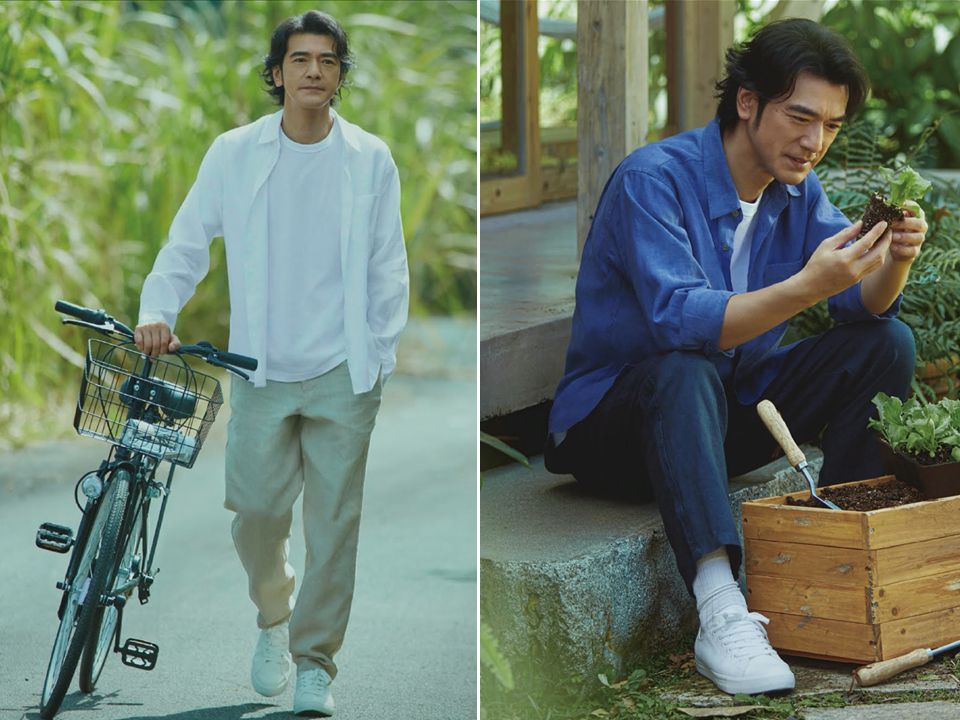
Takeshi Kaneshiro in Muji ads. Photos: Muji China
Yesterday, when Vogue Taiwan shared these photos on their Instagram page, the magazine described Takeshi Kaneshiro as “許久不見的男神 (xujiu bujian de nanshen) or long time no see male god”. The Chinese arm of Japanese retailer Muji had, a day earlier, shared on their website new advertising images of the Taiwanese-Japanese star in their spring menswear line. Famously reclusive, Mr Kaneshiro’s sudden appearance in the public sphere excited many of his fans, mainly—as one marketing consultant told us—“boomers, with no derogatory intent”. The 51-year-old, known in Chinese as 金城武 (Jin Chengwu) has barely made any film in recent years and is likely unknown to many young movie-goers, namely the Gen-Zers.
Muji did not refer to their star model as a god. And did not style him as one. In fact, Mr Kaneshiro could have been a handsome mature model that regularly appear in magazines such as Monocle or Kinfolk. In fact, he looked like those Japanese fellows, such as the famed same-sex couple, #shiba_dads Shigeki Matsumoto and Koji Suzuki, who are absurdly photogenic, and live idyllically at one with nature, and stylishly. In fact, Muji even pitched the wholesomeness as “自然 (ziran)”, which means nature or natural. And Mr Kaneshiro totally satisfies the brand’s easy trope of a bounteous natural world. In a Weibo post to announce him as a “Muji friend”, the brand wrote in Chinese, “Nature holds the wisdom of a comfortable life. Nature holds the answer to a comfortable life.” And in the ads, the beautifully simple “自然有生活 (ziran youshenghuo)”—there is life in nature (or the natural).

The completed ad that appeared on the Muji website. Photo: Muji China
Unsurprisingly, the images went viral on China’s 微博 (Weibo) with many praising how good he still looks. One excited fan commented: “帅老头终于营业了 (the handsome old chap is back in business).” But it is not known how long Mr Kaneshiro is contracted to Muji. Or if this marks the coming out of unofficial retirement. His last feature film was 2017’s 喜欢你 (xihuanni) or—the English title—This is not What I Expected (excluding the still-to-be-released 风林火山 (fengling huashan), Sons of the Neon Night of the same year). The actor has been reported to be “living in Japan”, but that is not officially stated by him. His last media appearance was for the cover story of China’s Elle Men, with the unambiguous cover blurb, “普通人 (putongren) or ordinary man—still the regular, the everyday, or the natural that is projected through the Muji images.
In the latest ads, Mr Kaneshiro is fitted with supremely basic clothes, featuring the fabric 汗麻 (hanma), a type of linen made from hemp grown in Heilongjiang (黑龙江), northeastern China, known for their agriculturally important black soil. Accompanying the images is a short, video (seemingly a making-of-style clip) that showed the model—or the character he plays—enjoying tranquil pastoral life, wearing the Muji pieces as if they are his everyday attire, wrapped in a soothing soundtrack that included birdsong and the clink of wind chimes. Takeshi Kaneshiro is seen admiring the natural surroundings and then planting what looks like vegetables (there is even a harvest of freshly pulled-from-the-soil carrots). He was happy, he was at peace, he was even tasting the greens; he was down-to-earth, naturally.
 Style on the Dot