It’ll probably turn out to be the best fashion event of this calendar year, especially with tourists and fashion students turning up noisily. But what is really the lure?

The entrance and opening zone of the exhibition, with the bubble wrap-like Siejaku dress
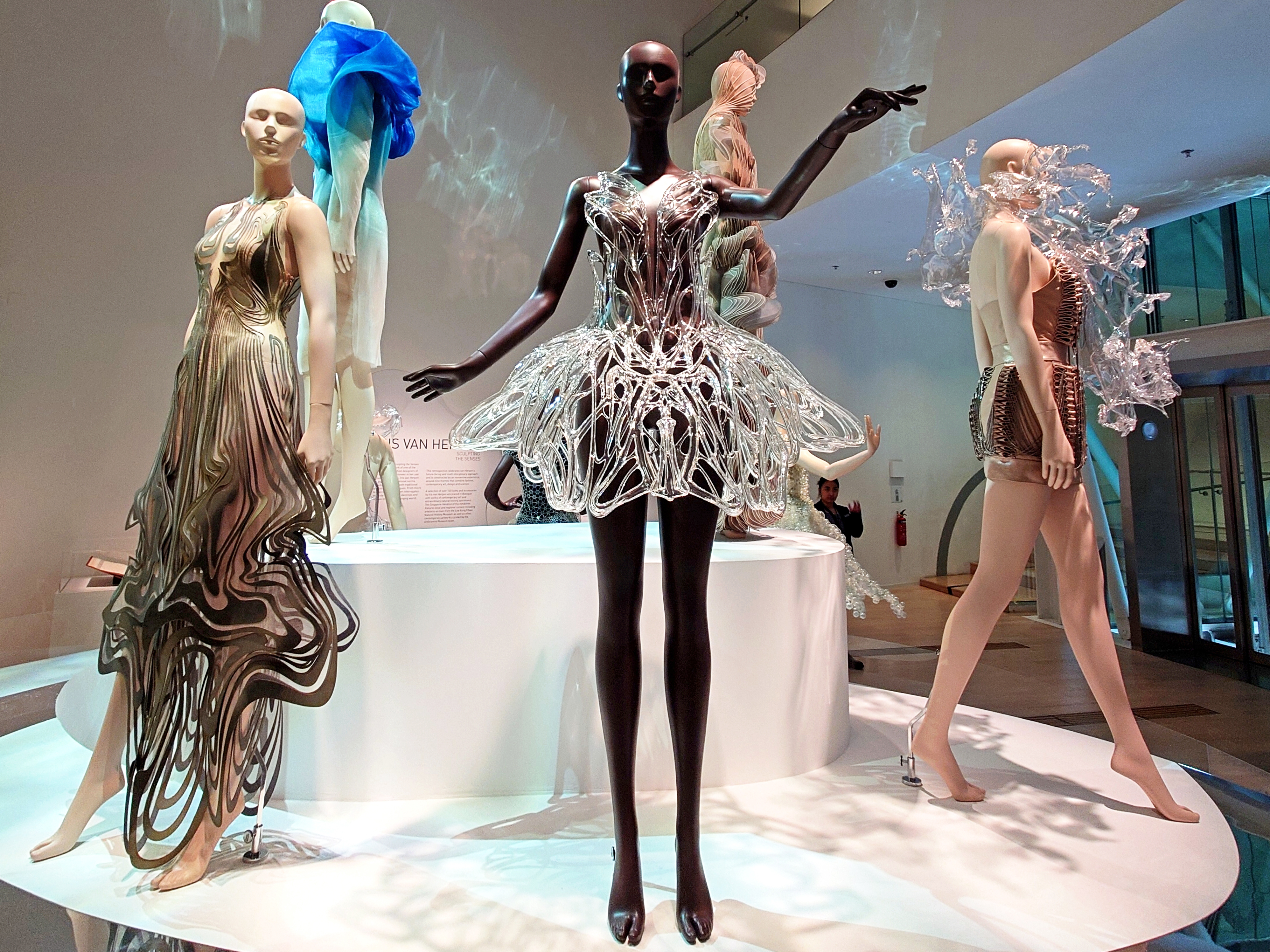
Two-tier centrestage that is the opener, ‘Water and Dreams’
Rare is the fashion exhibition in Singapore that expounds clothing designs on the edge. The ArtScience Museum’s latest, Iris Van Herpen: Sculpting the Senses, allows visitors to come up close with what the museum described as defiance of “conventional norms of fashion”. Yet, if you take away the textile manipulation and the surface treatments of the garments, there are, in the elemental forms, shapes unmistakably conventional. Perhaps, it is this somewhat paradoxical leaning that makes Dutch designer Iris van Herpen’s work intriguing, even if they are to us, after spending some two and half hours studying the pieces, a tad repetitive. While her designs take advantage of the technological tools available to her, what is truly beneath the elaborate exterior is not always varied or marvels of garment engineering. They are surprisingly basic.
Possibly due to the smallness of the circular exhibition space on the third floor, we were immediately thrust into the first zone of the show the minute we stepped out of the elevator. A ticket collector came immediately towards us to ensure that we had the requisite entry passes even before we could digest what was before us. We were quickly ushered inside, possibly because the area was not large enough to contain guests arriving and leaving. It was until we completed the exhibition and came back to square one did we realise that it was here—‘Water and Dreams’—that the journey was supposed to begin. It was, therefore, while exiting that we had the chance to properly examine the eight looks here. The exhibition comprises nine themed zones, split into 11 segments of this level of the museum, and explores the conceptual heft of Ms van Herpen’s no doubt dramatic work.

The surprisingly un-aquatic Sensory Sea Life zone. On the right, the famed Hydrozoa Dress from 2020, a version in blue was worn by Lady Gaga

Two of the zone’s most striking pieces: (left) the Harmonia Dress from 2019, a version she has worn to the Met Gala in 2022 and (right) the Arachne Bodice from 2022’s Meta Morphism collection
Iris van Herpen: Sculpting the Senses first opened in Paris in 2023 at the Musée des Arts décoratifs. It reportedly took five years for the exhibition to come to life. The Singapore stop of the traveling exhibition is the first in Asia, after previously opening in Brisbane, Australia. Like its debut in Paris, the clothes are displayed alongside fossils, artworks, and architectural details, “placed in dialogue with works of contemporary art and extraordinary natural history specimens” (as the digital guide informs), which include pieces from our Lee Kong Chian Natural History Museum. While these other non-garment displays—some truly small—may show the correlation between designs of the clothes and the sources of inspiration, what they provided to the viewing experience is negligible.
The exhibition employs soundscapes (some abstract), lighting effects, and video projections to lend context to the displays. But this is no Savage Beauty (the homage to Alexander McQueen), with the exhibition design that was spectacle in itself. Yet, there is, curiously, a zone with its own ‘Cabinet of Curiosities’ and, much like the one in Savage Beauty, a display of paraphernalia and accessories that purposefully delineate the designer as multi-faceted. Despite its sensory beckon, Iris van Herpen: Sculpting the Senses arouses, foremost, the sight and—moderately—hearing (the first thing that the ticket inspector told us after examining our entry passes was: “do not touch the clothes”). Much of the secondary displays provided insufficient commentary on how Ms van Herpen came to design what she showed in the exhibition.

The curious, un-cabinet-like ‘Cabinet of Curiosities’

Dresses inspired by the work of British artist Rogan Brown
Her World magazine enthusiastically elucidated that the “exhibition transforms fashion into art”. They could have written that in the context of a presentation that is akin to museum exhibition. All the pieces are worn on mannequins, not hung on a wall, although in the last zone, Cosmic Blooms, some mannequins were suspended upside down, with the clothes secured in place by the use of clear display strings—aerial sculpture, perhaps. The debate about whether fashion is art is as old as fashion itself and no universal agreement has silenced it. Ms van Herpen’s work is not outright art, however sculptural they are. It is really positioned somewhere between fashion and art. She forms, for sure, and shapes, and manipulates her choice of medium in the manner of sculpture, using textiles and materials that have the density to appear weightless against the body. She clearly has an atypical approach to fabric use.
Many admirers of Ms van Herpen’s work speak of her “craftsmanship with digital technology”. She does use considerable tech in her execution, including laser cutting techniques and 3-D printing, and those less commonly employed, such as selective laser sintering, a method to create hinges or snaps that allowed pieces to be joined together. Common fastenings are avoided. In addition, Ms van Herpen loves to work with all manner of less everyday fabrics such as Mylar, silicone, PETG (a thermoplastic polyester or modified PET), or “eco-leather” (why they are not described as PU is not clear). The technology and the fabrics allow her to do those fantastic exterior treatment, but there is, as far as we could see, no surprising clash of contrasting elements, other than a highly womanly form on which sometimes menacing spikes or filaments protrude. And all of it isn’t quite the craftsmanship of traditional metiers.
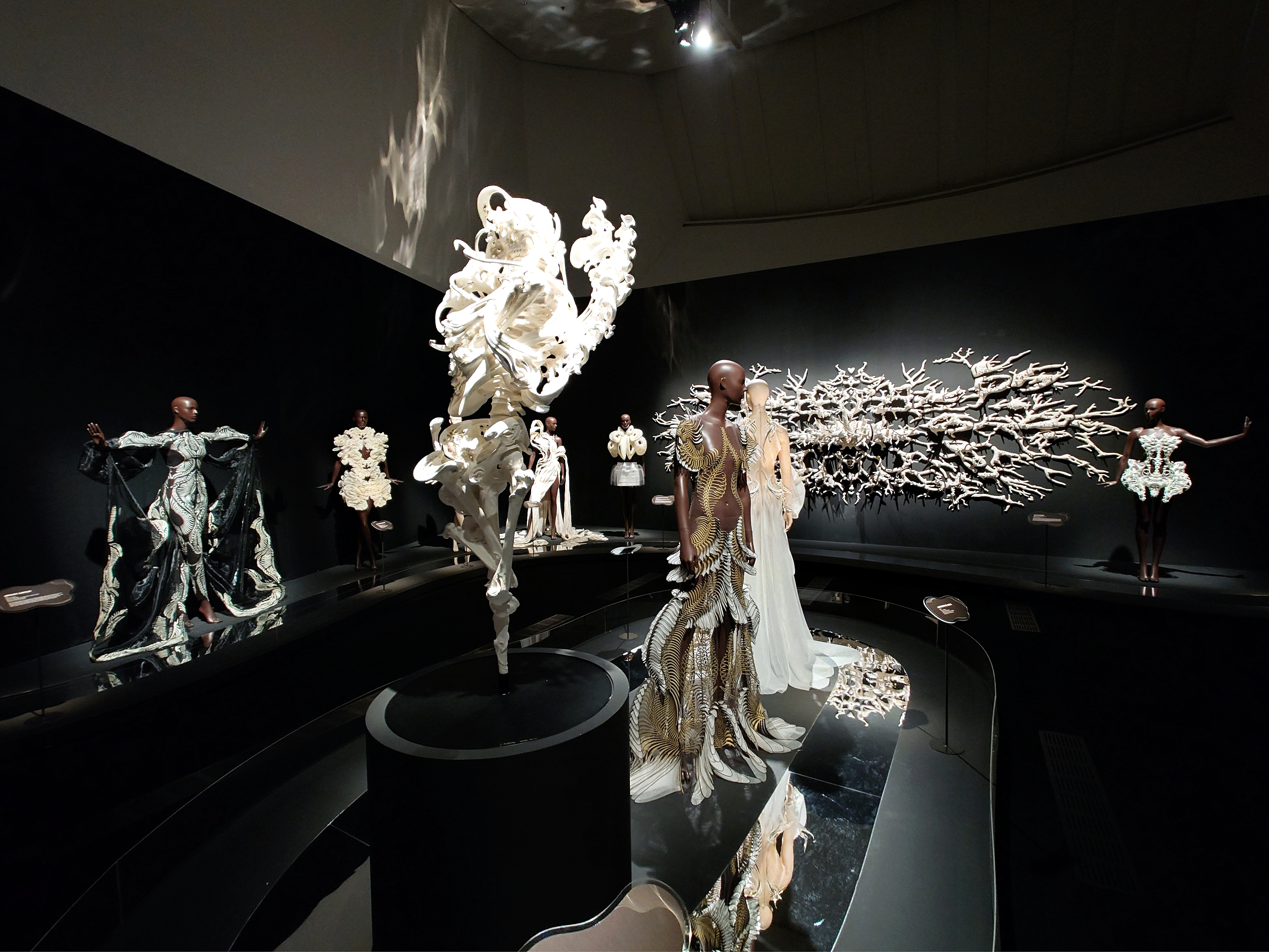
One of the most fascinating zones is Skeletal Embodiment. It was almost a Night at the (Anatomical) Museum

One gown, ‘Labyrinthine Kimono Dress’, shown in the three stages of its creation
The technological married to the traditional is supposed to be evident in her work. But it is hard to discern the two clearly when the former tends to override the latter. Most of the pieces we noticed are build on a base form of stretch-tulle. Then all the different pieces are attached to what are essentially body stockings—a construction method favoured by our own Frederick Lee for a long time. In that sense, there is scant dressmaking in ways that we are familiar with. If you hope to see the complex underpinnings of couture, you’d be disappointed. To be sure, there are attempts—actually, one—to show that Ms van Herpen, like most couture practitioners, approach the realisation of a dress by first creating a paper pattern, which also allows the pre-determined placement of the surface attachments. A toile is then made, followed by the actual garment—here, the Labyrinthine Kimono Dress. If only more of the other pieces were allowed to reveal their “phases of the creative process”, as the description of this particular exhibit goes.
A more revealing display may, however, also disclose what a designer wishes to hide. The almost-nude Labyrinthine Kimono Dress affords a front and back view. When we took a close look of the rear, it surprised us that the centre-back zip was not neatly finished (with puckering at the waist) and the top end stuck out above the neckline. Is it deliberate? We could not tell, but it is, to us, unsightly. Surely couture finishing cannot be this slack? It is hard to say if this was a one-off since most of the displayed garments were so heavily bedecked with the skeletal or layered with her signature gossamers. We could not see how she cleverly use or pivot darts, for example, or manipulate seams, if at all. There are, of course, new approaches to dressmaking, such as using tape, dispensing with the need to make a block. Ms van Herpen is, of course, prone to the experimental and, in boundary-pushing, as they call it, some fundamentals can be omitted.

Made famous by Björk, the ‘Snake Dress’ from 2011 in Mythology of Fear

The most arresting zone is Cosmic Bloom with the art installation, ‘Contact Lens’ by Japanese artist Haruka Kojin as backdrop
Iris van Herpen founded her eponymous label in 2007 and has showed during the official Paris Haute Couture Week since 2011. Surprisingly, the exhibition offered mostly the flou of her atelier or the studio that specialises in flowy, soft clothes (or those made of lightweight fabrics), as opposed to the tailleur, which essentially handles structured garments, such as suits and coats. Of the 90 looks (excluding miniatures) on show, 88 are those from the flou. Only two tailored garments, a coat and a jacket, were displayed, and both showed that tailoring is not be Ms Herpen’s strength or even something she dislikes creating. The exhibition does suggest that she is more of a textile artist than a designer in the vein of, say, John Galliano. This is, however, not to suggest that the exhibition is bare of merit. Many of the pieces are beautiful assemblages that evoke what has been called “cerebral wonderland”.
There is admittedly enough to allow an enthralling visit, and one could easily spend hours trying to uncover her techniques, although not necessarily with fruitful outcomes. The experiential component of the exhibition is regrettably, somewhat inconsistent. While the water theme of the second zone ‘Sensory Sea Life’, for example, is unexpectedly un-aquatic, the ninth, ‘Mythology of Fear” was nicely atmospheric, so much so that, at the entrance, an attendant would warn that if you have a fear of serpents, the exhibit of the Snake Dress—worn by Björk on her Vulnicura tour (2015 to 2017)—is best avoided. With a five-month run, Iris van Herpen: Sculpting the Senses may turn out be a sleeper hit, despite its potentially too avant-garde offerings. And that could be a good thing. Our island need not only be a stage for tourist dollar-generating pop concerts, it can also be a stop for major fashion exhibitions, however they sculpt our senses, if at all.
Note: Curiously, the exhibition catalogue, although placed at the exit for browsing, is not available to buy. It was not seen at the museum gift shop either. A staffer told us, “many people asked for it, but we don’t carry it.” When we asked why, she said she did not know. A check at the drastically down-sized Kinokuniya was similarly met with nought.
Iris van Herpen: Sculpting the Senses runs till 10 August 2025. This is a ticketed event. Photos: Chin Boh Kay
 Style on the Dot