Denmna Gvasalia dials down the exaggerated volumes and the extreme layering for what could be a new “standard”

About halfway through the Balenciaga autumn/winter 2025 show, a male model appeared in a dark grey, crew-neck T-shirt with the tone-on-tone word: STANDARD, in full caps. This could easily be mistaken for the incomplete branding of Japanese retailer Journal Standard or the Japan-only The North Face Standard. But no, this was Balenciaga with yet another cryptic message. Whether underscoring a standard or establishing a new standard? Or was this simply a description of clothes regarded as the most common form of its kind? Typical? The said tee would have looked ordinary—a la Gap, even—were it not for the styling of the look. The wearer was one among the usual motley talents that populate the usual Balenciaga runway; his hair was longish and wavy and his fringe curtained a pair of massive sunglasses. In sum, achingly cool, not.
Demna Gvasalia is especially good at creating these characters that can be traced to hypster-occupied streets and personality-strong neighbourhoods (Wall Street this season?), with people for whom clothes are not circumscribed by boundaries. Mr Gvasalia was fond of saying that he designed clothes that people were already wearing, hence the omnipresence of, for example, hoodies or hood attached to garments. This season the thus-far-adopted included what could be ‘office wear’, a fast-fading category that was as anything-goes as what was worn outside corporate confines. There were neat, conventionally-fitted suits, with the models carrying what could be WFO attaché cases. One muscular male model wore a plain white shirt so fitted, he would not be out of place among bank officers in Raffles Place during lunch time. His pants were artfully creased to give the impression that the chap was alien to ironed trousers.
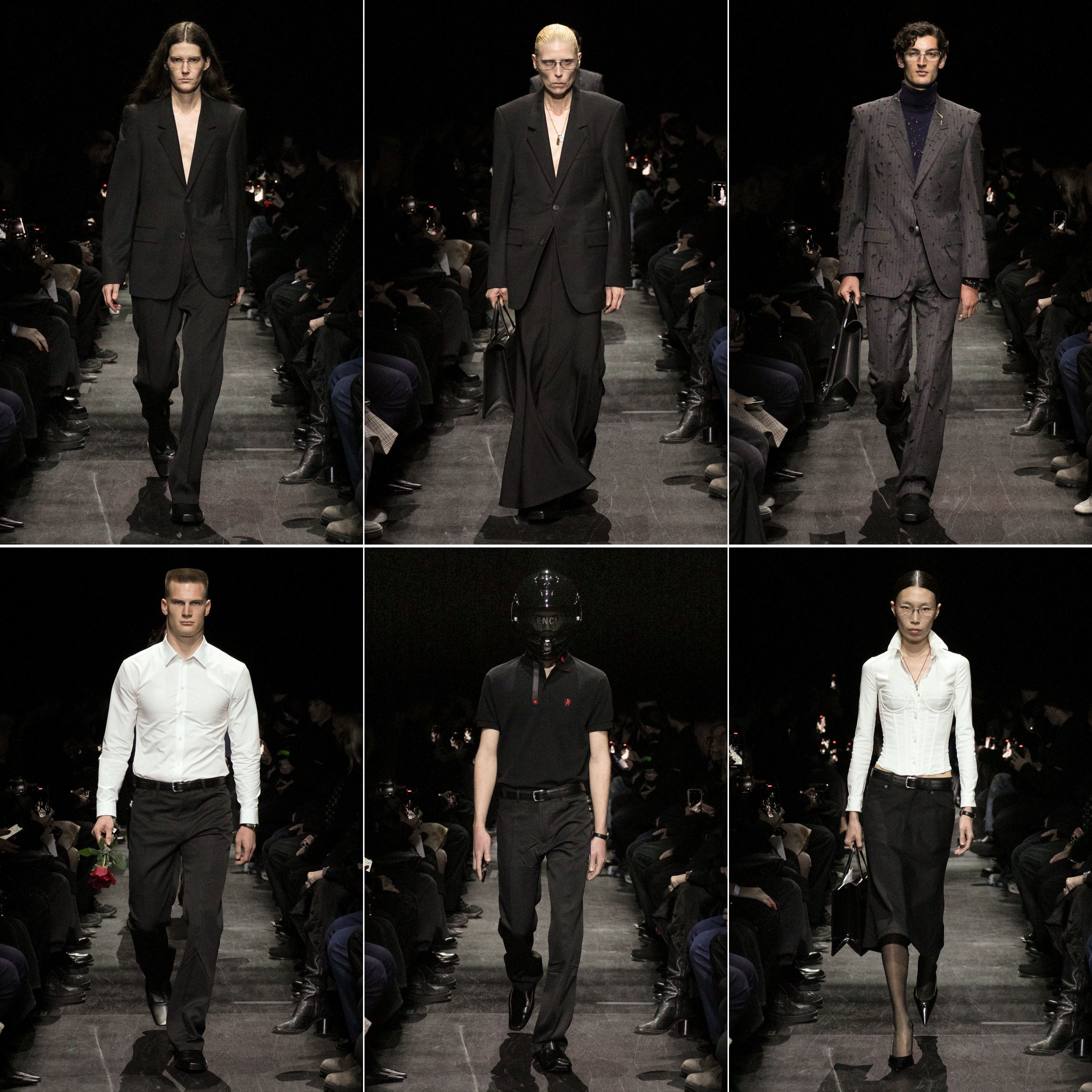
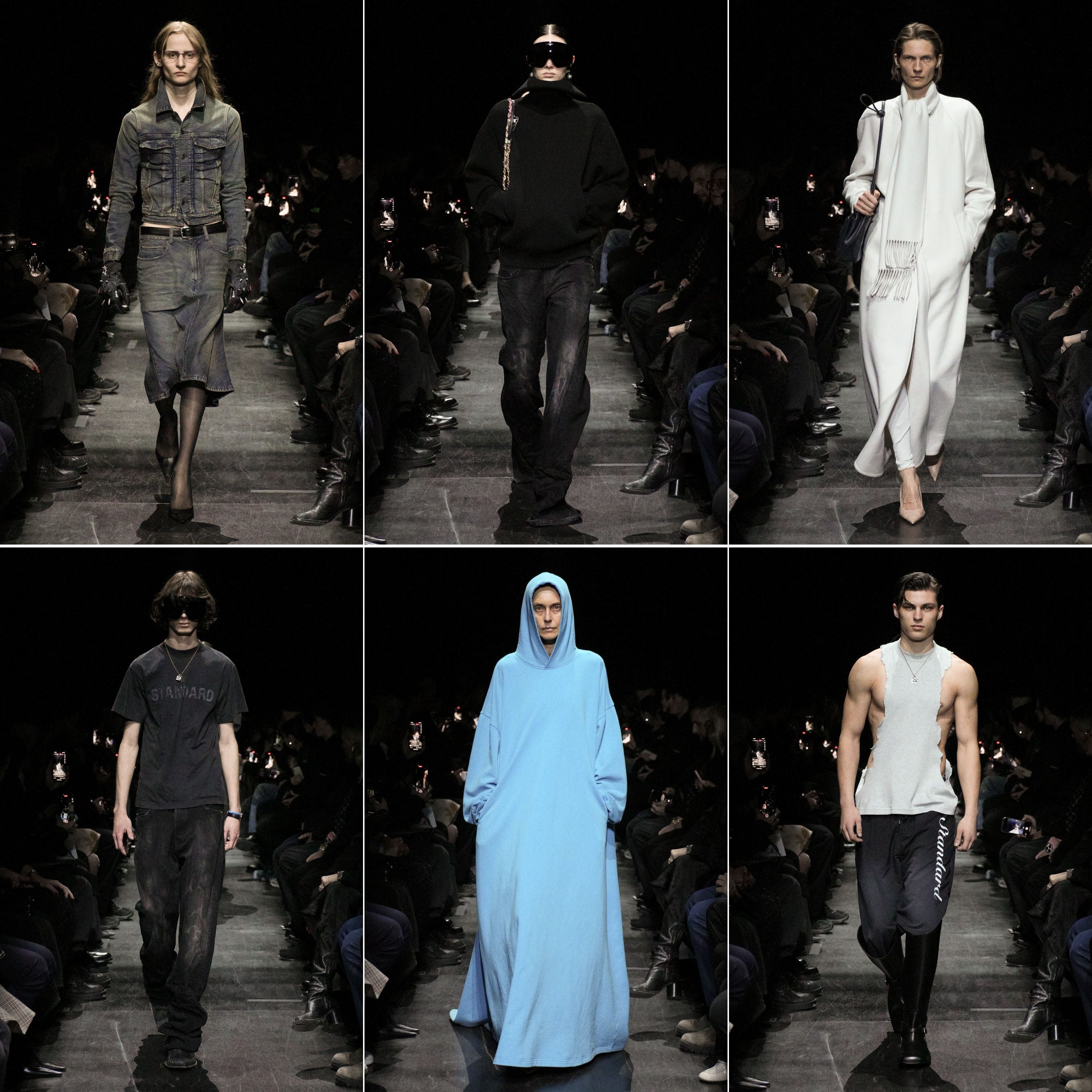

Talking about muscular executives, there were also those who looked like they had just stepped out of the gym after work, and did not bother to change back into their work attire. The guys wore fairly loose tank tops that were really crew-neck T-shirts, with the arms and torso crudely cut lobbed off to effect an arm hole that ended at the waist—the better-considered version of those already worn by body builders (and gym bunnies alike), for whom total cover of the torso might assert undue pressure on the hard-earned muscles. Gym wear this season was in collaboration with Puma, which, in the case of Balenciaga, means tracksuits or just the tops, all worn without athletic vibe (with above-the-knee boots for women) and surprisingly less baggy than those from previous collaborations. In fact, the tracksuits and Balenciaga are as fresh as Kim Kardashian and skimpy clothes. They have appeared so often now that it is not crazy to wonder if Balenciaga might become a tracksuit brand.
This season, the models were made to walk a runway that was quite a maze, so much so that it required frequent aerial views during the livestream to capture the dark, winding path. Only one row of seating flanked the runway, which meant every attendee enjoyed a front-row view. To better see what was quickly touted on social media as “wearable clothes”, as if there was a huge relief that Balenciaga had finally succumbed to the conventional. Such as the sexy hot pink dress Liu Wen wore to close the show? While we could have looked at this season’s Balenciaga superficially, it dawned on us that perhaps the radical is no longer that. It has been said that Balenciaga is exercising “controlled distortion” in the wake of parent company Kering’s dismal overall performance, but a brand that has used the atypical to set itself apart cannot sacrifice the unorthodox for something even Philipp Plein might find banal.
Screen shot: balenciaga/YouTube. Photos: Balenciaga
 Style on the Dot