A pair of tassels crowned with an Oriental knot on the sides of a Baguette bag is causing considerable displeasure in China. Could Fendi have been more sensitive or more aware?
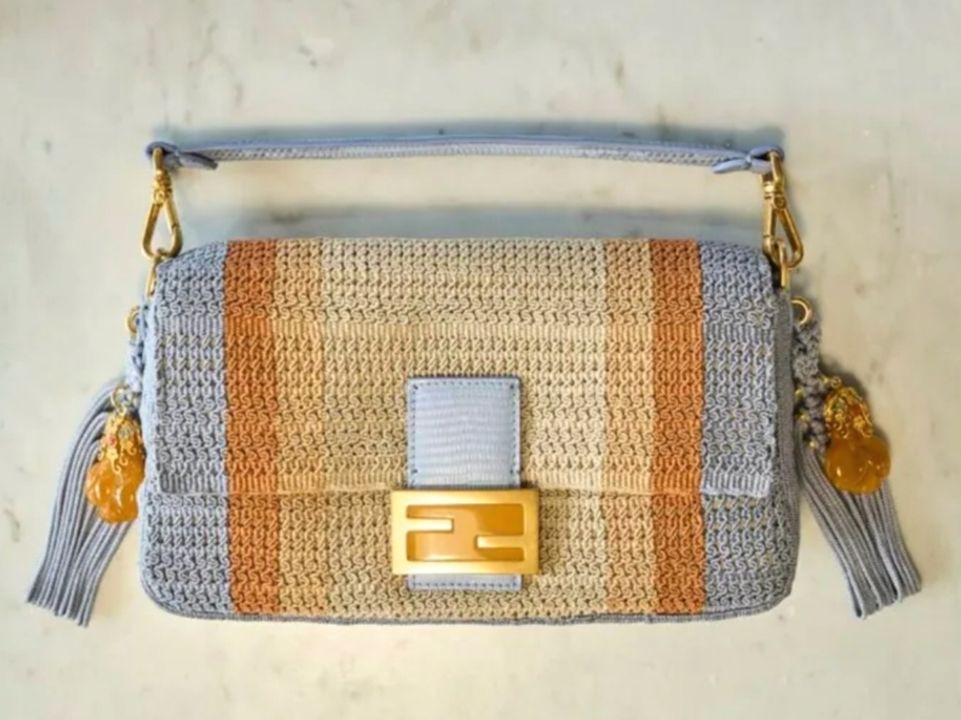
The Baguette bag with knot-topped tassels flanking it that Chinese Netizens are unhappy with. Photo: Fendi
Fendi is in the thick of their 100th anniversary celebrations, and has just staged a “grand” fashion presentation that to fans was the highlight of Milan Fashion Week. But over in China, there is scant regard for what is an important milestone for the house. Rather, Chinese Netizens are furious with the Italian brand for what could be a lapse—regrettable as it is—in accurately attributing the cultural origins of an Oriental decorative knot. According to the Chinese news site, Global Times, Fendi had shared a post on Instagram last Thursday that showed a detail on the knit version of a Baguette bag, with charms in the form of a tassel fastened under a decorative knot.
Most people would call it a Chinese knot or, in China, a 中国结 (zhong guo jie). Interestingly, Fendi wrote to accompany the close-up of that knot: “In Korea, Fendi collaborated with local artisan Kim Eun-Young, who has specialized in Maedeup—a traditional craft of tying and fastening a single long string to form multiple shapes in the form of ornamental knots—since 1965,” without mentioning that the technique is, to many historians of decorative or folk arts, attributable to China. Symmetrical knotting is featured in not only in Korean decorative art, but also in Japanese (known as hanamusubi)—both techniques are generally known to originate in China. There are, expectedly, aesthetical differences between knots from the different nations.

The side view of the Baguette with the controversial knot. Photo: douyin
It is possible that Fendi was referring to the knot style that the Koreans are familiar with, especially since they were in collaboration with a local artist. It is not certain if Chinese Netizens would not be ruffled if Fendi had written that Mr Kim created a Korean style of a Chinese knot. They angrily considered it 文化剽窃 (wenhua piaoqie or cultural plagiarism). Facing intense public displeasure, Fendi has deleted that post on Instagram. When we checked their website this morning, the Baguette in question was not available. It is not clear if Fendi totally withdrew that particular style from the market or was just taking the bag out of online view. In the midst of celebratory high, Fendi should be proud of what the Baguette has brought the company. But because of a slip-up, they have on their hands a potentially frightening PR nightmare, even if only in China.
Despite instances in the past involving other Western brands’ lack of alertness to cultural sensitivities in China (the most maddening was the post by Dolce & Gabbana in 2018), there are still those who stay on the wrong side of vigilance and are not able to see beyond their potted thinking when it comes to communicating with the market supposedly important to them. According to the Global Times, Fendi’s customer service office in China has received “numerous phone calls regarding the issue”, and investigations are underway. However, no statement from the brand has been issued. It is possible that, like Dior with the horse-face skirt fiasco in 2018 that also miffed Chinese Netizens (even leading to protests in Paris), Fendi would chose to remain silent, and hope all—however knotted—will be forgotten.
 Style on the Dot