Miuccia Prada and Raf Simons refrained from noticing trends. Rather, they preferred to react to how they felt about the world at a given time and determine if femininity can be underscored as in the past

They kept the set that was created for the men’s show back in January: the scaffolding, even the carpet of Art Nouveau curlicues. It came handy—and suitably—for the womenswear autumn/winter 2025 show. But it was not a collection that was a spin-off of the men’s. The first four dresses that appeared were black and past-the-knee. At first, they appeared to be nothing to get excited with—sack-like and a tad baggy. But when they were given a closer look, they were not, as it is typical of Prada, what they seemed. It was easy to think that Miuccia Prada and Raf Simons created a palate cleanser quartet even before the full course of the collection, but it was not. These were a subtle commentary on the state of the world now, and the darkness that had enveloped it.
And, initially, you couldn’t really see Prada’s technical finesse in those black dresses, worn with the cant’t-be-bothered attitude of women who potter about in house coats, even going to the corner store. But further down the line-up, lighter-coloured dresses in the same aesthetical vein, revealed fascinating details and proportional control that would delight even the most conservative pattern-maker. We are talking about the shaping of the bodice while keeping the waist loose, the pleating that formed some kind of reversed parenthesis for flapped pockets, the U-shaped waistband that seemed to catch the pleating from the neckline, the sleeveless fit-and-flare tops bunched up at the cleft of the chest, the gathered skirts that appeared to be poorly-made cartridge pleads… we could go on. The collection was a patterning wet dream!
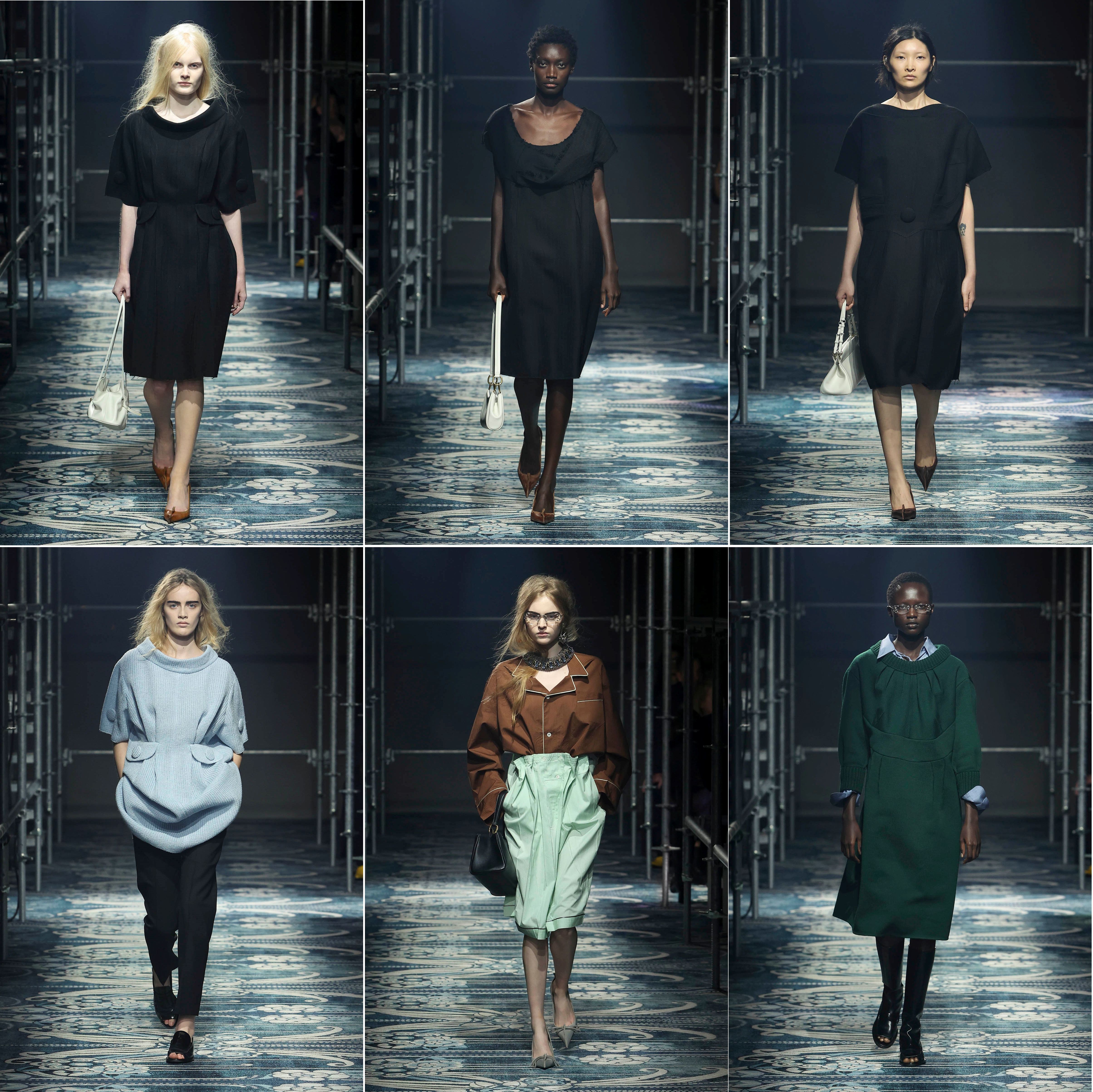


It is always exhilarating to view a show of a collection that comprises considered thought on how generally recognisable garments can be re-imagined in such a way that they are challenging not only to the pattern-maker, but to the consumer. Prada’s tweaked and twisted pieces—even pajama dressing was given a scrunched-up remake—may not have the immediate commercial appeal of the brands that have showed so far, but therein lies their appeal, especially among women who understand the appeal of the off-kilter so judiciously applied in almost-classic shapes. Like at other houses, Prada, too, offered fur and leather, but there was no fashioning them with unfiltered lenses focused on various hazy spots in the ’60s or ’70s.
In a luxury business at large concerned with mere merchandise—and more of them—than solid design, what Prada has persisted to do is admirable. They do not adhere to what the majority desire from “fashion”: the instantly relatable and the easily immitable. Rather, they put every garment through rigorous thought and trials. And with astute understanding of how cut and textural manipulation can make a garment more interesting and far less ordinary, Prada has set itself apart from so many brand contemporaries. This is not to say that the house has not resorted to humour, as some alleged. The house coat reference, for example, did emerge in forms more obvious: three looks in luridly-coloured, offbeat floral patterns that was not out of character for Prada. Re-evaluating old-style home wear? What fun.
Screen shot (top) prada/YouTube. Photos: Prada
 Style on the Dot