Asma al-Assad is believed to be now in Russia, where her spouse—former president of Syria—and she have been granted asylum. Who is the London-born former first lady, who loves her red-soled heels?

In a 2011 Vogue editorial, the former first lady of Syria Asma al-Assad was described as “a rose in the dessert” (also the cringy title of the piece). The Assads, according to the writer Joan Juliet Buck, who was sent by the magazine to Damascus, ran their household on “wildly democratic principles” (their kids, ironically, “voted” to purchase a chandelier fashioned with “cut-up comic books”). The year that Vogue featured Bashar al-Assad’s wife, the president’s regime killed over 5,000 civilians and hundreds of children, according to The Atlantic. Thirteen years later, the Assad reign of terror collapsed. On 8 December, opposition forces captured the capital Damascus. Media reports stated that the president and his family left the capital by air—“escape” was frequently used—to Moscow. There, they were granted political asylum by the Russian government, Syria’s long-time ally. Twenty four years of Assad rule ended rather unspectacularly—without a fight.
It is not known if the Assads were prepared to flee, even if there was, as it appeared, a get away plan. Although Asma al-Assad has enjoyed less a visible public profile then, say, Queen Raina Al Abdullah of Jordan, she was known to have a predilection for luxury fashion. While the glowing Vogue story painted her as a somewhat low-key dresser, Wikileaks documents revealed in 2012 that she spent US$7,000 (or about S$9,440) on crystal-encrusted shoes. The world already knew she had a penchant for Christian Louboutin heels, thanks to Vogue. She considers Mr Louboutin a “personal friend” (he is said to own a castle in the Syrian city of Aleppo). But almost nothing is revealed about what she brought with her to Russia, or if her wardrobe and her shoes went along. In the infamous, failed flight to Vareness in 1791, the doomed Marie Antoinette had trunks of her clothes —she was known to have acquired 300 gowns a year—and shoes sent ahead of her, including her hairdresser! Did Asma al-Assad make similar requests prior to fleeing to Russia?
While the glowing Vogue story painted her as a somewhat low-key dresser, Wikileaks documents revealed in 2012 that she spent US$7,000 (or about S$9,440) on crystal-encrusted shoes
Asma al-Assad was luckier that the French queen of the Ancien Régime: she was not caught. It isn’t known exactly where in Russia the Syrian escapees are now. In 2019, investigations by the Financial Times discovered that the Assad extended family brought no less than 18 luxury apartments in Moscow alone. Apparently this was to keep “tens of millions of dollars” outside Syria throughout the almost 14 years of civil war. US state department, in a 2022 report to Congress, estimated the net worth of the Bashar al-Assad and his extended family at between US$1 to 2 billion, based on open sources. The Assad family has ruled Syria for more than 50 years, of which 24, Bashar al-Assad dominated as president. Raids by ordinary Syrians in the presidential palace and other Assad residences after he was deposed showed that the family lived in utter and unimaginable luxury.
At one of the family’s forsaken and then looted houses in the al-Maliki neighbourhood of northeastern Syria, “a rack of clothes including a Dior garment bag” was seen, The Guardian reported. One influencer Fady Maaz posted a video that showed “a paper bag from the luxury brand Hermès left in front of the fridge”. Other reels posted or shared on X showed Louis Vuitton boxes (they usually house bags) being hauled away (unclear if with content intact). Middle Eastern Eye shared that the family bedrooms have become “a graveyard of designer clothes boxes. Chanel here, Givenchy there”. Journalist Dominic Waghorn of Sky News filed a report from inside Asma al-Assad’s “personal storage room” in one of the family’s many homes in Damascus. It showed the results of intense looting: smashed boxes from luxury brands that included Hermès, Cartier, Lalique, and many others.
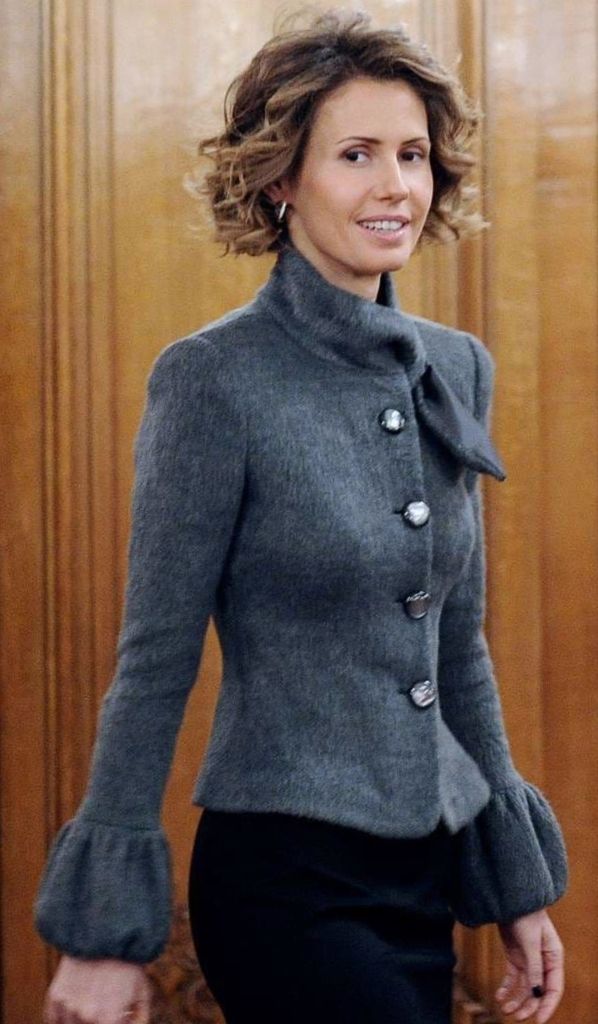
Asma al-Assad in an updated photograph, wearing an Armani Collezioni jacket. Photo: AFP/Getty Images
International sanctions against her and her husband, and his family, effective since 2011, meant that she could not shop as freely as she did before the civil war. But media reports pointed to her resourcefulness. She started shopping online, using an alias—reported to be AAA (presumably for Asma al-Assad)—or the moniker of a secretary, Alia Kayali. She continued to buy jewellery, but asked friends to collect them for her in Paris. The Telegraph reported that for furniture she ordered to be delivered to her home, she had to find a “friendly shipping company in Dubai”. Why the friendliness was not extended to her other purchases is unknown. She continued to indulge in her favourite Louboutins, especially the jewel-encrusted ones. She apparently even sent photos of some heels “not made for the general public” to a friend, who responded, “Haha?I actually LOVE them!!!?But I don’t think they’re not going 2 b useful any time soon unfortunately..”
The Assads’ dramatic flight—to many Syrians—confirmed that they indeed had reasons to flee, not just for the alleged money they siphoned off from state resources, but also for human rights violations (countless extrajudicial killings included), war crimes, use of chemical weapons, economic exploitation, among other atrocities. Asma al-Assad is believed to be complicit in much of the “evil” that the regime, led by her husband and supported by his family, inflicted on her compatriots. While some (or many?) might have been impressed with the beauty of the dictator’s wife and what she wore (Vogue, no doubt), there are those not taken by her cleverly pulled-together image, especially less her support of her husband’s brutality, even sugar-coating the wickedness expressed, all the while supposedly asserting her influence and power in the economy for her own and family’s gain. So profound was what she could leverage that in 2020, then-Secretary of State Mike Pompeo asserted that she became “one of Syria’s most notorious war profiteers”, aided by her husband and her family.
While some (or many?) might have been impressed with the beauty of the dictator’s wife and what she wore (Vogue, no doubt), there are those not taken by her cleverly pulled-together image
Born Asma Fawaz Akhras in London, 1975, to a Syrian cardiologist, Fawaz Akhras, and his diplomat wife, Sahar Otri, Ms Akhras grew up in North Acton, west London (but she apparently gave Joan Juliet Buck the less specific Ealing), in a terraced house with her two younger brothers, Firas and Iyad (also spelled Eyad). Not much is known about her childhood except that she was bright and studied at Acton’s Twyford, a Church of England high school, where she curiously called herself Emma, according to The Times, and eventually went to the private Queen’s College in Marylebone for her A-levels, and, in 1996, to King’s College London, where she graduated with a bachelor’s degree in computer science and French literature. After graduation, she chose to work in investment banking, first with Deutsche Bank Group and then with JP Morgan. It seemed she was happy with a career in finance. But then meddlesome cupid appeared and changed the trajectory of her life.
London was where her romance with Bashar al-Assad sparked. He was in the capital in 1992 to receive training as an opthalmologist. In fact, both of them were acquainted much earlier, when they were kids, when she—as a young girl—met her future husband through friends of the family, which suggested that her parents were well-connected, even when they chose to reside in London (the city both went to in pursuit of professional opportunities). Bashar al-Assad and Asma Akhras reconnected in London the year Queen Elizabeth commemorated her ruby jubilee (40th anniversary). Virtually nothing is known about their courtship. Two years after Mr al-Assad started his medical training, his older brother Rifaat met a fatal car crash. The spare is now the heir apparent, and the next in line to fulfill his family’s dynastic-succession dreams. In 2000, he was installed as the president when al-Assad elder died. The new president, by now, was in a serious relationship with Ms Akhras. “I tried to keep it low‐key,” she told Ms Buck. But, “suddenly I was turning up in Syria every month.” She quit her JP Morgan job and married Syria’s most powerful man on New Year’s Day, 2001.
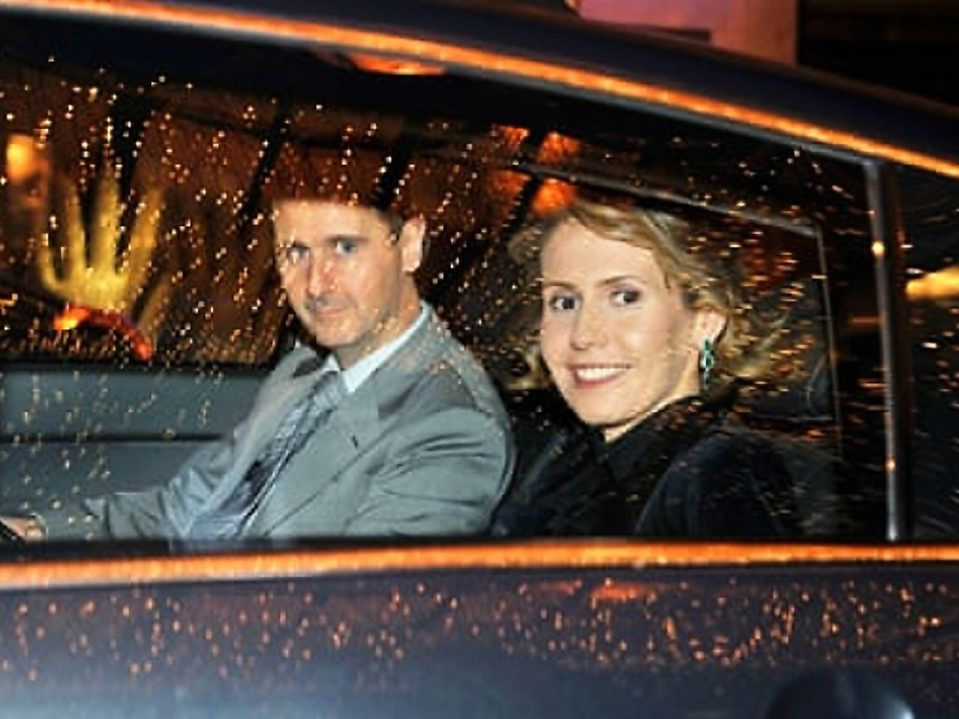
Bashar al-Assad with wife Asma in Paris, 2010. Photo: AFP/Getty Images
In her early years as first lady, Asma Al-Assad appeared to do considerable good for Syrians, especially the young, encouraging them to engage in what she calls “active citizenship”. She was also concerned about the country’s culture, telling Vogue in that fateful article, “People tend to see Syria as artifacts and history. For us it’s about the accumulation of cultures, traditions, values, customs.” And, she continued, “culture is like a financial asset. We have an abundance of it, thousands of years of history, but we can’t afford to be complacent.” And she was not. She went to Paris to discuss an alliance with the Louvre. Ms Buck, duly impressed, described that meeting: She “dazzled a tough French audience at the International Diplomatic Institute, speaking without notes. ‘I’m not trying to disguise culture as anything more than it is,’ she said, ‘and if I sound like I’m talking politics, it’s because we live in a politicised region, a politicised time, and we are affected by that’.”
It is hard to believe that given her awareness of the politicised life around her, Asma al-Assad was oblivious to the horrors afflicted to her people by the regime that she was so very much a part of. Her tendency to portray herself as a humanitarian was totally at odds with what her husband permitted on the soil they both called home. When the Syrian civil war broke out in 2011 (initially, as pro-democracy uprising, inspired by the Arab Spring protests affecting the region), she chose to aide—even “abet”, many belief—her husband’s cruel crackdown on dissidents, which killed thousands of civilians: she was resolutely silent. For someone who spoke to CNN in 2009 about the Palestinians in Gaza: “you put your children to bed at night, you expect to see them in the morning—that’s a luxury the people in Gaza do not have”, you’d expect her to feel the same for what happened in her own country. But she barely said anything throughout the war. In 2012, The Times received an email from her that read: “The President is the President of Syria, not a faction of Syrians, and the First Lady supports him in that role.”
Her tendency to portray herself as a humanitarian was totally at odds with what her husband permitted on the soil they both called home
‘A Rose in the Desert’ did not amuse anyone who read it and became so controversial after it was published that Vogue took the article from their website down weeks later (they had earlier defended its publication, saying it was “a way of opening a window into this world a little bit”). Joan Juliet Buck, the former editor-in-chief of French Vogue, was consequently shunned by the American counterpart, her contract as a contributor not renewed. She would later say to the New York Times that she was “tainted, like a leper”. Anna Wintour kept mum when the Internet showed how displeased its users were with what she allowed to go to print. She finally issued a statement of standard censure: “The escalating atrocities in Syria are unconscionable and we deplore the actions of the Assad regime in the strongest possible terms.”
It was later found out that the Washington, DC, PR firm Brown Lloyd James received US$5,000 a month to land Asma al-Assad within the pages of Vogue. Ms Buck told NPR’s ‘All Things Considered’ program in 2012 that “Vogue is always on the lookout for good-looking first ladies because they’re a combination of power and beauty and elegance. That’s what Vogue is about.” Introducing Asma al-Assad in that Vogue story, she described her subject as “glamorous, young, and very chic—the freshest and most magnetic of first ladies. Her style is not the
couture‐and‐bling dazzle of Middle Eastern power but a deliberate lack of adornment. She’s a rare combination: a
thin, long‐limbed beauty with a trained analytic mind who dresses with cunning understatement.” A lack of adornment is no indication of a lack of hunger for power. In a leaked e-mail The Telegraph obtained in 2012, she joked to a friend about her spousal dynamics: “As for listening, I am the REAL dictator, he has no choice.” No one, reading that, laughed.
Illustration: Just So
 Style on the Dot