Sort of. Marv Jacobs is the “guest editor” of the latest issue of American Vogue. Is it any good?
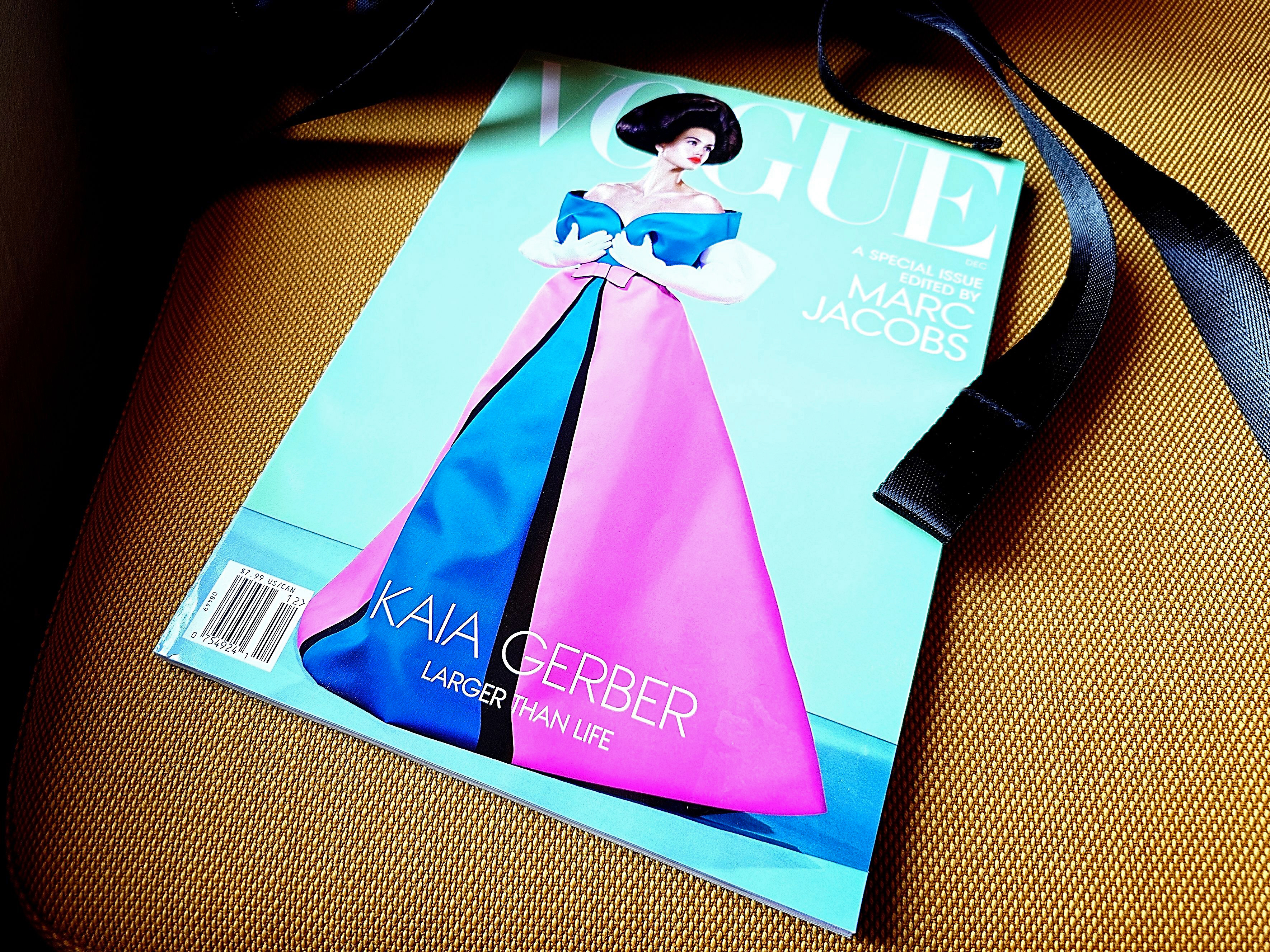
Kaia Gerber on one of two covers of Vogue US, styled by Grace Coddington and photographed by Steven Meisel
A guest in anyone’s home—or office—rarely gets to do whatever he wants. But not, apparently, Marc Jacobs. Over lunch of chicken paillards one unknown day in Balthazar, the designer was invited by Anna Wintour to guest-edit the last issue of the year of American Vogue. He accepted the task. And, unsurprisingly, he did as he pleased (mostly). You’d think that this is a Marc Jacobs brand supplement to go with Vogue, as a sort of bumper festive publication (which, no doubt, it needs, considering how thin the September issues have become, ditto the December—currently with a grand 168 pages). In all likelihood, Ms Wintour, wants Mr Jacobs’s signature all over the magazine. And she gets it. What is surprising is that Ms Wintour allows someone to edit her magazine, even if partly. She has never done it before. And in its nearly 140-year history, Vogue has never been guest-edited.
Has Ms Wintour run out of ideas for her beloved Vogue, so much so that she needed outside input, and from someone with no editorial credentials (such as Meghan Markle for British Vogue in 3019)? Has her endorsement-of-Kamala Harris issue not done well? Is it time to go back to fashion and leave politics—and the unpersuadable MAGA masses alone? Ms Wintour has been with the American edition of Vogue for 36 years. We don’t remember that she has allowed anyone to share her vision for the title. Hers is the only foresight that matters. For all his creative energy (and it was, for certain, expressed in the magazine), Mr Jacobs has a very peculiar aesthetic that is not necessarily flat out US Vogue. Exaggerated comes to mind. And he has effected his distorted sense of beauty within the pages. The American designer has dabbled in art, in the offerings of the pop world, in the cultural zeitgeist. For Vogue, his is no different: Marc, Marc, Marc.
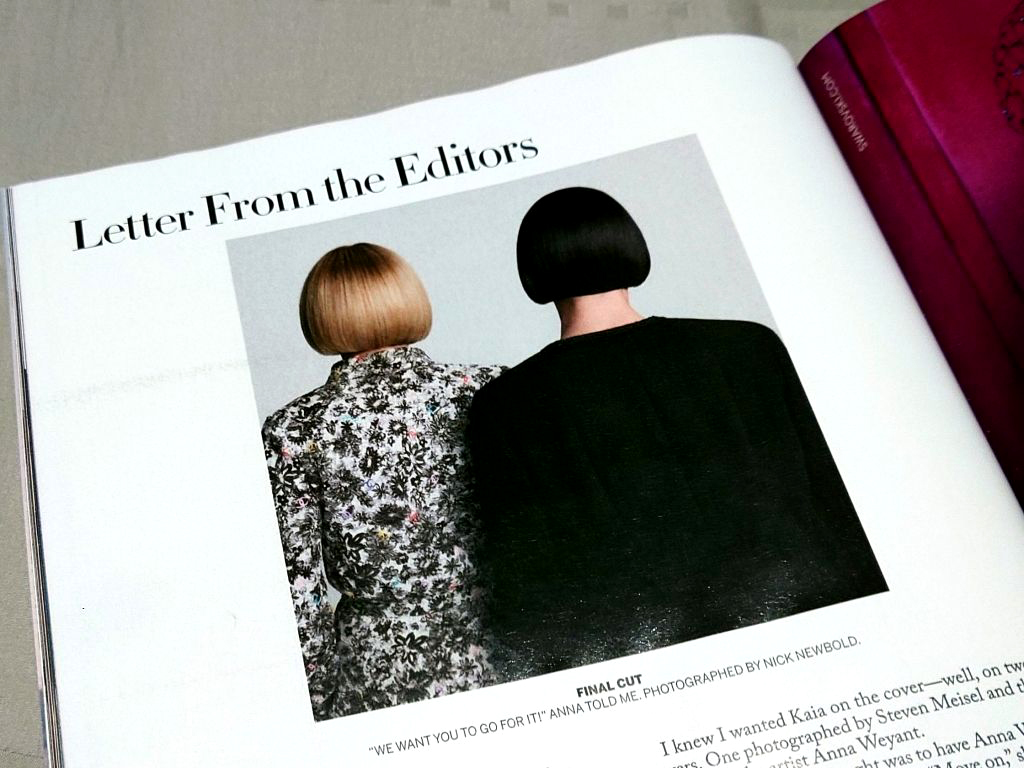
Startling as well is Ms Wintour’s willingness to let Mr Jacobs write her editor’s page—a first, too. So is the monochromatic photograph on it, which she shared willingly with someone else! Both she and Mr Jacobs had only their backs to be photographed, with the latter spotting the same bob hairstyle as the woman who is, hitherto, defined by it, but his is jet black and looks painted on. Even more extraordinary is that she did not sign off on the page with her guest editor. The running head read unambiguously ‘Letter from the editors’, yet, she seemingly did not mind his signature appearing singly on the 14-paragraph introduction of his Vogue, which, to be sure, is persuasively written and heartfelt, more so than anything Ms Wintour has ever penned. After more than three decades at the helm, has Ms Wintour softened her stand?
Mr Jacobs wrote rather earnestly about his experience working on his debut contribution to Vogue. He was not, at first, certain, about excepting Ms Wintour’s unexpected proposal, but what was there to stop him? Nothing it seemed, not even the “inner saboteur”. He went to the Vogue HQ for his first editorial meeting and was told by Ms Wintour, “We want you to go for it.” He sure did. Mr Jacobs did not work alone. He had considerable help, from former Vogue staffer, the much-loved Grace Coddington, the stylist and former editor-in-chief of i-D magazine Alastair McKimm, Vogue’s global creative director who happens to be his school mate, Raúl Martinez, and the usual fashion shoot suspects, photographers Steven Meisel and Inez & Vinoodh, as well as hairstylist Guido Palau and make-up artist Pat McGrath. It is a family affair, but with a strong patriarchal bent (or matriarchal, depending on how you see it). With a dream team, Marc Jacobs was able to assembled his own near-catalogue. “It was a love fest,” he said.

Kaia Gerber gets her own editorial feature, outfitted in Marc Jacobs entirely, of course
The cover star is Kaia Gerber, the follow-my-mother’s footsteps daughter of Cindy Crawford, with a comeliness sans the latter’s sultriness. Mr Palau styled like a hirsute helmet; her glassy skin by Ms McGrath a post-Maison-Margiela-porcelain-doll’s and her dress—Marc Jacobs, of course, from his autumn/winter 2024 collection—is as stiff-looking as those made of paper for flat figurines in the same material. It is not a reinterpretation of what was shown in his July show. And Ms Gerber looks every bit as doll-like as Mr Jacobs intends for her to be. In the requisite making-of video that promoted the Mr Jacobs’s guest-editorship on vogue.com, he said, “I felt like she would be a great cover because of who she is, because of the history I have with her and because of the work that she is doing.” Ms Gerber is not that versatile of a model. It could have been hard making her look a “stylised version of herself”, as Mr Jacobs described the results. “There is nothing wacky or zany about the pictures; they’re actually just very beautiful.” One man’s beauty is not necessary another’s.
Such as finger nails longer than the fingers themselves. The nail extensions, which has been adopted by Mr Jacobs since the Met Gala in May 2024, are part of the feature ‘Impossible Beauty’ that also includes caterpillar lashes. The title is somewhat a misnomer since the nails and the lashes shown are far from impossibilities for Mr Jacobs, professionally or personally. Protracted nails are nothing new. The women of the Qing imperial court in China were known to wear ornate, filigreed 指甲套 (zhijiatao) or nail sheaths that were also known as 护甲 (hujia) nail guards, a pun on the same Chinese word for armour. The nails shown in the editorial are not as elaborate as what the Qing-dynasty queens and dowagers wore, but they are no less dramatic. In fact, they bear striking resemblance to what Mr Jacobs now wears with considerable frequency. One man’s beauty!

And there is no mistaking that the beauty page salutes Mr Jacobs too
The other fashion spread that Mr Jacobs conceived is one inspired by dance—in all its myriad forms, especially those popular in New York, home of the stuttered Studio 54, once Mr Jacobs’s hangout, whose habitués inspired him till this day. The feature is photographed by Inez & Vinoodh, with conventional fashion images appearing between those of dancers in a club (shot in a studio) that could have come out of Time Out. Mr Jacobs is not a diurnal creature. So it is not surprising that the largest fashion spread is inspired by dance—as in ballet and clubbing, both primarily evening performance and late-night indulgence. It is, however, hard to see the relevance of the story (even if going dancing is still a thing) considering that people do not really dress up to go to a club. Or maybe they do in New York, but not quite here.
A profound read is Mr Jacobs’s account of his encounter with a large Frank Lloyd Wright house in Rye, in New York’s Westchester County. “When I crossed the threshold into the foyer,” he writes, “the house embraced me in a way I could never have anticipated.” He subsequently bought it. A month later, he married former model Charly Defrancesco in that very house. And thereafter, the renovation proper began. Although that is complete, the decorating of the house is not. Mr Jacobs writes, “I daydream about continuing to fill this reimagined interior with art, Arts and Crafts, Deco, Chinese and Japanese art, and Roman antiquities, I’ll wait for the sun to set before I surrender to an hour or two of Netflix….” In the sole image that accompanies the essay, Marc Jacobs is dressed in a regular, not fluffed-up bathrobe. His nail extensions are taken off. His hands look regular, right for the home, and ready for chores. Or, maybe for another round of guest-editing at Vogue.
Photos: Jim Sim
 Style on the Dot