Malaysia’s national costume for Miss Universe 2024 is revealed to be inspired by a fabled princess from Pahang

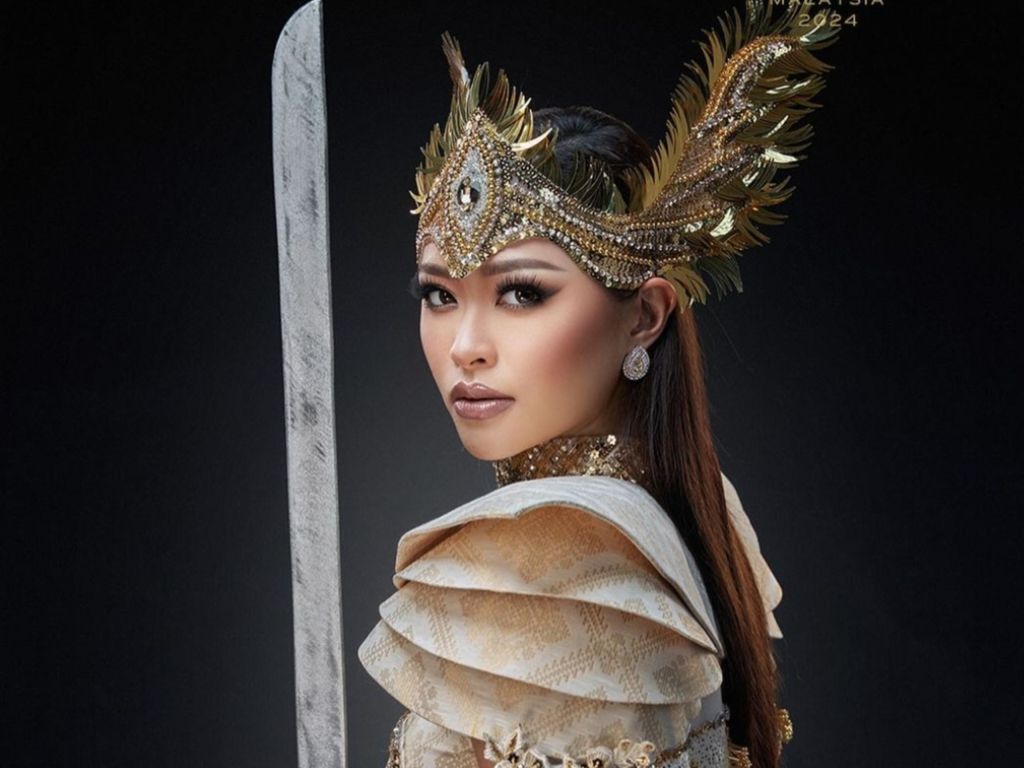
Our own national costume for this year’s Miss Universe in Mexico City has not been revealed, so we should not comment on Malaysia’s, but we shall, nevertheless, wade in. This year, the country’s pageant representative is Sandra Lim Shue Hui (林雪卉, Lin Xuehui)—actress, host, and model; born in Selangor. Yesterday, she revealed on her Instagram page the outfit she will wear during the popular ‘National Costume’ segment of the competition. Malaysians are not unanimous in their admiration of the outfit. The look is apparently inspired by a princess—Walinong Sari—from a folklore that, interestingly, is not from the state Ms Lim was born in, but neighbour Pahang. Despite its royal leanings, some consider the pakaian (costume) “so simple”, fearing the outfit may not win Ms Lim the award for Best National Costume.
The apprehension is not exaggerated if you consider what other nations—in particular, the South American countries, or Malaysia’s neighbour, the Philippines—would send out on stage. Ms Lim’s outfit is not offensive or jokey, as their 2021’s version was—a mobile kampung, emerging like a float, only wearable. Yet, there is something not quite dramatic and dazzling enough about it. Designed by Ezuwan Ismail, known for his gowns and baju pengantin (wedding wear), the outfit appears to be a two-piece with a top, crowed at the shoulders by a short, four-tier pelerine, like the roof of Negri Sembilan’s Rumah Minangkabau, but without the tanduk kerbau (buffalo horns). For the bottom half, Ms Lim wears a pair of slim-fitted pants that is oddly loose at the crotch. It is unclear if Mr Ismail is known for his tailoring.
The outfit is not offensive or jokey, as their 2021’s version was—a mobile kampung, emerging like a float, only wearable. Yet, there is something not quite dramatic and dazzling enough about it
Unsurprisingly, traditional Malay songket (brocade) is used, so is sulam tebuk (a style of embroidery), but in sum, they do not typify the grandeur and richness of Malay court baju (dress). The look of the puteri (princess) is completed with a winged headgear, sheer cape, sash-belt, a pair of gloves that stretched to the elbow, and knee-high boots, all could have been conceived for a festive procession. The outfit easily passes off as a Malay superhero’s modern-day costume, one that director Patty Jenkins would enthusiastically approve. Malaysians even compare the costumes to the white Power Ranger’s! In a way, the allusion is, perhaps, not hyperbolic. In the tale of Walinong Sari, she is very much the warrior-princess that she was created to be, a woman whose pugilistic bent robbed her of a chance at love.
According to lagenda, she is particularly skilled in the Malay martial arts of the silat. Although her reputation had spread through the region and suitors eventually came calling, she did not find any of the men worthy, until a celestial king, disguised as an ugly person, arrived to challenge her to a duel, to test her silat skills. It was a bout she found impossible to resist as she had never been defeated in a fight. But fate dealt her the worst card, and the opponent she eventually fell in love with—after three days of fighting and after he revealed his true countenance—was not to be had, following the intervention of the king’s father that was untimely and unnecessary.
In the popular Siti Nurhaliza song from 1999, Walinong Sari, the subject was described as a “puteri yang cantik (pretty princess)” and “puteri bistari (smart princess)”. And while there was mention of her descending from her mountain abode with a “payung kuning (yellow umbrella)”, there was no description of what she wore. In most costumed depictions of her, the puteri is rarely, if ever, given trousers to wear. But Ms Lim’s Wanilong Sari will show the world a decidedly watak bandar (urban character). It is not, of course, out of the ordinary these days that Miss Universe contestants wear bifurcated bottoms on stage. Last year, our own Clarissa Yap wore a 3-D-printed Frederick creation that was built upon leotard and leggings.
The thing is, Malaysia has folklores to refer to, an advantage that we are not really blessed with, which requires our costume designers to frequently turn to the reliable but terrible standby, Vanda Miss Joaquim. Walinong Sari’s fashion choices may not be clear, but she is the warrior-princess to admire and emulate. And to allow present-day pageant queen/warriors with a cause to carry the flag of feminism. Sandra Lim, herself a practitioner of the Chinese martial arts of wushu, told the New Straits Times that “Princess Walinong Sari symbolises resilience and beauty”. But she did not comment on the royal’s rush to love that eventually failed her. Beauty queens just need to be “fierce”, as Ms Lim described her inspirasi on IG. Macam ni la bagus (good this way), as some online approval went in Malaysia. It is uncertain if we will do better.
Photos: sandralimofficial/Instagram
 Style on the Dot