Jonathon Anderson did not hold back his manipulation of shapes for Loewe. And still, there were clothes

You didn’t think that hoop dresses and skirts could be this light. But they were. Or floated so freely. But they did. Or had the incredible ease of sundresses. But they had. Tradition and costume were forsaken. Loewe’s Jonathon Anderson is one of the very few designers who could rouse old dress forms and make them anything but old. And while florals may not be any breakthrough for spring, the faded prints did augment the garments’ appreciable airiness. And the hoops used were not just concentric in their placements. Some were skewed so that cunning asymmetry could be effected. The last hoops of some ankle-grazing dresses were not positioned at the heel of the wearer, rather they ended higher so that the rest of the skirt fall over and comport themselves like flounces. There was not only a perceptible whimsy about these looks, but an immense joy too. The Dior-dependent—and many there are—would probably be scratching her head.
The show, another typically white-space affair, was house in an also-prisitine marquee, plastered on the outside with sheet music for a violin sonata by Bach. This sat on the grounds of the Château de Vincennes, once a fortress and and royal residence on the eastern perimeter of Paris. The external musical theme was not continued inside where the almost clinical expanse featured, right in the middle, a single slender rod on which a bird perched at the top by the British artist Tracey Emin. Unless the bronze winged creature was a songbird. Titled The Only Place You Came To Me Was In My Sleep, the minimal line perpendicular to the floor was like a needle, without which the making of clothes, however simple or not, is nearly possible. But simplicity is not the main message of the collection, at least not by most common definition of it.


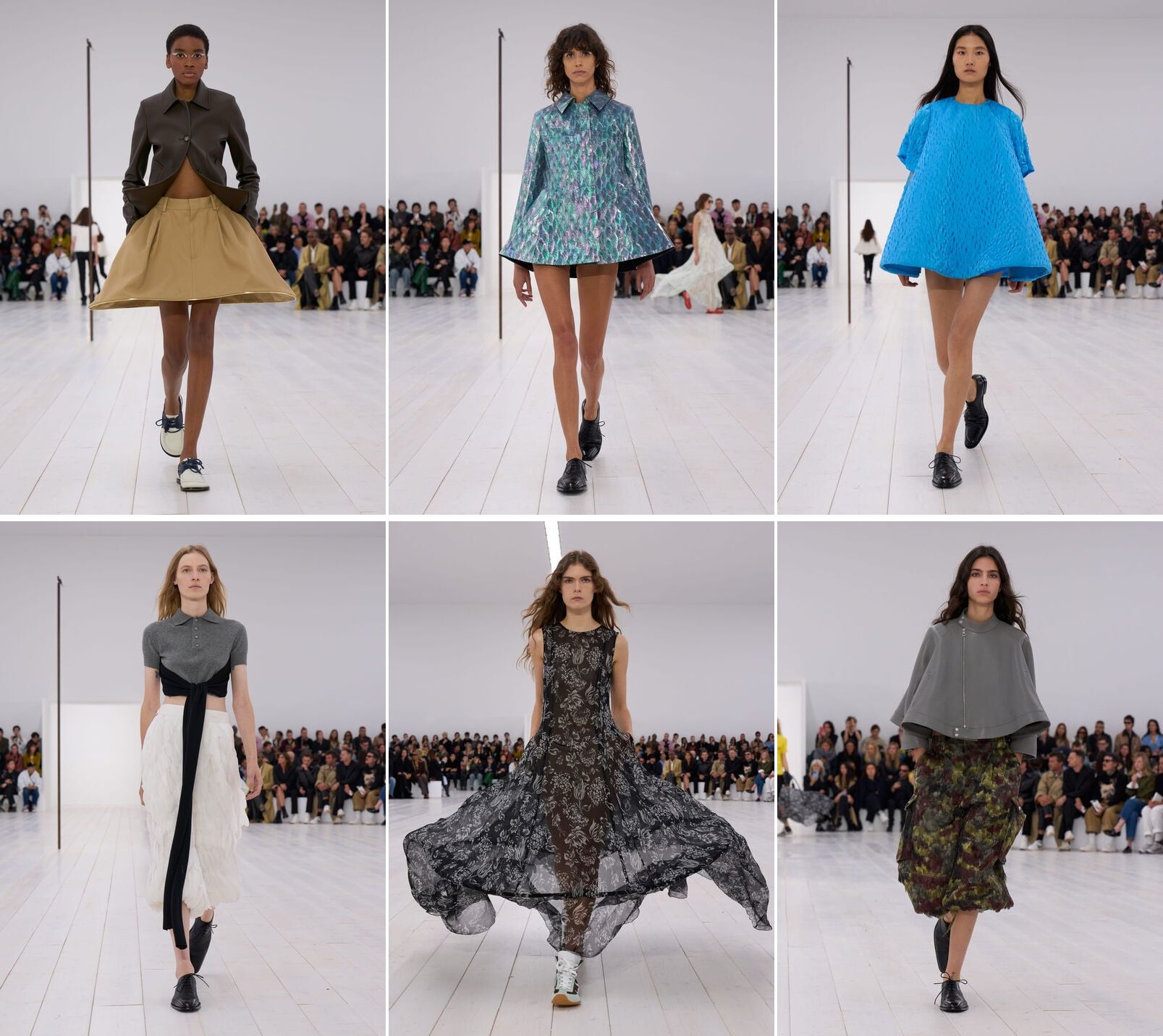

In the show notes, Mr Anderson describes the collection as an exercise in “radical reduction”. But it is not immediately determinable what tangible elements were reduced other than the decorative. Loewe explained that it was “stripping everything away, the silhouette remains: bending, bouncing, flowing in curves, long or crudely cropped, moving sideways and away from the body, like falling into and out of a dream.” Getting in and out of dreams is not always wondrous, but to diminish a collection so that the uncommon silhouettes retained were tantamount to doing away with the horrible falling in dreams that is real enough to jolt one awake. Yet, Mr Anderson did not make everything bare, plain, or placid. Apart from the hoop skirts that offered fetching movement, there were skirts that were shaped like cones lobbed off at the top; smart, tented mini-dresses; cropped, swing, tab-collared coats that could have been capes, and coats with edges in the front that seemed to be in a state of permanent blown-apart by wind.
The reduction did not mean discounting details. Much of the discernible ideas were puzzling in their application. Some trousers were draped and pleated to the left (obliterating the crotch seam), at the waist and they beguiled us with the possibility that the garment might have been a sarong skirt in a past life. Or the cropped tank top, with a pinch of the hem clipped to the right side of the waist of a pair of pants. Or the cute T-shirt, almost 3-D in their bulk (made of feathers!), with images of historical figures or the work of past artists. Or the top woven with feathers to mimick a trellis. Or the iridescent fish-scale patterns of a flared jacket that would make the Little Mermaid jealous. At a glance, the collection really appeared to be an exercise in toning down, but upon closer look, there was a lot to unpack. As there usually is at Loewe.
Screen shot (top): Loewe/YouTube. Photos: Loewe
 Style on the Dot