Even the finest clothes were worn in vain. The rain killed everything, the boats swallowed them whole
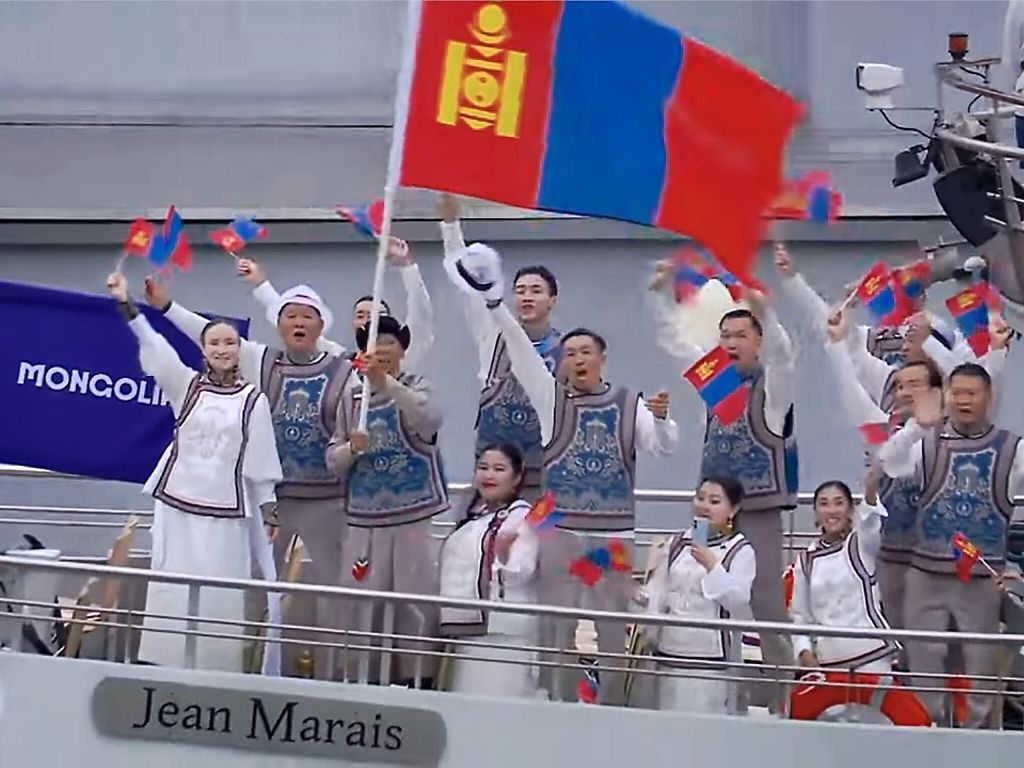
Mongolia in their much-lauded finery
While Paris did make fashion key in the opening ceremony of the 33rd Olympiad, they did not give the key players—the athletes—a chance to show off their costumes specially prepared for the occasion. They concerned themselves not even with their own athletes, crammed in the main deck of the largest boat, togged in Berluti. It didn’t help that the whole march past was a waterborne affair—contingents were sent down the Seine in a messy, awe-uninspiring, and drenched flotilla. The rain aside, the fringy shows, sandwiched between the Parade of the Nations on different spots along the river, were unnecessary distractions than enhancement of the riverine procession. Who, in the the end, was looking out for the uniforms worn? We were watching at home on our devices, and what we saw on our screens were not only the yawn-inducingly dull, but also the blurred, since the rainfall, as well as the raindrops-dappled camera lenses hindered the capturing of anything sharp.
The shots of the boats passing by hardly revealed the clothes we were hoping to see. Since you could barely make out the silhouettes, forget the details. We could not discern a trend, such as the men in skirts at the Tokyo Games. With the rain, many wore the clear plastic ponchos provided over their uniforms. The wetness of the rainwear further obscured what they came to proudly display. What did they really wear under? As many contingents shared a single boat, the camera lens did not remain on one team squeezed onto the onboard spaces long enough. You saw waving of small flags, and that was about it. As the camera work was, at best, inconsistent, not every nation’s athletes enjoyed the full, clear view they would have received if they walked into a stadium, as it had been for many editions of the Games. And it didn’t help that some of the teams had to be packed onto the main decks of their assigned vessels. So dense the boat tops were that many, such as the Chinese, the Italian, the American, and the French teams, were just their own indiscriminate throng.

China’s red-and-white suits was, as precited by their own citizens, no standout on deck

Although slammed back home, the Indian team did not look too bad. Photo: AP/PTI
In the end, the better-spaced teams not under rainwear better showed what they came to impress. And Asia was not a total letdown, we thought. Mongolia, as expected, did not disappoint. Although the close-up shots were brief, we could make out the vests and tunics they wore that had already won raves when the uniforms were revealed earlier. It helped that on the Seine, the team’s swimmer Batbayar Enkhtamir, standing at an impressive 1.92 metres, stood out—even in the rear—to be the star that he has become, especially on social media, where the “eye candy” has been winning hearts. For the North Asian contingents, there really was no other team that was attired for the history books. Even the uniform of China’s athletes was surprising 无趣 (wuqu, uninteresting), despite the eye-catching red of the blazers worn by both the men and women that was regrettably lost in the boatload of three other nations’ teams, coincidentally also in red. Japan, home to some of the best designers in the world, also sent out rather lame designs—cream-coloured blazers edged in black—that truly looket washed-out on the deck.
The South Asian teams, we thought, did not fare too badly. Although India’s uniform, designed by Tarun Tahiliani, was derided at home for looking “cheap and tacky”, the men in kurtas paired with a jacket and women in sarees, all in the tricolour of the Indian flag, did look ethnically recognisable. But many Indians had other views, with one columnist, Dr Nandita Iyer, sharing on X: “I have seen better sarees sold in Mumbai streets.” Mr Tahiliani defiantly told NDTV, “This is what we Indians wear; this is not to be a couture show.” Their neighbour to the South, Sri Lanka, did look poised to receive raves for what they wore. Designed by Lovi Ceylon, the uniform was just one of two worn by an Asian team—after Mongolia—that was a salute to historical/traditional dress. The white pieces were made of silk, hand-embroidered and beaded. The designs were reportedly inspired by the nation’s royal courts of the 19th century.
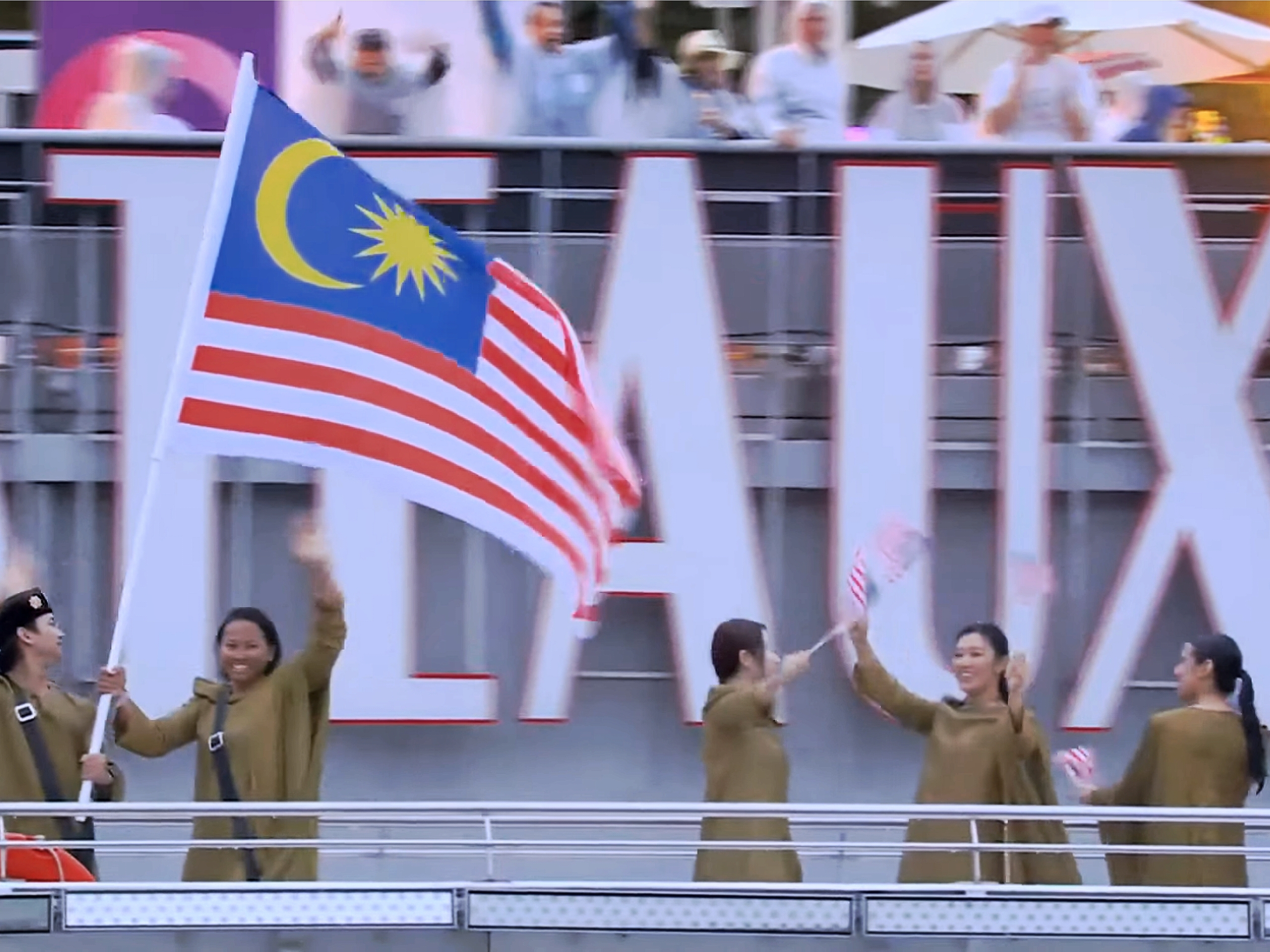
Malaysia’s much anticipated uniforms did not elicit wows as the team looked lost in the ship

Team Singapore reprised what they wore at the Tokyo games, looking “safely” collegiate
Nations nearer us made scant impact on the Seine. Thailand, whose uniform for the opening ceremony were also scoffed at in their homeland, offered little for the world to see as their athletes were mostly obscured by the rainwear. One Thai graphic designer told us, “this was less embarrassing for the team”. Indonesia’s uniform, designed by Didit Hediprasetyo, was a “modern” take on Javanese costume. It looked appealing in publicity shots, but it did not stand out: The ten-member team (India’s neighbour on deck), like others of similar size, looked nondescript on the shared main deck. Similarly, with the Philippine’s athletes, the Francis Libiran-designed shirt and a sort of holster (described locally as a “sling”)—worn to the left and over the arm—was a fleeting attraction. Malaysia’s much anticipated uniforms, designed by the nation’s reigning designers behind the “couture” label Rizman Ruzaini, had ethnic heft, but on the world stage that was the Olympics opening ceremony, they projected a balik kampung vibe. The supposed gold hue of the bajus, in the fading light and dampness of the late evening, appeared berlumpur—muddy.
Our own athletes, unfortunately, did not score a standout, even without the need to share boat space. Although Singapore hoped to do well in the games that our sports stars are participating in, it did not express even a tad loftier aspirations in how we would turn out during the opening ceremony as SEA’s wealthiest nation. Secretary-general of the Singapore National Olympic Council (SNOC), told The Straits Times back in 2012, “What works for any formal occasion is always a jacket and pants… we don’t need to be the most fashionable.” And we never have. More than a decade and four summer Olympics later, the SNOC approach to outfitting Team Singapore has not changed. Which may explain the hongbao-red jackets of questionable fit and the (still) skinny chinos (“did they buy them from Uniqlo,” we were asked!). The uniform remains just that: characterless garments for the body. Or, as one SOTD reader said to us, “inoffensive”.
Screen shots: mediacorp/YouTube, except indicated
 Style on the Dot