In Paris, they simply cannot count fashion out. With a major LVMH sponsorship, it was not just the Berluti suits that the French athletes wore, it was also the visibility of the other stuff—from Louis Vuitton trunks to Dior gowns. The night could have been mistaken for Vogue World

Dance performers on a floating platform with the Eiffel Tower in the background
The spotlight of the 33rd Olympiad, disappointingly, did not go to what the athletes wore. On the opening night of the Paris Games, every sportsperson was left out in the rain. The Paris sky did not cooperate. Many participants of the sodden Parade of the Nations, held for the first time outside a stadium, on the River Seine (sail down would be more accurate) wore clear plastic ponchos—probably issued by the organisers—that obscured the uniforms they wore. Even the French team, the largest contingent on the largest ferry on the rivière, impressed with their numbers, rather than by the Berluti suits they had on. It didn’t help that the rain washed out what should have been clear, even if too-distant shots of the athletes. Water droplets on camera lenses exacerbated the haziness too.
This is the third time Paris played host to the Olympics (after the 1900 and 1924 editions). It was fortunately a cool 21°C evening, but unlucky for the city, le ciel did not hold back the cloudburst. It rained and, according to the live commentaries and evidenced by the umbrellas that the spectators had to use, it rained hard (some called it “torrential”). The cameras even captured the visible rain in front of sheltered President Emmanuel Macron and his wife Brigette. To be sure, the precipitation did not dampen the spirit, but the way the entire event played out diminished the splendour of the show, at least for the online viewers, many of us in this part of the world, who stayed up through the wee hours of the morning to watch the livestream.
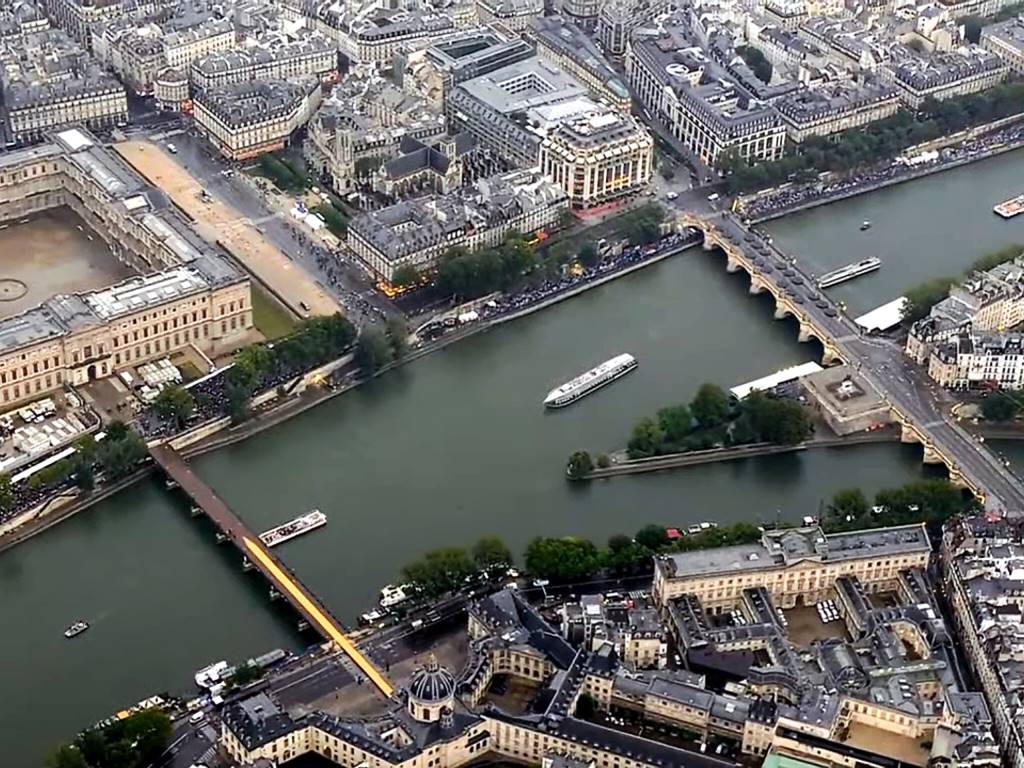
Aerial view of the Seine, with the boats transporting the athletes
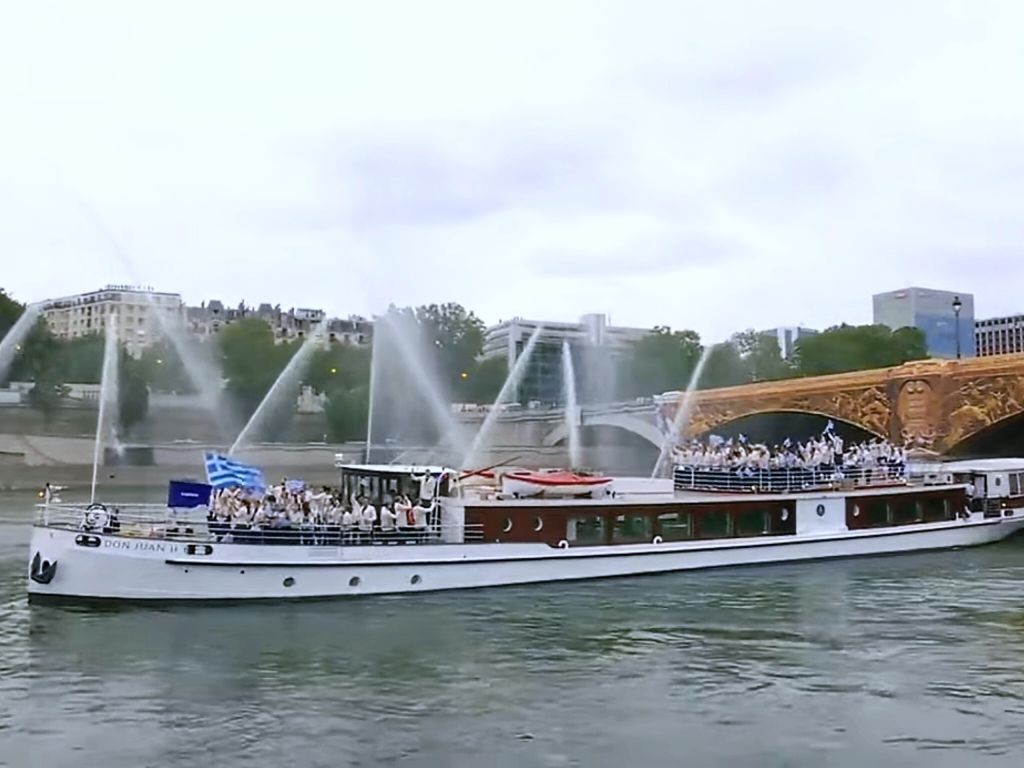
Greece, keeping with tradition, led the Parade of Nations
This was the first time in the history of the modern Olympics that an opening ceremony was not held in a stadium or the semblance of one. Central Paris on both sides of the Seine, as well as the Trocadero (right in front of the Tour Eiffel) were where the actions took place. Whether a riparian affair was better than a ceremony in a purpose-built stadium is debatable. It is clear that Paris wanted to show off its city but while the key landmarks were there, the entire show—dubbed “unique”—was oddly fragmented that it did not provide entirely pleasurable viewing, even for those of us watching what was clearly an edited version of a live broadcast in bed. It was likely worse for those more than 320,000 who had arrived early to watch the sprawling show as close to it as was possible, bit mostly watched the action on giant screens.
It did not help that a good part of the first half was pre-taped. The strange, roof-top parkour run of the initial torch bearer for one. And the odd spurt through the Louvre, where characters from old paintings left their canvases, as if it was Hogwarts School of Witchcraft and Wizardry, to peer through a window and marvel at the happening below, another. Unlike the usual opening ceremony, with introductory performances and mass displays before the Parade of the Nations begins, in Paris they decided to jumble everything, which meant that the night saw the float-by of boatloads of athletes interspersed with performances—some on the banks of the river, some at the window of buildings (such as the Conciergerie), none of which was a mass display (those of the sensational Beijing 2008 opening ceremony are still vivid in our mind), nor quite the spectacle expected of the opening night of the Olympics.
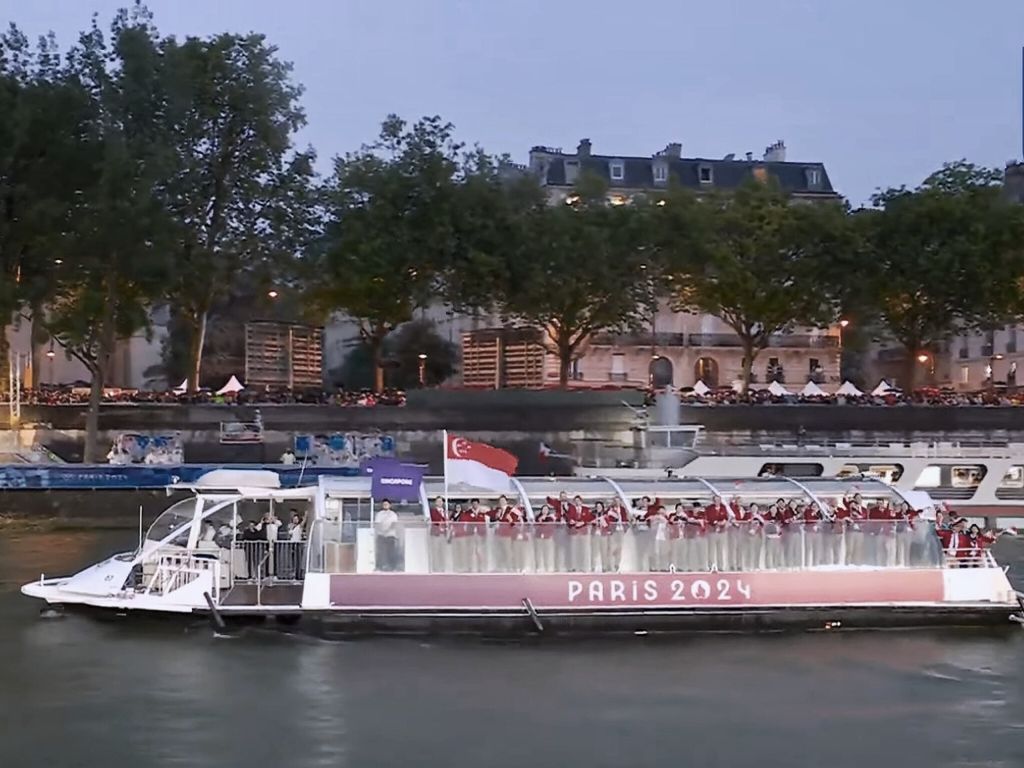
Team Singapore on their very own barge

Host nation France, in practically a cruise ship, concludes the Parade of Nations segment of the show
On the opposite end of the mass display that did not exist, there were the solo performers, including pianist Alexandre Kantorow, offering Ravel’s Jeux d’eau (Water Games) on a very, very wet piano and the solo dancer signing and dancing towards the end of the evening for five minutes to the very extended and “symphonic” mix of the 1977 hit of French disco drummer/producer (Marc) Cerrone’s infectious Supernature. It was simply dull to watch someone who basically moved about free form, while the screen cut, now and then, to the torch relay on the river. And in case you were not aware that there were catacombs beneath the city and that the Minions, even the odd crocodile, lived under the Seine, you were shown the city’s subterranean world.
As the athletes had to be transported down the Seine, Paris likely used whatever river transport that was available. Boats of all shapes and sizes—86 of them—ferried the 6,800 sportspersons to wave at spectators and to bring them from the Austerlitz bridge in the east to the second part of the show at the Trocadero esplanade. Which means even pleasure crafts, including those that tourists board to dine and view the city from the river were used too. The vessels of the riverine parade was a discordant mix, with some contingents waving from tiny boats, while others sharing far larger cruisers with others. Even previous host Japan had to share a boat with Jordan, Kazakhstan, and Kenya. We felt sorry for the Malaysian contingent of about less than a dozen. Despite raya-worthy costumes conceived by the country’s top kutior brand, Rizman Ruzaini, they looked somewhat lost in the massiveness of the event, as well as on the kapal that carried them. Our own athletes looked safe with the same outfit seen at the Tokyo Games in 2021—red blazer, white shirt, and khaki trousers, but did not standout. Curiously, Singaporean athletes had a whole vessel to themselves. Netizens wondered if we paid for our own boat.

There is something for everyone, even the macabre: A very beheaded Marie Antoinette
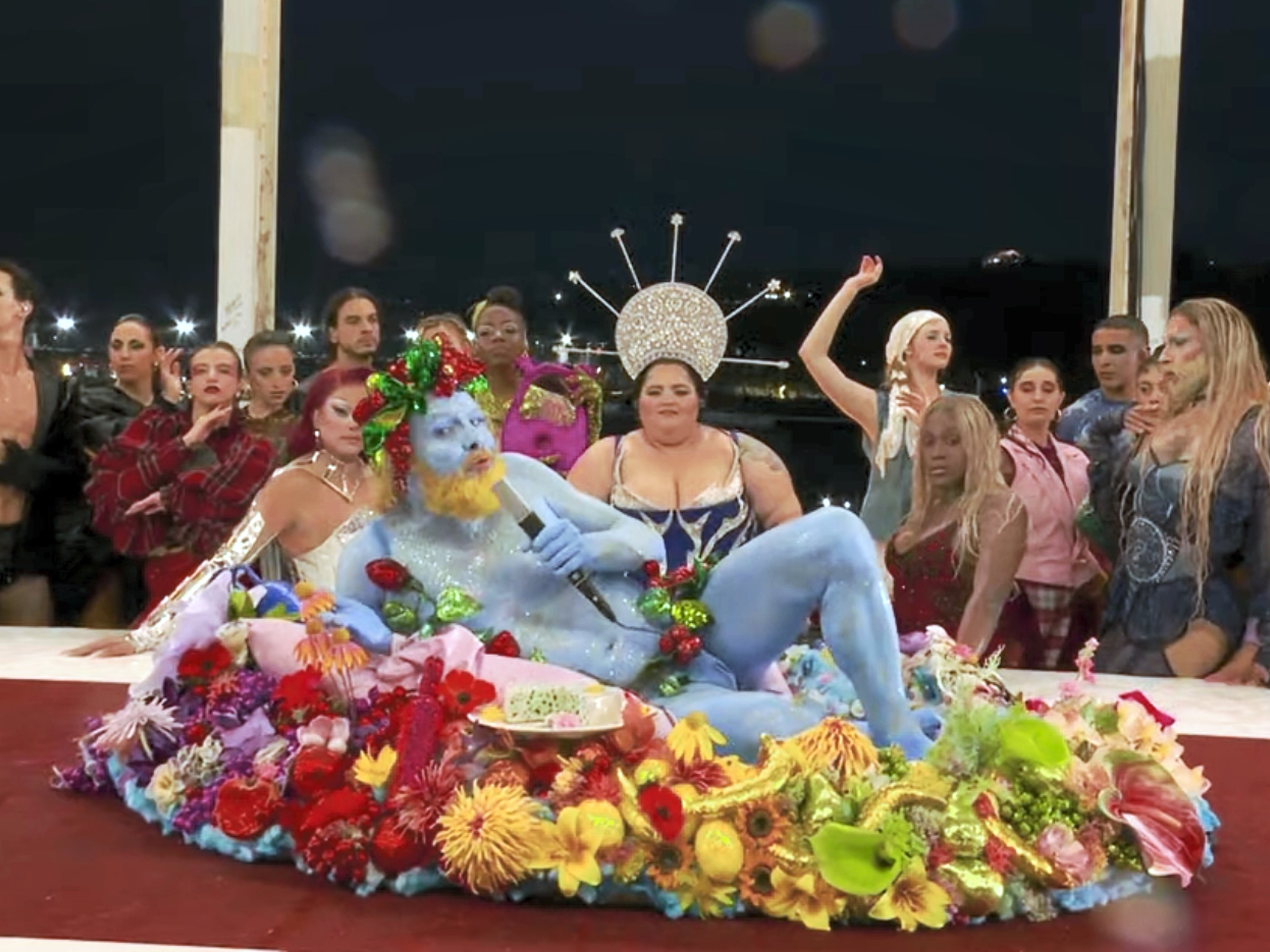
And the total bizarre: A blue and naked Dionosys
With the whole village availing their resources to the event, it look regrettably messy and disjointed. With performances happening simultaneously on the river itself, its banks, in buildings, on their rooftops, the four-hour show as a whole was not as sleek a staging as we thought Paris, home of some of the most striking fashion runways, would be capable of putting up. Interestingly, the acrobatic dance on the scaffoldings of the still-under-renovation Notre-Dame Cathedral, showing the work crew in balletic form against the sky, was more artistic than the even more grassroots performances. With snatches of street-style offerings here and there, it felt like a city fete than the opening ceremony of the world’s largest sporting meet. The performances, in fact, were not consistently good. Some were downright weird.
How else to describe the appearance of a clearly guillotined Marie Antoinette, bloody at the point where she was severed, standing up and holding her own well-coiffed, singing (!) head, framed by one of the windows of the Conciegerie (where she was imprisoned!), while the French heavy metal band, Godzilla-turned-Gojira, banged on furiously as the first such act at an Olympic opening ceremony? Or, possibly worse, the reveal of a very blue man—the French singer/actor Philippe Katerine lying on a giant flower-and-fruit platter, naked except for a matching slip bleu and a garland strategically placed? And he was supposed to be Dionosys, the Greek god of wine, singing unironically a song titled Nu (naked)! Was Paris trying to show its more extreme, clever side? Or alluding to the Games of antiquity? Or, was there no one else in history or myth to feature who could offer a vestige of élan?

A Louis Vuitton craftsman was shown putting together a trunk

LV trunks with their unmistakable monogram pattern were displayed on the bank of the Seine
Just as uncommon as the near-freak show was the very commercial brand-boosting exercise and product placement of main sponsor LVMH. A phantom-like parkour athlete, with face obscured by a full mask, had been leaping on the rooftops of buildings along the river. At one point he eased into a workshop that conveniently turned out to be one that made Louis Vuitton trunks. He moved with burglar-like gait—unencumbered by a lit torch—among the craftsmen, who were not bothered by the presence of the intruder. And then before you knew it, massive trunks with drawers that were supposed to house the medals of the Games were moved out into the open, including, oddly, to the bank of the Seine. At one time, two athletic youths hauled one trunk down the stone stairs to what appeared to be a jetty. It is unclear why the moving of LV’s signature product had to be shown at length or why it had to sit there at the river’s edge. Was the massive hoarding (depicting a trunk) of the LV store—now under renovation—at the nearby Avenue des Champs-Élysées insufficient to announce that Louis Vuitton is synonymous with Paris?
LV’s visible presence was not all. Dior, too, had a share of the glory of the evening. While some of the performers were outfitted in LV (including rapper Rim ’K), the female singers wore Dior. TV commentators were tasked to mention that! End credits are dead. The French expectedly dressed local, such as Aya Nakamura and Juliette Armanet. Both were in Dior, but so was Guadeloupean mezzo-soprano, Axelle Saint-Cirel, singing on a roof top. And, American Lady Gaga and Canadian Celine Dion. Lady Gaga wore a bustier-and-hot-pants number performing a borderline campy rendition of Zizi Jeanmaire’s Mon Truc en Plumes (My Thing with Feathers), with dancers around her equipped with pink powder-puff shields to form shapes around her. Possibly most striking was Celine Dion’s gown, reportedly designed by Maria Grazia Chiuri herself. It was less Las Vegas residency and more a night at the Opera Garnier; it fitted her touching performance of Edith Piaf’s L’Hymme à l’amour (The Hymn to Love), high on the Eiffel Tower. But how anyone in the audience could see her, let alone make out the dress, is unclear.
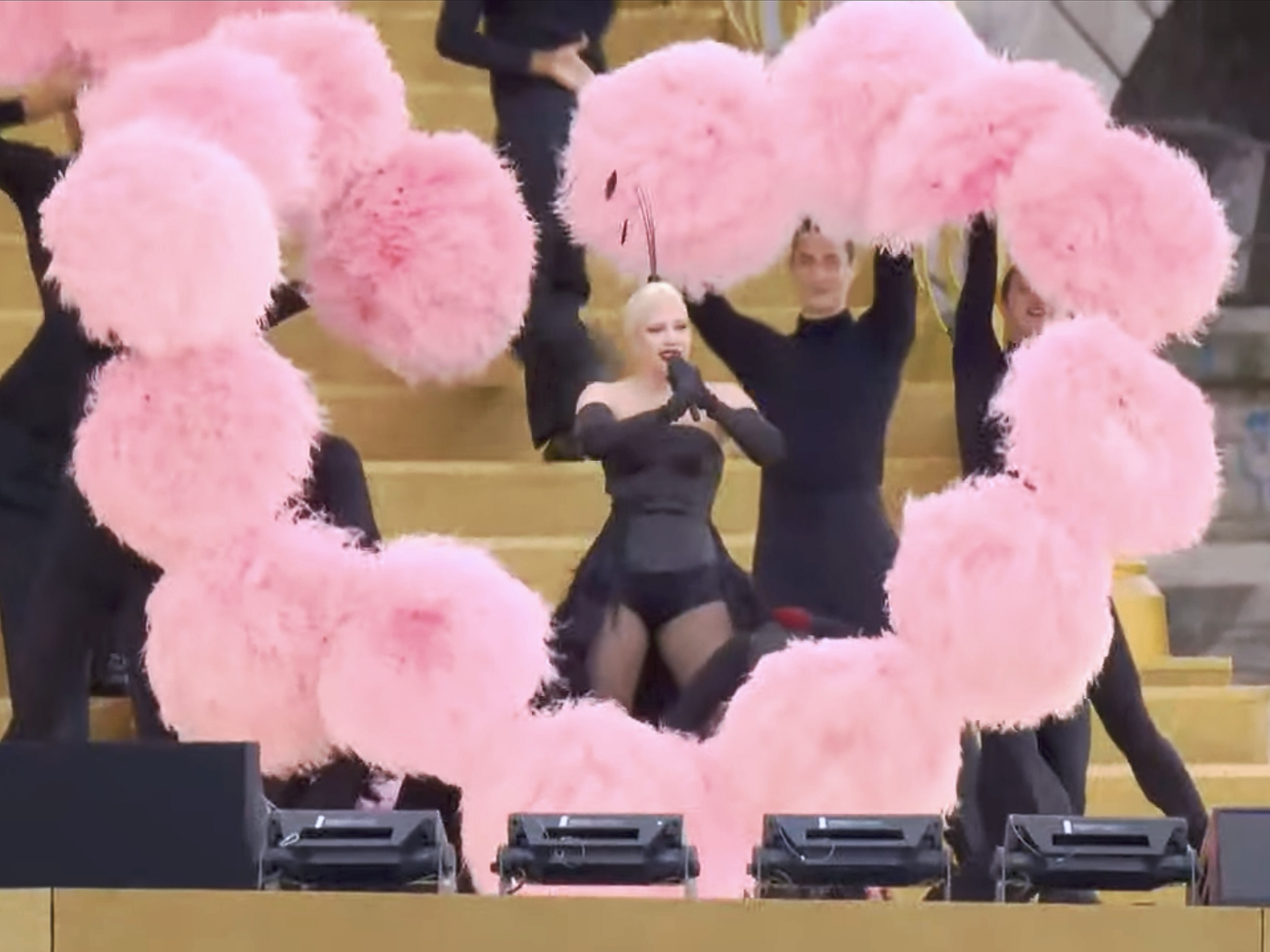
Lady Gaga’s opening performance of the evening

Celine Dior’s touching singing on the mid-levels of the Eiffel tower
Just as Paris and Louis Vuitton were one, fashion needed to be the city itself. Even the Olympic mascot is based on an article of fashion. This year, the French has the Phryge (pronunciation guide: sounds like ‘fridge’), a character based on a traditional French hat that is not the beret. But just in case all that escaped you, the night, you were reminded, was about fashion, too. The spotlight was on the young designers of the city, including Charles de Vilmorin, who created the colourfully-patterned clothes worn by the literature-leaning ‘throuple’ in the Richelieu wing of the Bibliothèque Nationale de France and Jeanne Friot, who dressed the ‘rider’, tasked with a tedious journey on a mechanical and real horse to present the Olympic flag to the flag raisers. It was also announced that among the dispersed sideshows was a fashion presentation on the Passerelle Debilly (Debilly Footbridge). But this was not a presentation of the couture synonymous with the city. Part drag show, part fashion school graduation show, it was hard to see how synonymous the designs were with what the French maisons have been generating. It was fun without function.
Although this may not be the first time that Paris hosted the Games, it is the first time that the Olympics was sponsored by a luxury conglomerate. And it did not involve just one brand, but an entire group, LVMH. According to Forbes, the value of the backing is “worth about US$163 million (or about S$219 million). Antoine Arnault, Bernard Arnault’s eldest son, told the press that through the Paris Games, LVMH could “enhance the image of the group and its houses”. It is not clear why LVMH and the brands under its watch need the boosting when the group owns some of the world’s most famous fashion entities. Other than LV’s visible presence, fashion’s dominant personalities, especially those with well-places friends in the sporting world, were there too. Among the guests was Anna Wintour, an Olympic opening ceremony regular. This year, she was interviewed on a French channel before the ceremony began. On the chyron, her name was displayed as “Annal Wintour”. Did the broadcaster know something we do not? Ms Wintour wouldn’t be amused if she saw that news segment. Still, she must have been awfully pleased that the Olympic opening ceremony could have passed off as her Vogue World.
Screen shots: mediacorp/YouTube
 Style on the Dot