Luxury fashion brands are moving into the cultural space. Dior is no exception as it continues to augment one of its boxy bags as a ‘legend’
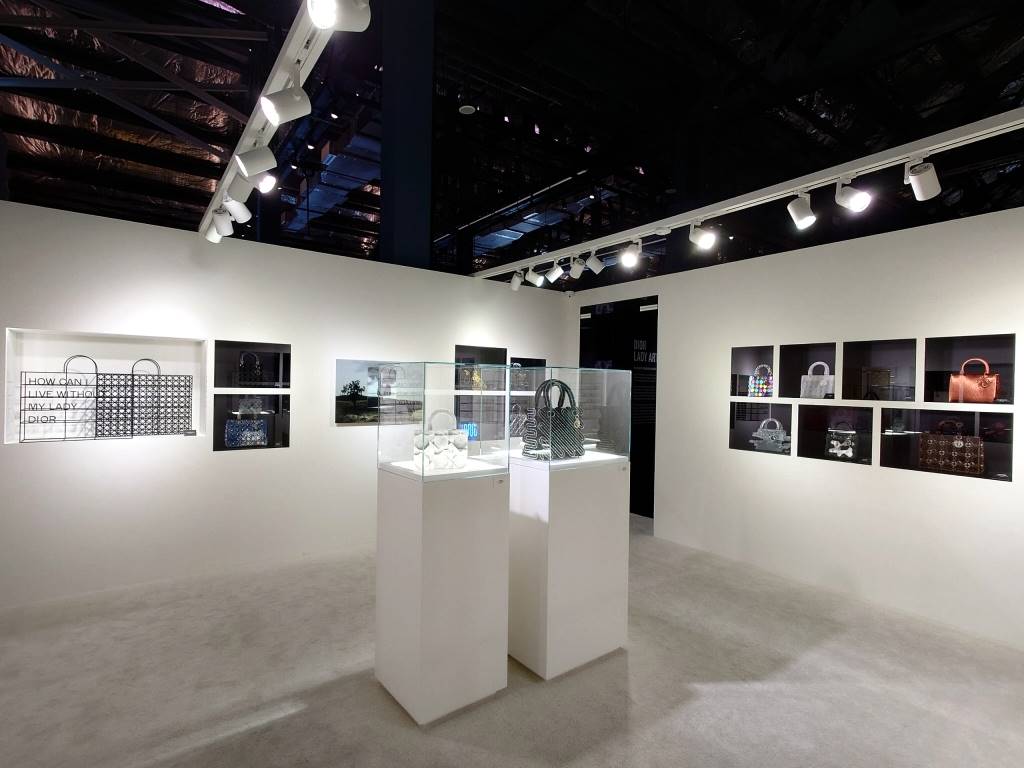
The room ‘Lady Dior as Seen by’
It is hard to visit an exhibition of Lady Dior bags without thinking of the recent reveal of how much money Dior makes from their bags, as well as the conditions under which some of them are produced. And, the ensuing investigation by the Italian authorities into their production practices (to be fair, Giorgio Armani, too, is under similar probe). Although it is not clear which bag was spotlighted by the media, the staggering profitability of Dior bags has made many question the true value of luxury today or even its very definition. Perhaps the reputational dent to Dior’s bags could be minimised with the exhibition, Lady Dior House, now on at the old Zouk nightclub along Singapore River. Entry to Lady Dior exhibition is free, which delights many for whom such events are those to look forward to, but is it not already subsidised, if not paid for, by the many who own Lady Dior(s)?
Itinerant exhibitions such as this or or pop-up cafés, such as Dior’s kitschy ‘Dioriviera’, concurrently happening in various parts of the world, remind us of what we pay for in the acquisition of luxury merchandise. The pricing policies of high-end brands are rarely transparent, but even those with scant marketing or business management knowledge can guess that much of what is paid for by consumers feed the labels’ desirability-building muscles and come in the form of indirect production costs. We pay for “experiences”, including those that are not our own (at the exhibition, it isn’t clear if visitors are truly interested in the art or just keen to be seen and be photographed against the rainbow-hued product wall). Some mainstream media, even those dependent on “luxury advertising”, have gone as far as to say that “brands have priced themselves out of reach”—WSJ. Or, “Luxury fashion prices have gone too far”—Forbes.

Singapore’s contribution to Lady Dior House: (clockwise from top): Genevieve Chua, Samuel Xun, and Grace Tan
To stage Lady Dior House and other such brand-boosting events, it is likely that the prices of their merchandise have to go further, if not far. Lady Dior House is basically walk-in handbag-porn-as-advertising-exercise. However enthusiastically the brand sold it as an art exhibition, the event is, in fact, postfixed by a selling opportunity of the Lady Dior in its myriad iterations/colours/sizes. It is not a labyrinthine exhibition that ends with a gift shop—but a full-blown store. There was not even a proper exit, just an end-point—a room where you’d be surrounded by bags. And you’d be offered whichever one you desire to examine, to carry on your arm; a gentle nudge to make a purchase. To leave the small exhibition, which you can easily cover in ten minutes, you’d have to U-turn, go against on-coming visitor traffic, and leave at the access point whence you first entered.
The Lady Dior House is sited at the former multi-dancefloor discotheque Zouk, which the club moved out of in 2016, on Jiak Kim Street (off Kim Seng Road). Taking up the middle of three former godowns, it is a S$10,900-a-day event space that’s sandwiched between serviced apartment Fraser Residence River Promenade and the restaurant Jiak Kim House, which serves “modern Asian” fare. A curious venue to glorify a handbag, the simply-design exhibition is a tad too pedestrian for a Lady. The layout comprises a grand-sounding five rooms, which includes a ‘photo wall’ with mock-up bags. TickTokers, Instagrammers, and selfie diehards would be delighted here—it takes up the extent of a room, with two rear walls dotted with what appear to be 3-D printed Lady Diors in colours that formed an ombréd repeated pattern. The exhibition proper, comprising only two similarly-sized rooms, is followed by a mock workshop with a single desk (where the construction of the star bag is explained by a French technician—“140 elements to make one bag,” she underscored), and the sales space.

Dior Lady Art room, where the pieces are for sale
The idea of getting artists to reimagine what is considered an “iconic” product is not new. We have seen it with Louis Vuitton Trunks at the 200 Trunks, 200 Visionaries: The Exhibition in 2022 and even with Mickey Mouse at the Mickey ‘Go Local’ exhibition in Raffles City in 2018. While the reimagined Lady Dior pieces have varying degrees of creative merit, it is not clear if they could really be considered art. Conceived on a commercial product, it is debatable if these bags, however wildly imagined, have the same value as the Joama Vasconcelos installations that inspired the artist’s spectacular set design for the Dior autumn/winter 2023 show. It is obvious that the intention of the art (one says “How can I live without my Lady Dior?”) is to capture the viewer’s attention in order to peddle a product. And this is especially true for the third room, where overwrought pieces from various artists can be purchased. The most expensive Lady Dior is one with twisted leather and colourful embroidery by the Romanian artist Mircea Cantor: S$33,000. Unfortunately, we kept ringing up €53.
Lady Dior House in Singapore is the exhibition’s second stop after it debuted in Ho Chi Minh City in March this year. Here, we get to see three bags reinterpreted by Singapore creatives—two of them, to us, put out true stand-outs in the exhibition: Samuel Xun with surface treatment that looked like glittery flattened tubes, diagonally placed and Grace Tan (of sometime fashion label Kwodrent) with the exaggeratedly oversized cannage pattern in marble. Their pieces stood our nation in good stead. Yet, it isn’t clear how they speak of Lady Dior’s purported popularity here. A guide-cum-salesperson at the exhibition told us that sales have been “very good—of course”. His assertion seemed to contradict what Forbes reported very recently: Luxury brands are “struggling” in the first six months of this year, as they “cope with declining sales in Asia.” Lady Dior House could be habitat for just a make-believe legend.
Lady Dior House runs from now till 11 August (11am—9pm) at 5 Jiak Kim Street. Booking required. Photos: Chin Boh Kay
 Style on the Dot